
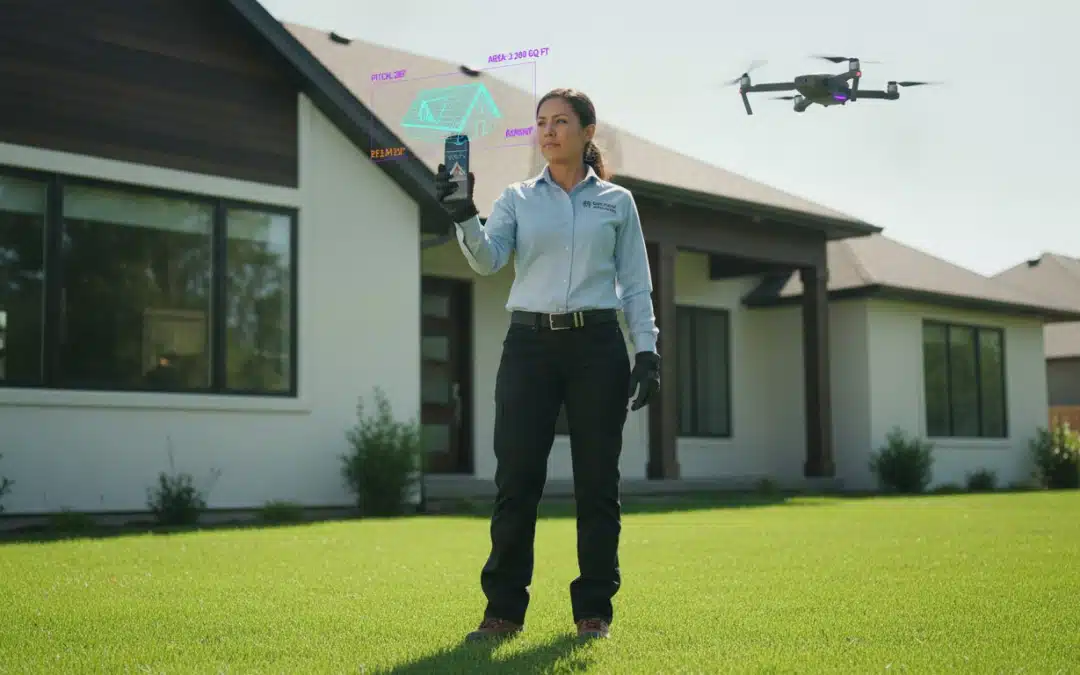
The most effective piece of personal protective equipment in 2026 isn’t a harness or a hard hat; it’s your smartphone. For years, field professionals have accepted physical risk as a standard part of the job. You know the grind: scaling steep roofs, squeezing into cramped crawlspaces, and risking serious injury just to capture a single photo. It is exhausting, dangerous, and entirely unnecessary. Prioritizing virtual inspection safety means you stop sending your best people into harm’s way when digital documentation can do the heavy lifting from the safety of the ground.
We understand that the physical danger of the jobsite is your biggest headache, and the liability of onsite accidents is a constant weight on your shoulders. This guide promises to show you how to leverage virtual inspection tools to eliminate these hazards, lower your E&O insurance premiums, and keep your field teams safe. We will preview the latest remote standards like NFPA 915, explore the speed of aerial measurements, and demonstrate how automated reporting restores order to your documentation. Get ready to transform your workflow, protect your crew, and accelerate your claim cycles with total confidence; it is time to work smarter, faster, and safer.
Key Takeaways
- Adopt a digital-first mindset to eliminate physical exposure and protect your field teams from unpredictable onsite hazards.
- Prioritize virtual inspection safety by utilizing aerial measurements to completely remove the need for dangerous ladder work.
- Leverage voice-to-text labeling and automated photo organization to keep hands free and eyes focused on the environment.
- Reduce E&O insurance premiums and liability by replacing outdated manual assessment methods with precise digital documentation.
- Streamline your entire workflow to achieve faster claim cycles and zero onsite injuries through advanced remote inspection tools.
What is Virtual Inspection Safety and Why Does It Matter?
Stop risking your team for a photo. In 2026, virtual inspection safety is the definitive protocol for modern field work. It is the strategic use of remote tools to assess property conditions without ever placing an inspector in a hazardous environment. For decades, the industry relied on “boots on the ground” to get the job done. Today, that model is obsolete. We have shifted to an “eyes on the screen” reality where technology serves as the ultimate barrier between your professionals and physical harm. This isn’t just about convenience; it is about survival and scale.
The core of this movement is a concept we call high-velocity safety. You need to move fast, document accurately, and close files without breaking things or hurting people. By adopting remote protocols, inspection firms are seeing a massive reduction in workers’ compensation claims. When you remove the physical exposure, you remove the risk. It is a simple equation that results in lower overhead and a more resilient workforce. Protect your assets. Empower your team. Lead with digital precision.
The Core Components of Remote Safety
True remote safety is built on three essential pillars. First, data integrity is paramount. You must ensure your digital view is a perfect mirror of physical reality. Second, hazard avoidance is achieved through Remote Visual Inspection (RVI) technologies. These tools bridge the gap between the inspector and the risk, allowing for high-resolution assessments of steep roofs or flooded crawlspaces from a safe distance. Finally, real-time oversight gives managers the power to monitor field operations from a central dashboard. This ensures every safety protocol is followed perfectly, every single time.
Why 2026 is the Year of the Virtual Adjuster
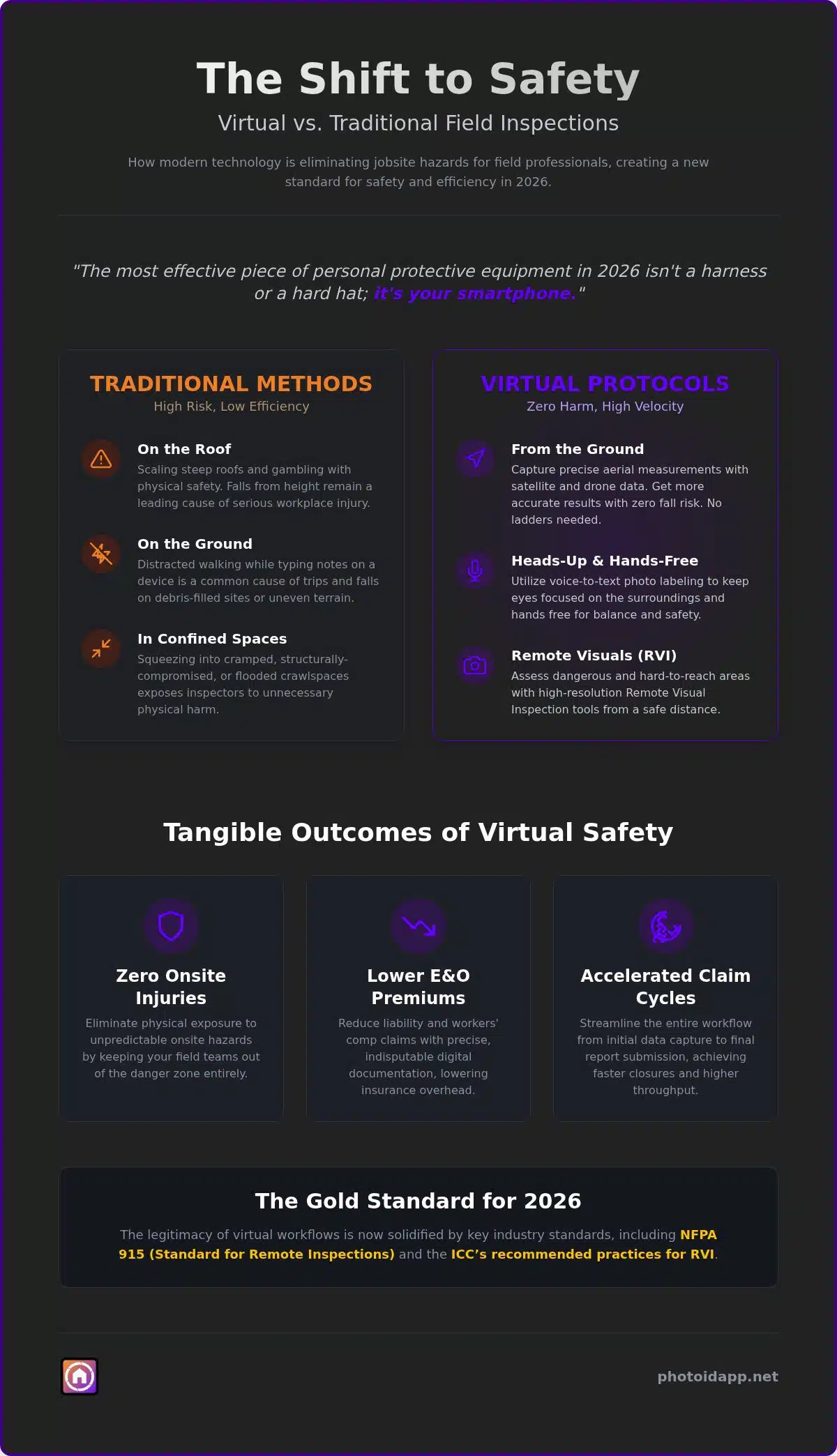
The industry reached a tipping point this year. Rising travel costs and ballooning onsite liability have made traditional field methods unsustainable. Carriers no longer demand physical presence for every claim. Instead, they prioritize the speed and clarity of high-resolution mobile documentation. Regulatory standards have also caught up. The 2026 adoption of NFPA 915, the Standard for Remote Inspections, has solidified the legitimacy of virtual workflows. Combined with the ICC’s recommended practices for RVI, these standards mean your remote reports are now the gold standard for accuracy and virtual inspection safety. Don’t get left behind in the dust of a traditional jobsite. Embrace the digital shift and watch your efficiency soar.
Eliminating Physical Risks with Virtual Documentation Tools
Traditional inspections are inherently dangerous. Every time an inspector scales a ladder or enters a compromised structure, they are gambling with their physical safety. In 2026, we have the technology to stop this gamble. Digital documentation tools act as a virtual shield, allowing your team to gather critical data without entering the “danger zone.” Prioritizing virtual inspection safety isn’t just a policy change; it is a fundamental shift in how we protect our most valuable assets: our people.
Aerial Measurements: The End of the Ladder?
Eliminate the ladder. Erase the fall risk. Elevate your accuracy. Falling from heights remains a leading cause of workplace injury in the assessment industry. By integrating satellite and drone data, you can now capture precise dimensions for roofs and walls from the ground. Modern roof software provides high-resolution data that is often more accurate than manual tape measurements. This shift doesn’t just keep your feet on the ground; it removes the liability of onsite accidents and significantly lowers insurance premiums. When you remove the need for physical climbing, you transform a high-risk task into a safe, digital workflow.
Situational Awareness with Voice-to-Text
Stop looking down at your screen while walking a jobsite. One of the most common causes of onsite injury is a simple trip or fall because an inspector was distracted by their device. Voice-to-text labeling solves this problem instantly. By using voice commands to tag and describe photos, your team can keep their eyes on their surroundings and their hands free for balance. This level of situational awareness is critical when navigating debris-filled sites or uneven terrain. It allows for a high-velocity pace without compromising the inspector’s physical safety. Keep your head up, stay alert, and document everything through simple voice commands.
Fatigue is a silent killer on the jobsite. When inspectors are overwhelmed by manual labeling and disorganized photo piles, they make mistakes. These “fatigue-based” errors often lead to missed hazards or rushed physical movements that result in injury. Automated photo organization and instant report generation change the game. By reducing the cognitive load on your field team, you keep them sharp and focused. Furthermore, generating reports instantly means your team spends less time inside unstable or hazardous structures. They get in, capture what they need, and exit safely while the software handles the documentation. To see how this works in real-time, consider implementing the PHOTO iD mobile app to streamline your safety protocols today.
Comparing Virtual Safety Protocols to Traditional Field Methods
The “Old Way” of inspecting property is a recipe for disaster. It relies on manual measurements, physical climbing, and constant exposure to onsite hazards. In contrast, the “New Way” prioritizes virtual inspection safety by keeping the inspector at a safe distance. This shift isn’t just about safety; it is about pure efficiency. When you move to a “Virtual First” approach for initial damage assessments, you slash claim cycle times and eliminate the primary causes of inspector burnout. Stop the grind. Start the stream. Secure your future.
Consider the real-world impact. Industry research shows that remote inspection methods can save up to 515 hours in drive time per year. That is time reclaimed from the road and reinvested into high-velocity documentation. By reducing the physical grind, you extend the careers of your best field professionals and close files faster than ever before. You aren’t just saving time; you are saving your team from the exhaustion that leads to costly onsite errors.
Risk Assessment: Physical vs. Virtual
Traditional field methods force inspectors to confront fall risks, structural collapses, and environmental hazards like mold or asbestos. These are not just “part of the job” anymore. They are avoidable liabilities. Mitigation begins with remote data collection. Using a professional home inspection app allows your team to standardize safety protocols across every jobsite. You can capture high-resolution evidence of damage without stepping onto a rotting floorboard or breathing in toxic spores. Standardize your workflow. Secure your team. Succeed without the risk.
Cost-Benefit Analysis of Safety Tech
Safety tech is not an expense; it is a high-yield investment. Firms that adopt virtual-first protocols often see reduced insurance premiums because their risk profile drops significantly. You are lowering the Total Cost of Risk (TCOR) for your entire organization. This includes avoided medical costs, reduced litigation, and lower E&O insurance rates. The ROI of safety is undeniable. Better technology pays for itself by preventing a single catastrophic accident. Invest in protection. Increase your profit. Insulate your business.
The liability landscape is shifting. In 2026, your biggest concern shouldn’t be a broken leg onsite; it should be the integrity of your digital data. As we move away from physical risks, the focus turns to digital data security and reporting accuracy. Ensure your documentation is encrypted, organized, and instantly accessible. This transition allows you to trade physical danger for digital certainty, creating a safer environment for everyone involved.
Best Practices for Maintaining Data Integrity and Site Safety
Data integrity is the backbone of every successful remote operation. Without accurate, organized documentation, even the most advanced virtual inspection safety protocol will crumble under the weight of liability. Start with pre-inspection planning. Identify high-risk zones like fire-damaged interiors or unstable balconies before your team ever arrives. When you know the risk, you can deploy the right tools. Equipping your crew with the best construction management software ensures that every piece of data is captured with precision and stored with total security.
Empower your team with a “Stop Work” authority. If a physical risk exceeds safety thresholds, the inspector must have the power to pivot to a virtual-only assessment immediately. This isn’t just a safety measure; it’s a productivity strategy that prevents costly downtime. Standardize your photo labeling to prevent any misidentification of hazards. Clear, automated labels ensure that adjusters and contractors see exactly what the inspector saw, without the risk of human error. Standardizing your approach to virtual inspection safety through rigorous training is the only way to ensure long-term resource optimization.
The 4-Step Virtual Safety Workflow
- Remote Site Triage: Review aerial data first to map out the safest route through the property.
- Digital Perimeter Walk: Document the exterior from a safe distance using high-resolution zoom features.
- Voice-Guided Detail: Capture specific damage points using voice-to-text to maintain situational awareness.
- Instant Sync: Move your data off the site and into the cloud immediately to secure the record.
Training Teams for Virtual Competency
Competency is the key to safety. Ensure every field technician is a master of automated labeling. They should know how to navigate the app, manage their mobile devices, and maintain equipment for reliable performance. Training should also cover how to integrate this safety data with Xactimate. This ensures that your estimates are as accurate as they are safe. When your data flows seamlessly from the field to the estimate, you eliminate the friction that leads to accidents. Ready to upgrade your team’s safety? Explore our virtual inspection tools to see the difference for yourself!
How PHOTO iD Powers Safer, High-Velocity Inspections
PHOTO iD is the engine behind your safety strategy. It isn’t just an app; it is your frontline defense. As the central hub for virtual inspection safety, it transforms how you interact with every jobsite. By centralizing documentation, you eliminate the chaos that often leads to onsite accidents. Order. Clarity. Speed. These are the hallmarks of a PHOTO iD workflow. This platform empowers your team to capture high-resolution evidence while maintaining total focus on their physical surroundings. It is time to replace the burden of manual reporting with the relief of technological efficiency.
Safety doesn’t stop in the field. The PHOTO iD team management dashboard allows managers to provide remote safety oversight in real-time. You can verify site conditions, monitor documentation quality, and support your team from the office. This collaborative approach ensures that your field professionals never feel isolated in high-risk zones. It provides a secondary layer of protection, ensuring that every protocol is followed and every hazard is documented safely. Total visibility leads to total confidence.
Safety Through Automation
Automation is the ultimate safety net. Our automated photo labeling system drastically reduces the cognitive load on your inspectors. Instead of fumbling with file names or worrying about photo counts, they can focus entirely on their environment. This heightened awareness prevents the trips, slips, and falls that plague distracted workers. Furthermore, our system eliminates the “forgotten photo” syndrome. You won’t have to send an inspector back for a dangerous, rushed return trip to an unstable structure because they missed a shot. Use our custom inspection templates to ensure that every safety check is completed perfectly the first time. Capture. Label. Secure.
The Future of Field Safety
The industry is moving toward a zero-accident future. You can scale your business without scaling your risk profile. The top professionals in the field choose PHOTO iD because it delivers high-velocity results without compromising on virtual inspection safety. By trading physical exposure for digital precision, you protect your team’s health and your firm’s bottom line. Don’t let outdated documentation methods be your weakest link. It is time to embrace a tool that is as modern as it is reliable. Scale safely with PHOTO iD today!
Secure Your Field Team with Digital Precision
The physical risks of the past are now entirely avoidable. By prioritizing virtual inspection safety, you transform your inspectors from physical risk-takers into high-velocity data managers. You’ve seen how aerial measurements replace ladders and how voice-to-text keeps eyes on the environment. These tools aren’t just gadgets; they are essential partners in a zero-accident culture. Leading adjusters and roofers nationwide already rely on this technology to protect their crews and their bottom lines. It’s the new standard for 2026.
Efficiency doesn’t have to come at a cost. Automated labeling saves 50% of reporting time, while industry-leading voice-to-text integration ensures your team stays alert and hands-free. Don’t wait for an onsite accident to force your hand. Take control of your documentation, reduce your liability, and restore order to your field operations today. You have the power to eliminate hazards before they happen. It’s time to work smarter. It’s time to work faster. It’s time to work safer. Empower your team with the tools they deserve and watch your business thrive.
Stop climbing and start scaling; get PHOTO iD now!
Frequently Asked Questions
Is virtual inspection safety regulated by OSHA?
Virtual inspection safety currently falls under OSHA’s General Duty Clause, which requires employers to provide a workplace free from recognized hazards. While specific OSHA mandates for remote workflows are still evolving, industry standards like NFPA 915 and ICC’s recommended practices now provide the formal framework for safe remote visual inspections. Adhering to these 2026 guidelines ensures you stay compliant while protecting your team from the physical risks traditionally associated with onsite assessments.
What tools are essential for a safe virtual inspection?
You need a robust smartphone equipped with a professional photo documentation app and integrated aerial measurement capabilities. These tools allow you to capture high-resolution data from the safety of the ground. Essential features include automated labeling to reduce cognitive load and voice-to-text functionality for hands-free operation. Combined with a central management dashboard, these technologies create a comprehensive safety ecosystem that keeps your field teams out of hazardous zones while maintaining report quality.
Can virtual inspections really replace physical roof climbs?
Yes, modern aerial measurements and high-resolution drone imagery have made physical roof climbs largely obsolete for initial assessments. These tools provide precise dimensions and clear evidence of damage without the inherent fall risks of ladder work. By shifting to a virtual-first model, you eliminate the primary cause of onsite injuries. This transition protects your staff, reduces your liability, and delivers the high-velocity data required to close claims faster and more accurately.
How does voice-to-text technology improve onsite safety?
Voice-to-text technology is a game-changer for situational awareness. It allows inspectors to document their findings while keeping their eyes on their surroundings and their hands free for balance. Looking down at a screen while navigating a debris-filled jobsite is a leading cause of trips and falls. By using voice commands to label photos instantly, your team remains alert to environmental hazards, ensuring they move through the site with maximum safety and efficiency.
What are the liability risks of remote property inspections?
The primary liability risks shift from physical injury to digital data integrity and reporting accuracy. If a remote inspection misses a critical structural defect due to poor image quality or disorganized documentation, it can lead to costly errors. Mitigate these risks by using standardized templates and automated organization. Ensuring your digital record is encrypted and verifiable protects your firm against claims of negligence while maintaining the high standards required by carriers and regulatory bodies in 2026.
How do I ensure data accuracy during a virtual safety assessment?
Accuracy depends on high-resolution imaging and automated organization. Use software that forces standardized photo sequences and provides instant labeling to prevent misidentification of hazards. High-velocity documentation must be paired with clear, verifiable evidence to be effective. By removing the manual guesswork from the reporting process, you ensure that every digital assessment is as precise as a physical one, providing a reliable record for all stakeholders involved in the claim.
Can virtual inspection software reduce my insurance premiums?
Firms that adopt virtual inspection safety protocols frequently see a reduction in E&O and workers’ compensation premiums. By significantly lowering your risk profile and Total Cost of Risk (TCOR), you become a more attractive prospect for insurers. Eliminating high-risk activities like ladder-climbing directly correlates to fewer claims. Document your safety-first workflow and share your digital-first success rates with your carrier to negotiate better rates and protect your firm’s financial health.
What happens if the virtual data is insufficient for a safety claim?
If remote data is insufficient, you must trigger a “Stop Work” authority and pivot to a more detailed assessment. This might involve using high-resolution zoom features or, in rare cases, a targeted physical inspection with enhanced PPE. However, with the advancements in 2026 documentation tools, most gaps can be closed by capturing additional high-velocity photos from safer angles. Always prioritize the safety of the inspector over the immediate completion of the report.