
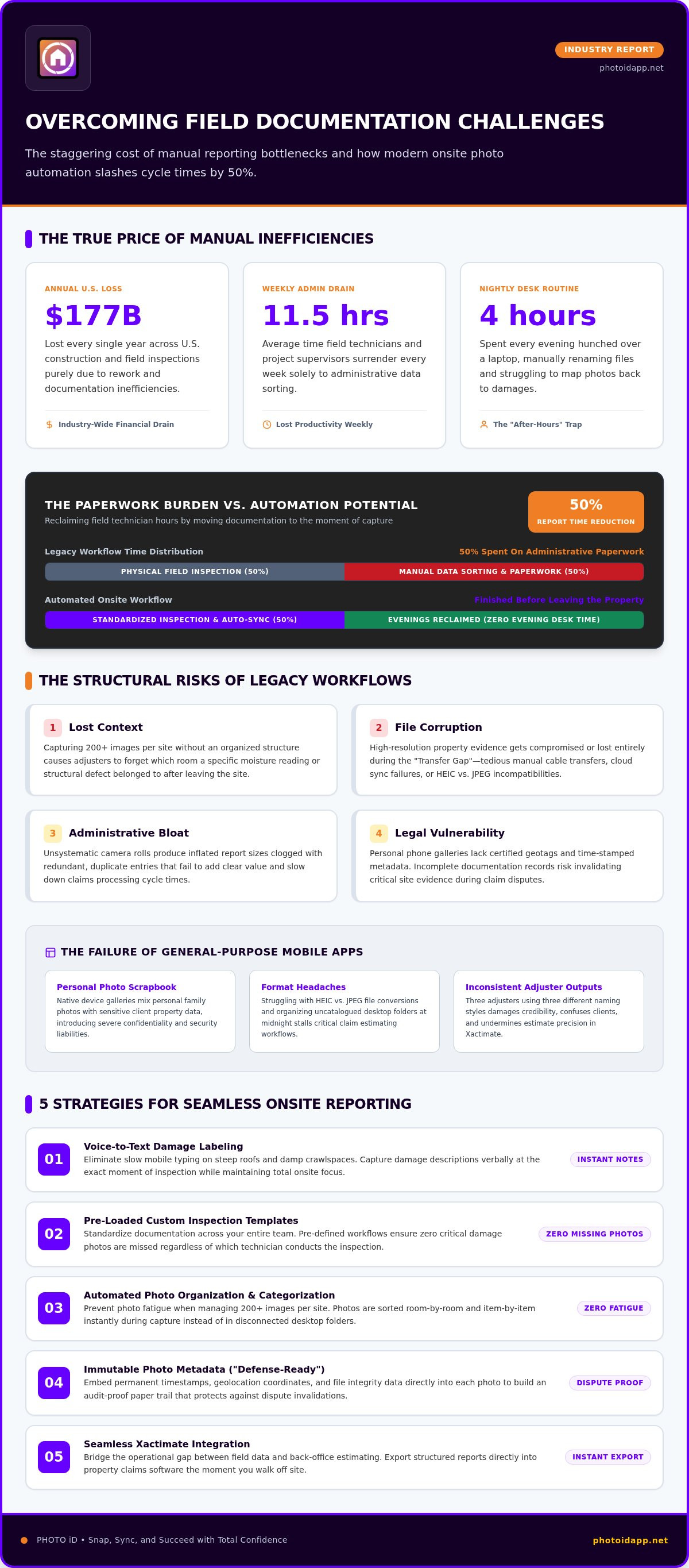
Did you know the U.S. construction and field inspection sector loses $177 billion every year to rework and documentation inefficiencies? It’s a staggering figure that highlights the urgency of overcoming field documentation challenges in a fast-paced market. You’ve lived this reality. You spend all day in the field and then four hours every night hunched over a laptop, manually labeling photos and trying to recall which damage belonged to which room. It’s a chaotic, inconsistent process that creates bottlenecks, leads to reporting errors, and slows down your payments.
Stop sacrificing your personal time to administrative grunt work. This guide provides the roadmap to automate your workflow and slash your reporting times by 50%. They say a picture is worth a thousand words, but in 2026, a picture is only worth the metadata attached to it. We’ll explore the latest tools for automated photo organization, voice-to-text labeling, and seamless Xactimate integration. You can finally eliminate the evening desk time ritual and finish your reports before you even leave the property. It’s time to snap, sync, and succeed with total confidence.
Key Takeaways
- Stop wasting hours on manual entry and start overcoming field documentation challenges with a high-velocity, automated approach.
- Swap slow typing for rapid voice-to-text labeling to document damage instantly while maintaining absolute onsite focus.
- Utilize pre-loaded custom templates to standardize your inspections and eliminate the risk of missing critical photos.
- Master the five-step workflow that transforms raw field data into professional, export-ready reports the moment you leave the site.
- Build a “defense-ready” paper trail through seamless Xactimate integration and immutable photo metadata that protects your business.
Stop the Documentation Drain: The Crisis of Manual Field Reporting
Manual field reporting isn’t just a nuisance; it’s a structural failure that drains your profitability. When you’re balancing on a steep roof or squeezing through a damp crawlspace, the last thing you need is a disorganized camera roll. This “photo fatigue” sets in quickly when you’re capturing 200+ images per site without a system. Overcoming field documentation challenges starts with recognizing that manual labeling creates a dangerous lag in claim cycle times. If your data stays trapped on a memory card or a personal phone, it’s vulnerable to corruption and loss. Traditional workflows often lead to missing files that can delay a claim for weeks. This fragmented approach prevents you from scaling your business because your expertise is tied up in administrative grunt work. You can’t grow a team when everyone is drowning in their own disconnected folders.
The risks of sticking to legacy manual workflows are clear and costly:
- Lost Context: Forgetting which room a specific moisture reading belonged to after leaving the site.
- File Corruption: Losing high-resolution evidence during manual cable transfers or cloud sync errors.
- Administrative Bloat: Inflating report sizes with duplicate entries that don’t add value.
- Legal Vulnerability: Missing metadata that can invalidate site evidence during a dispute.
The “After-Hours” Reporting Trap
Field technicians and project supervisors currently lose an average of 11.5 hours per week to administrative data sorting. This is the “after-hours” trap. You finish your physical inspections by late afternoon, but your workday is only half over. Spending 50% of your time on paperwork isn’t just inefficient; it’s a recipe for burnout. The emotional toll of documentation eating into your personal life creates a point of diminishing returns. You’re exhausted, and that’s when critical photos get mislabeled or lost. You can’t sustain high-velocity growth when your best people are tethered to a desk every night. Stop the bleed and reclaim your evenings by moving documentation to the moment of capture.
Inconsistency: The Enemy of Professionalism
Professionalism dies when documentation is fragmented. If three different adjusters use three different labeling styles, your clients get confused and your credibility drops. This lack of uniformity directly impacts the accuracy of your estimates in platforms like Xactimate. Standardized templates are no longer optional in 2026. Modern field service management systems demand clean, structured data to bridge the gap between the field and the back office. Without a “defense-ready” trail, your business can’t scale. You’re stuck managing chaos instead of growing your team. Fix the workflow now to ensure every report looks like it came from the same elite professional. Consistency isn’t just about aesthetics; it’s about building a reliable, scalable machine that delivers results every time.
The Technical Bottlenecks: Why Your Current Process is Failing
Technical friction kills momentum. When you’re onsite, physical hurdles like low lighting in attics or driving rain on a roof aren’t just uncomfortable; they jeopardize your data quality. Most adjusters struggle with the “Transfer Gap.” This is the tedious, manual process of moving photos from a device to a computer and finally into a report. NIST research on visual progress documentation confirms that traditional manual photo documentation is plagued by severe organizational and accessibility limits. You shouldn’t be fighting file format headaches like HEIC vs. JPEG or hunting through unorganized cloud folders at midnight. Overcoming field documentation challenges requires a system that handles the technical heavy lifting for you.
The Failure of General-Purpose Photo Apps
Your phone’s native gallery is a personal scrapbook, not a business tool. It lacks the metadata, geotags, and professional context required for high-stakes inspections. Using a standard camera roll creates a massive security risk, mixing personal family photos with sensitive client data. Standard apps don’t offer the structure needed to categorize damage as it happens. If you want to stop the chaos, you need a dedicated photo organization software that secures your data and organizes it instantly. Don’t let a generic app compromise your professional reputation.
Communication Gaps Between Field and Office
Information silos lead to expensive mistakes. Without real-time syncing, your office team is flying blind until you get home and upload your files. This delay in project oversight often results in missing photos, which forces you into a costly re-inspection. You lose time, fuel, and credibility. A centralized team management dashboard is the only way to ensure everyone sees the same data at the same time. High-velocity reporting depends on immediate transparency. Stop the back-and-forth emails. Eliminate the “did you get that photo?” phone calls. Synchronize your team, secure your data, and finish the job the first time.
Automated vs. Manual: Solving the 3 Biggest Field Hurdles
Overcoming field documentation challenges requires moving beyond the limitations of human memory and manual entry. In 2026, the gap between top-tier adjusters and the rest of the pack is defined by automation. Manual photo sorting is a relic of the past that wastes over 11 hours of your week. Automation transforms that dead time into productive, billable hours. Let’s break down the three primary hurdles that only a high-velocity digital workflow can clear.
Hurdle 1: Speed. Traditional typing is slow, especially when you’re wearing gear or balancing on a ladder. Swapping manual keyboards for voice-to-text labeling allows you to document damage at the speed of thought. Hurdle 2: Accuracy. Humans make mistakes; systems don’t. Using custom inspection templates ensures you never leave a site with a missing photo. The app prompts you for every required angle, elevation, and room pairing. Hurdle 3: Scale. You can’t manage 100+ projects simultaneously using random folders on a desktop. Automated organization categorizes every image the moment you snap it, allowing for instant report generation and total project oversight.
The Power of Voice-to-Text Labeling
Talking to your app keeps your hands free and your eyes on the damage. This isn’t just about convenience; it’s about safety and precision. By using voice-to-text labeling, you capture the specific details of a loss while they’re fresh in your mind. Modern natural language processing turns your spoken observations into structured report data instantly. This “Snap, Speak, and Send” workflow is a fundamental shift that eliminates messy handwritten notes and exhausting evening transcription sessions. You document, you describe, and you deliver without ever touching a keyboard!
Leveraging Aerial Measurements and Virtual Tools
High-velocity reporting means working smarter. Integrating aerial roof and wall measurements into your workflow slashes onsite time and keeps your feet on the ground. This technology provides precise dimensions without the physical risk of climbing high-pitch roofs or navigating unstable structures. When a physical site visit isn’t required, virtual inspection software allows you to guide property owners through the documentation process remotely. This hybrid approach ensures your team stays safe, stays efficient, and stays ahead of the competition. You get the data you need without the travel time or the liability. It’s the ultimate game-changing partner for the modern field professional!
Master Your Workflow: 5 Strategies for Seamless Onsite Reporting
Efficiency doesn’t happen by accident. It’s the result of a disciplined, high-velocity workflow that eliminates friction at every turn. Overcoming field documentation challenges requires more than just a camera; it demands a strategic sequence of actions that turn raw data into professional deliverables. Follow these five strategies to dominate your workday, impress your clients, and reclaim your personal time.
First, pre-load your custom inspection templates. Don’t start from scratch at the jobsite. Configure your required shots and data fields before you arrive to ensure total consistency across every file. Second, use automated photo labeling. Label every image as you shoot using voice-to-text. This removes the “what was this photo of?” guesswork that usually haunts your evenings. Third, implement real-time syncing. Connect your field data to a team management dashboard instantly. This allows your office staff to begin their work while you’re still on the ladder. Fourth, generate the instant photo report before leaving the driveway. Never leave a property without a completed document. Fifth, seamlessly export your data. Move your organized photos directly into property claims estimating software to finalize the file without manual uploads.
Building the Ultimate Inspection Template
Success starts with a clear roadmap. Identify the mandatory shots for every property type to ensure zero missed opportunities or costly re-inspections. When using a professional home inspection app, you can structure templates that guide you through every room, elevation, and damage type. Customize your fields for specialized assessments like roofing, mold, or water mitigation. A well-built template acts as a digital safety net. It forces a high standard of quality across your entire team and ensures your estimates are backed by bulletproof, organized evidence every single time!
Real-Time Oversight for Team Leaders
Stop chasing status updates. Use a centralized dashboard to monitor progress across national territories in real time. Transparent data reduces the need for disruptive “check-in” calls and allows you to maintain strict quality control from anywhere in the country. You can review photos, flag missing data, and approve reports the moment they’re generated. This level of oversight builds a stronger, more reliable operation that can scale without losing its professional edge. If you’re ready to transform your field operations, start your PHOTO iD subscription today and lead your team with total confidence!
Scale with Confidence: Why PHOTO iD is the Logical Conclusion
Overcoming field documentation challenges is the final step in reclaiming your time and scaling your business. PHOTO iD stands as the logical conclusion for professionals who demand speed, accuracy, and seamless integration. This platform wasn’t created in a vacuum; it was designed by industry veteran Ken Perry, known as “The Claims Coach,” who lived the frustrations of the field. It functions as a game-changing partner that restores order to the chaos of onsite documentation. By integrating directly with Xactimate and Verisk workflows, it ensures your data moves from the camera to the estimate without a single manual step.
You gain a massive competitive advantage by delivering 10-minute reports in a market that still relies on overnight processing. This high-velocity approach builds a “defense-ready” documentation trail. Every image is anchored by immutable GPS coordinates and system-generated timestamps. This level of detail protects your business against backcharges and ensures you get paid for the work you actually perform. You aren’t just taking pictures; you’re building an airtight case for every claim.
Streamlining the Claims Cycle
Automation is the only way to stay ahead in 2026. Verified performance metrics show that using PHOTO iD leads to a 32% increase in field documentation efficiency and a 55% reduction in inspection processing costs. These aren’t just numbers; they represent a fundamental shift in your earning potential. Industry research indicates that 73% of property disputes involve missing or disorganized records. By automating your organization onsite, you eliminate the gaps that lead to disputes and 16-month resolution delays. Faster documentation leads to faster approvals, shorter cycle times, and more satisfied clients. Position your business as a technology leader and leave the manual struggle behind.
Getting Started with High-Velocity Documentation
Don’t let the fear of new technology slow you down. Transitioning from legacy folders to a mobile-first workflow is seamless. You can train your entire team for maximum adoption in under 48 hours. The interface is built for the mobile professional, prioritizing clarity over complexity. It fits into your existing routine while removing the administrative weight that holds you back. Stop spending your nights labeling photos and start generating reports in the driveway. Reclaim your evenings, protect your data, and scale your operations with total confidence. Experience the power of PHOTO iD today!
Take Command of Your Field Operations
The era of manual photo sorting and midnight report assembly is officially over. By embracing automated labeling and standardized templates, you aren’t just saving time; you’re building a more resilient and scalable business. Overcoming field documentation challenges is the key to reducing cycle times and increasing your team’s overall capacity. You’ve seen how voice-to-text technology and seamless Xactimate integration can transform a chaotic jobsite into a high-velocity data engine. It’s time to stop the documentation drain and start delivering results before you even leave the property.
Built by industry veteran Ken Perry, PHOTO iD is the game-changing partner you need to stay competitive in 2026. Join the top field professionals nationwide who use our mobile-first ecosystem for instant report generation and immediate delivery. Don’t let another evening slip away to administrative grunt work. Start Your High-Velocity Documentation Journey with PHOTO iD and experience the relief of a truly automated workflow. Your future is fast, efficient, and completely organized!
Frequently Asked Questions
How does automated photo labeling actually work in the field?
Automated photo labeling works by categorizing your images the moment you snap them. You use voice-to-text to tag images or select pre-defined labels within your custom templates. This eliminates the need for manual sorting later. It’s a “snap, speak, and save” process that organizes everything in real time. This is a core strategy for overcoming field documentation challenges and finishing your reports before leaving the site!
Can I use PHOTO iD for roofing measurements and wall assessments?
Yes, the platform includes dedicated tools for aerial roof and wall measurements. You can capture high-precision data without ever setting foot on a ladder. This improves safety and slashes onsite time significantly. These measurements integrate directly into your reporting workflow, ensuring that your damage assessments are backed by accurate, verifiable dimensions. It’s the ultimate tool for high-velocity roofers and exterior estimators!
Is the documentation compatible with Xactimate and other estimating tools?
Absolutely. PHOTO iD is designed for seamless integration with industry-standard estimating platforms like Xactimate and Verisk. You can export your organized, labeled photo reports directly into these systems. This eliminates the “Transfer Gap” where data usually gets lost or corrupted. Your estimates stay accurate, your evidence remains structured, and your claim cycle times drop because the information is ready for immediate processing. Sync, secure, and succeed!
What happens if I lose internet connection while documenting a remote site?
Don’t worry about dead zones. The app features a robust offline capture mode that lets you continue documenting without an active connection. Your photos, voice labels, and template data are stored securely on your device. Once you return to an area with service, the app automatically syncs everything to the cloud. Your workflow stays fast, your data stays safe, and your momentum never stops. Keep moving forward!
How much time can I realistically save using voice-to-text labeling?
You can slash your reporting time by 50% or more. Most field professionals spend over 11 hours per week on manual data entry after leaving the jobsite. Voice-to-text labeling allows you to document details in seconds while your hands are busy inspecting. You eliminate the evening “desk time” ritual entirely. By capturing observations in the moment, you ensure higher accuracy and finish the job while you’re still onsite!
Does the app support team management for large inspection firms?
Yes, the platform features a centralized team management dashboard built for scale. Leaders can monitor project progress across national territories in real time. You can assign tasks, review photo quality, and approve reports from a single interface. This transparency reduces the need for constant check-in calls. It ensures that every team member follows the same high standard of documentation, regardless of their location. Lead with total confidence!
Can I create custom inspection templates for different types of properties?
You can build unlimited custom inspection templates tailored to your specific needs. Whether you’re handling roofing, mold remediation, or standard home inspections, you can define mandatory shots and data fields. This standardized approach is vital for overcoming field documentation challenges and ensuring no critical evidence is ever missed. Your team follows a guided path that guarantees consistency and professionalism across every project. Standardize, streamline, and scale your business!
Is the data stored securely in the cloud for long-term access?
Your data is protected by 256-bit SSL encryption and SOC 2 compliant cloud infrastructure. This ensures that your property records and photo metadata remain secure and accessible for years. You build an immutable, “defense-ready” documentation trail that protects your business during disputes. You can access your files from any device at any time. Your professional data stays organized, encrypted, and ready for review whenever you need it!