
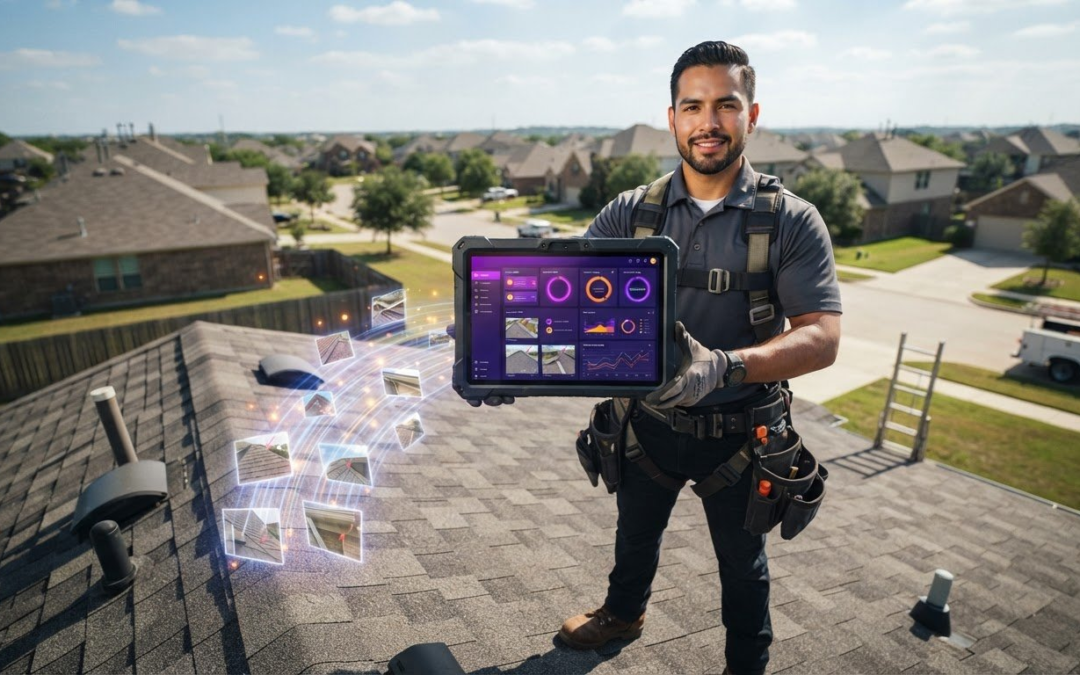
Roofing crew leads spend between 45 and 90 minutes per job manually sorting, organizing, and labeling photos long after leaving the site. If you’re burning evenings matching blurry hail strikes to shingle slopes, you already feel that administrative drag. Adopting a dedicated roof inspection reporting app cuts through the chaos, turning messy camera rolls into structured, field-ready documentation before you even leave the driveway.
You shouldn’t have to moonlight as a late-night data-entry clerk. Wrestling with disjointed photo files, inconsistent slope labels across your crew, and carrier disputes over missing details costs you real money and valuable hours. In this guide, you’ll discover how advanced automation eliminates manual photo labeling, standardizes your inspection assets, and generates professional reports in half the time.
We’ll break down the practical steps to automate photo organization, integrate field documentation seamlessly with estimating platforms like Xactimate, and build high-velocity inspection workflows across your entire team in 2026.
Key Takeaways
- Eliminate late-night administrative work by turning on-site damage observations into finished reports before leaving the property.
- Discover why standard digital form builders fail roofing contractors and how a high-velocity roof inspection reporting app structures damage data at the point of capture.
- Accelerate field documentation using automated photo labeling and hands-free voice-to-text tools designed for steep slopes and challenging job sites.
- Standardize crew photo capture across asphalt, tile, and metal roofs to deliver consistent, carrier-ready files that speed up claim approvals.
- Deploy a five-step implementation blueprint to streamline multi-crew oversight, protect profit margins, and cut inspection turnaround times.
The Hidden Cost of Manual Roof Inspection Reporting
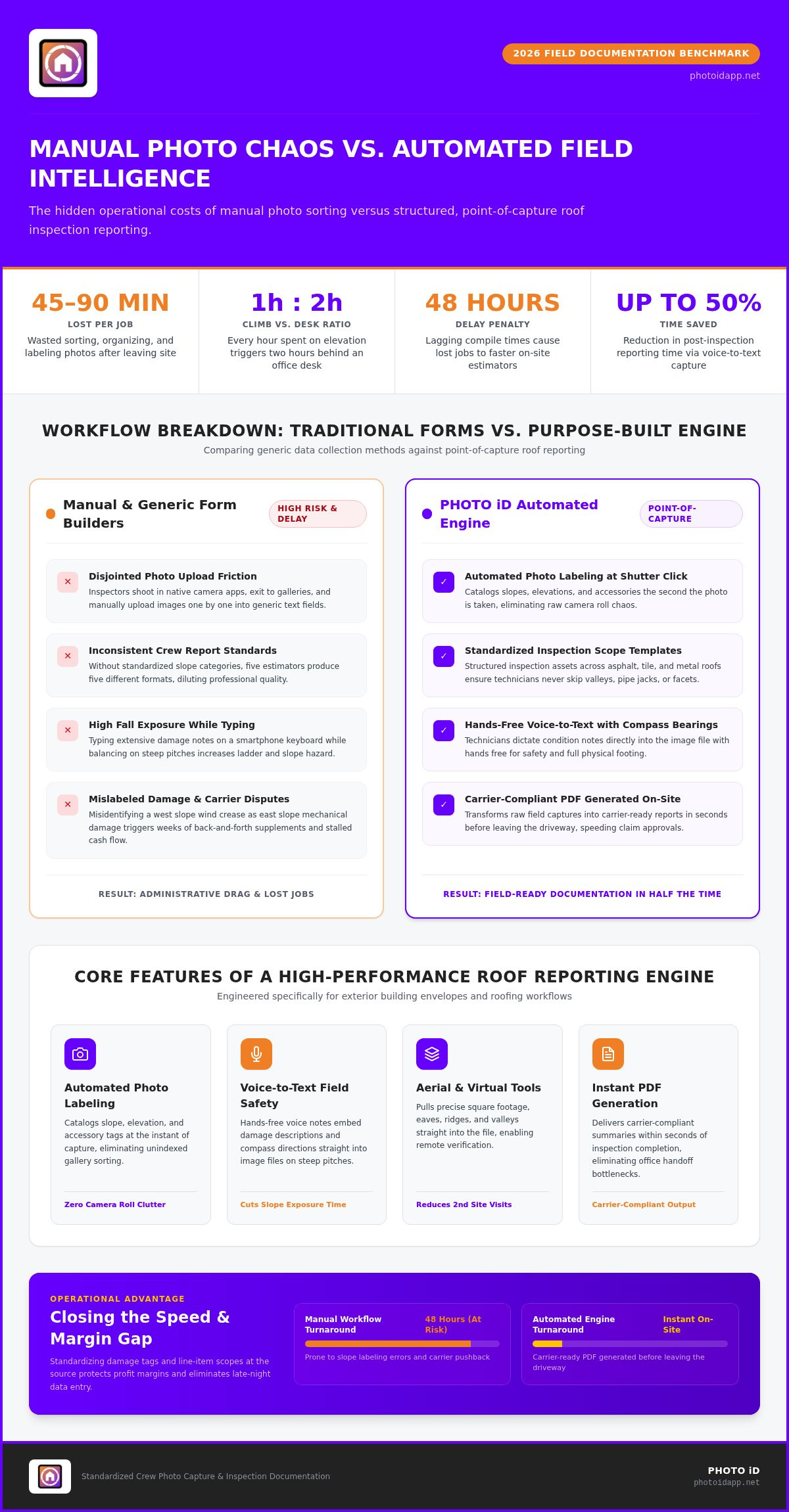
Every hour spent climbing an elevation often spawns two agonizing hours behind an office desk. Sorting hundreds of unindexed photos, typing repetitive damage descriptions, and stitching files together drains your team’s energy. This desk-time drain directly stunts business growth. Homeowners and commercial property managers sign contracts with the contractor who delivers a clear, professional scope first. Taking 48 hours to compile photos means losing high-margin jobs to agile competitors who present polished files on the spot.
Manual photo labeling also introduces costly human errors. Misidentifying a wind crease on the west slope as mechanical damage on the east slope can derail an entire insurance claim. Insurance adjusters reject sloppy, mislabeled photo sheets without hesitation. That triggers weeks of back-and-forth supplements, extended claim cycle times, and stalled cash flow. Deploying a specialized roof inspection reporting app replaces this chaotic manual sorting with structured field capture, protecting your profit margins from administrative drag.
Why Traditional Reporting Apps Fail Roofing Pros
Standard digital form builders cannot handle the realities of exterior assessment. They force inspectors to shoot photos in a native camera app, exit to an image gallery, and upload files one by one into generic text fields. This friction wastes precious daylight. Furthermore, generic apps lack structured damage categories for shingles, valleys, and flashing. Without standardized templates across your team, five different field estimators produce five completely different report formats, diluting your company’s professional standard.
The Safety Factor: Documentation While Climbing
Typing extensive notes on a smartphone screen while balancing on a steep slope creates severe safety hazards. Fall protection remains a critical priority on every jobsite; every extra minute spent staring at a mobile keyboard increases risk exposure on ladders and high pitches. Field professionals need fast, heads-up tools that document site conditions without taking their focus away from physical footing. A purpose-built roof inspection reporting app keeps documentation moving rapidly, cutting slope exposure time and helping inspectors climb down safely.
Core Features of a High-Performance Roof Reporting Engine
High-velocity field operations demand tools engineered specifically for building envelopes. A top-tier roof inspection reporting app replaces disconnected camera shots with structured inspection intelligence. Instead of dumping raw photos into local phone storage, high-performance platforms leverage automated photo labeling to catalog slopes, elevations, and accessories the second the shutter clicks. Paired with custom inspection templates, these systems ensure technicians capture every valley, pipe jack, and shingle facet without skipping critical scope items.
Speed defines the competitive difference in 2026. Instant report generation transforms raw field captures into carrier-compliant PDF summaries within seconds of inspection completion. By standardizing damage tags and line-item scopes at the source, field teams eliminate estimating handoff bottlenecks and accelerate approval timelines directly from the field.
Voice-to-Text: The Game Changer for Field Safety
Navigating ridges and valley transitions requires full physical balance. Point-of-capture voice-to-text labeling allows technicians to speak damage descriptions directly into the capture tool, embedding detailed condition notes and compass bearings straight into each image file. Dictating observations while keeping both hands free cuts post-inspection reporting time by up to 50% while keeping adjusters and roofers alert on steep elevations.
Aerial Measurements and Virtual Tools
Modern field inspections blend boots-on-the-deck verification with high-altitude data. Integrating accurate aerial roof and wall measurements reduces dangerous pitch assessments by pulling precise square footage, eaves, ridges, and valleys straight into your file. When combined with virtual inspection software, estimating teams can review live slope data remotely, verify hail spatter counts, and export structural geometry directly into carrier-ready deliverables without scheduling second site visits.
Ready to upgrade your field workflow? Test the capabilities of the PHOTO iD Mobile App to experience rapid capture firsthand.
Documentation Engine vs. Standard Form Builders
Converting a paper checklist into a mobile PDF form solves very little. Generic form apps treat damage media as unindexed attachments, forcing estimators to manually group files into separate folders back at the truck. That is digital paper, not a system. High-volume roofing assessments require a robust documentation engine capable of handling hundreds of high-resolution images while preserving orientation, slope data, and damage tags at the moment of capture.
Centralized oversight transforms how companies operate across multiple properties. A specialized roof inspection reporting app connects directly to a live Team Management Dashboard, allowing operations managers to review incoming slope captures in real time. Rather than waiting for midnight syncs, project managers can track daily inspection progress, verify photo clarity immediately, and securely store geo-stamped image assets in the cloud to protect against carrier audits and future warranty disputes.
The Workflow Gap: From Field to Xactimate
Estimators waste hours matching vague photo names to item lines in property insurance files. Pre-labeled, compass-stamped photo batches streamline Xactimate estimating workflows by aligning images directly with repair line items. When uploading field packages to downstream review platforms like XactAnalysis or Encircle, structured damage records eliminate guesswork. Carrier adjusters receive clear evidence organized by elevation, removing the friction that typically stalls roof replacement approvals.
Scalability for Large Teams
Managing ten or more inspectors across multiple territories easily devolves into operational disorder without standardized controls. A purpose-built roof inspection reporting app enforces consistent terminology across every team member, safeguarding your company’s reputation for precision. Operations leaders can monitor field progress live, audit photo quality across active jobs, and ensure that every technician follows the same rigorous documentation standard regardless of location.
- Eliminates fragmented camera-roll storage by organizing assets dynamically by roof facet.
- Keeps desk estimators aligned with field crews through real-time media feeds.
- Maintains structured cloud backups for frictionless file retrieval during claim disputes.
How to Implement Automated Reporting in 5 Steps
Adopting high-speed inspection software requires a clear rollout plan across your entire organization. Moving from fragmented paper pads or basic smartphone galleries to a unified digital system takes deliberate execution. Follow these five practical steps to deploy a modern roof inspection reporting app across your field teams:
- Select a specialized mobile engine: Equip your team with a dedicated platform like the PHOTO iD Mobile App, engineered specifically for high-volume roofing documentation rather than generic checklists.
- Configure custom inspection templates: Build out structured category trees for specific roofing assemblies, including architectural asphalt shingles, standing seam metal, and concrete tile systems.
- Train field crews on voice capture: Mandate point-of-capture voice-to-text labeling so technicians describe hail strikes, wind uplift, and flashing deterioration hands-free while on the roof.
- Connect to your team management dashboard: Establish live synchronization between mobile field units and administrative hubs to monitor inspections in real time.
- Automate report delivery: Set up one-click delivery protocols so completed PDF reports and structured data packets land in the homeowner’s or adjuster’s inbox before your inspector leaves the driveway. Once rapid delivery impresses the property owner, leveraging an automated platform like Review Rank Ai to send feedback requests and handle customer responses turns exceptional service into higher ratings.
Customizing Your Inspection Templates
Lock down mandatory photo checkpoints for every slope, ridge, and valley transition. Build logic-based prompts that direct technicians to document specific damage categories, whether assessing mechanical scuffing, severe hail bruising, or wind tear-offs. Standardizing these inputs ensures every file meets strict carrier criteria and aligns with recognized industry inspection protocols from day one.
Training for High-Velocity Adoption
Getting veteran field pros on board comes down to respecting their time. Demonstrate how speaking photo descriptions out loud eliminates two hours of late-night keyboard entry at home. Establish the strict “one-and-done” rule: label every asset at the point of capture on the roof, and never touch the photo file again. Transitioning to a photo-first capture habit ensures that by the time boots hit the ladder base, documentation is 100% complete.
Ready to modernize your company’s field operations? Get started with PHOTO iD today and cut your documentation cycle in half.
Maximizing ROI with the PHOTO iD Ecosystem
Time recovered in the field translates straight into revenue. When your estimators recover 45 to 90 minutes per assessment, that saved administrative time turns directly into two additional sales appointments or property walk-throughs every day. Over a standard workweek, saving 30 to 60 minutes per site visit banks up to 10 hours of productive labor per inspector. That reclaimed capacity compounds quickly across an entire sales team, driving higher close rates without increasing operational headcount.
Field practicality sits at the core of the PHOTO iD platform. Founded by “The Claims Coach” Ken Perry, the system was built from the ground up by insurance adjusters who intimately know the friction of carrier file reviews. By aligning field evidence with the exact documentation structure carriers demand, you drastically cut insurance claim cycle times. Adjusters receive clear, undeniable damage files that minimize supplement disputes, accelerating claim approvals and ensuring your business gets paid faster.
Professionalism That Wins Contracts
Property owners quickly distinguish reputable exterior contractors from fly-by-night storm chasers based on initial presentation. Handing a homeowner a comprehensive, labeled inspection packet from your truck establishes instant credibility. Beyond slopes and gutters, utilizing built-in home inspection app features allows crews to document collateral damage across window screens, siding, and perimeter fencing. This thorough documentation gives property owners complete transparency and arms them with rock-solid evidence for their insurance adjuster.
Next Steps: Starting Your High-Velocity Journey
Implementing an advanced roof inspection reporting app modernizes your entire field operation with minimal learning curve. Download the app, configure your first inspection project, and begin documenting facets immediately using intuitive voice tagging. Bring administrative leadership into the loop by connecting your field staff to the centralized Team Management Dashboard for instant, real-time oversight across every active project. Start automating your roof reports today!
Accelerate Your Field Documentation in 2026
Stop burning your evenings organizing photos at an office desk. Manual data entry slows claim cycle times, frustrates carrier partners, and steals billable hours from your bottom line. Equipping your crew with a true roof inspection reporting app changes that dynamic completely. By utilizing voice-to-text automated labeling and instant photo report generation, your field documentation finishes the moment your feet hit the ladder base.
Built by industry veteran Ken Perry, the platform transforms jobsite chaos into structured, carrier-compliant files in seconds. You protect inspector safety on steep pitches, deliver clear transparency to property owners, and hand your estimating team clean data that speeds up project approvals. Eliminate administrative bottlenecks and put valuable hours back into your workweek. Scale your inspections with the PHOTO iD Mobile App today and lead the exterior industry with confidence!
Frequently Asked Questions
What is the best app for roofing inspection reports?
The PHOTO iD Mobile App stands out as the premier roof inspection reporting app because it was designed specifically for high-velocity field documentation. Unlike basic form fillers, it uses automated voice-to-text photo labeling and instant PDF report generation right from the jobsite. Created by industry veteran Ken Perry, the platform provides contractors and adjusters with structured slope-by-slope photo evidence that aligns directly with insurance carrier requirements and estimating workflows.
How does voice-to-text labeling improve roof inspection safety?
Voice-to-text labeling keeps your hands completely free and your eyes focused on your footing while navigating steep roof pitches or ladders. Instead of typing lengthy damage descriptions on a small screen while balancing on an elevation, you simply snap the photo and speak your observations. The app embeds your spoken notes directly into the photo metadata instantly, drastically reducing physical distraction and unnecessary slip or fall hazards.
Can I use a roof inspection app for insurance claim documentation?
Yes, a specialized roof inspection reporting app is essential for insurance claims because carriers demand structured, indisputable visual evidence. PHOTO iD organizes photos by specific elevations, directional bearings, and damage classifications such as hail impact or wind uplift. Presenting adjusters with a standardized, pre-labeled photo summary eliminates ambiguous damage calls, prevents extensive back-and-forth supplements, and significantly accelerates overall claim cycle times for faster settlements.
Does PHOTO iD integrate with Xactimate or Verisk?
Yes, PHOTO iD streamlines the estimating pipeline by organizing field assets for rapid use in Xactimate and related estimating software. While field photos export cleanly into structured PDFs, the underlying data and pre-labeled photo sets align directly with standard line items used in insurance restoration estimates. This eliminates manual photo sorting during estimate creation, allowing desk estimators to import labeled damage documentation into their files without redundant data entry.
How much time can an automated reporting app save per inspection?
An automated reporting engine typically saves field pros between 30 and 60 minutes on every inspection. Rather than spending up to 90 minutes back at the office manually renaming camera roll files and formatting PDF summaries, the system organizes and labels photos during capture. That time savings adds up to roughly 10 hours reclaimed per inspector each week, letting your team complete more site visits or sales calls.
Do I need a drone for aerial roof measurements in the app?
No, you don’t need to fly a drone to obtain aerial roof and wall measurements within the PHOTO iD ecosystem. The platform provides integrated aerial measurement tools that pull precise roof geometry, slope counts, and wall dimensions straight into your project file. This feature eliminates manual tape measuring and dangerous ladder setups while supplying the accurate square footage data required to compile complete estimates and material orders.
Is there a team management dashboard for multiple roofing crews?
Yes, the platform features a centralized Team Management Dashboard built specifically for multi-crew operations. Business owners and project managers can track inspection progress across multiple jobsites in real time, audit incoming field photos immediately, and maintain unified documentation standards across every technician. This centralized visibility eliminates missed photo requirements, ensures company-wide labeling consistency, and allows management to dispatch teams effectively across large service territories.
Can I customize the inspection templates for different roof types?
Absolutely. You can easily configure custom inspection templates tailored to specific roofing materials, including architectural asphalt shingles, standing seam metal, clay tile, and low-slope membranes. These customizable workflows prompt field crews to capture required slope overviews, flashings, valley transitions, and collateral damage systematically. Creating standardized templates ensures complete documentation on every property and prevents crew members from missing crucial scope details before leaving the site.