
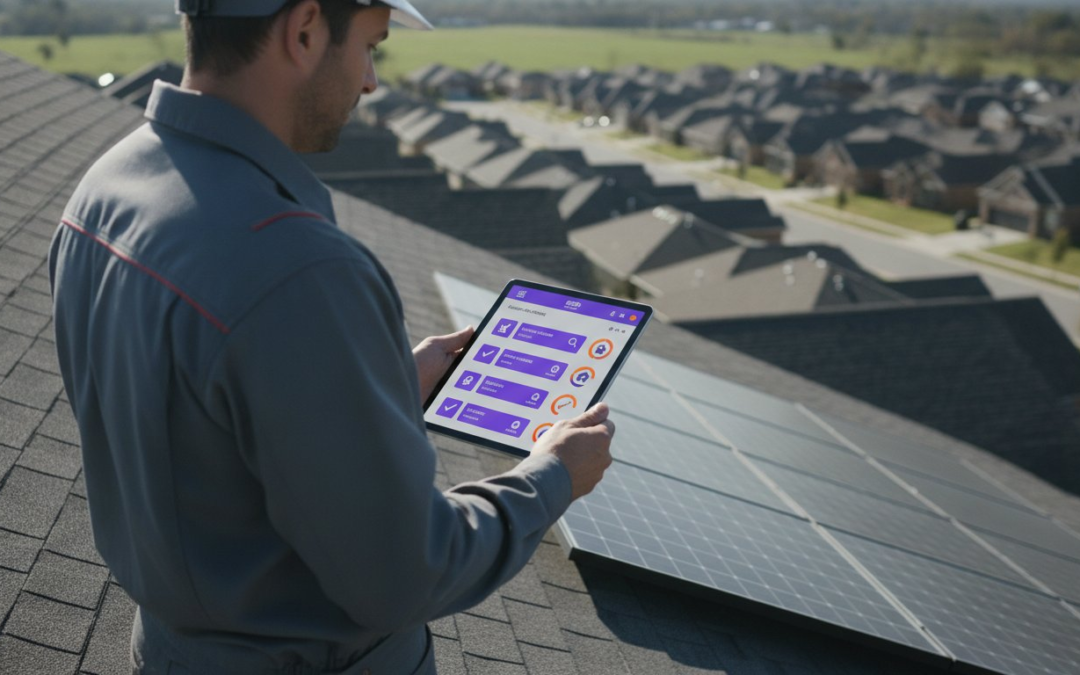
What if your field team could finish an entire inspection report before they even stepped back into their truck? For most professionals, the job does not end when the site visit does. You know the frustration of spending your evenings squinting at blurry photos, manually labeling files, and trying to piece together a coherent narrative from a mountain of disorganized data. It is a cycle of delayed delivery and inconsistent documentation that drains your resources and stalls your project turnaround.
We agree that your expertise should be spent on the inspection, not the paperwork. This guide shows you how to reclaim your time by implementing a visual-first workflow. By choosing the right inspection quality control software, you can eliminate reporting chaos and skyrocket field efficiency instantly. We will explore how to standardize your documentation, automate your photo labeling, and ensure uniform reports every single time. Get ready to transform your process from a manual grind into a seamless, automated powerhouse that delivers results while you are still on-site. Capture, label, deliver!
Key Takeaways
- Transform your field process from a manual grind into a repeatable, automated engine that scales with your business.
- Master the three pillars of visual documentation to ensure your inspection quality control software captures every critical detail with total precision.
- Identify and destroy the documentation bottlenecks that stall project turnarounds and force your team into hours of manual office work.
- Follow a proven five-step checklist to build master templates that guarantee uniform, professional reports across your entire organization.
- Learn how to automate photo labeling at the moment of discovery to deliver instant reports before you even leave the jobsite.
What is a Standardized Inspection Workflow?
A standardized inspection workflow is a repeatable process ensuring every site visit follows the same sequence, captures the same data, and meets the same quality bar. It’s the difference between a chaotic pile of unlabeled photos and a professional, defensible report. In the past, field teams relied on paper checklists and human memory. This manual approach was slow, prone to error, and impossible to scale. Today, high-velocity teams use inspection quality control software to turn field observations into instant, structured digital records. This evolution from ink and paper to automated workflows has changed the game for property professionals.
Scaling a field service business is impossible without this backbone. If every inspector does things their own way, your quality fluctuates wildly. That inconsistency creates a massive liability for your firm. By following a rigid standard, you ensure that every claim is backed by indisputable evidence. This process is the foundational element of Quality Control, protecting your company from disputes while allowing you to manage larger teams across national territories. Standardize your process to protect your bottom line!
Core Components of Modern Inspection Standards
True standardization relies on three non-negotiable elements that every team member must follow. First, procedural consistency requires every inspector to move through a property in the exact same order. This eliminates missed rooms or forgotten exterior shots. Second, data uniformity ensures that labels and descriptions match across every report. You can’t have one person call it “hail damage” and another call it “surface wear” on the same project type. Finally, your workflow must define specific visual evidence requirements. This means setting rules for which angles, distances, and lighting conditions are required for compliance. When these three components align, your documentation becomes bulletproof.
Why Consistency Wins in Property Assessment
Consistency is your greatest competitive advantage because it stops expensive re-inspections in their tracks. When an inspector misses a critical photo, you lose time, fuel, and money sending them back to the site. A standardized workflow acts as a digital fail-safe. It forces the capture of every required data point before the inspector even steps back into their truck. By using inspection quality control software, you remove the guesswork from the field.
Predictable results build lasting client trust. When a carrier or property manager knows your reports will always be organized, accurate, and delivered on time, you become their most reliable partner. A standardized workflow is the definitive blueprint for field accuracy that transforms individual effort into organizational excellence! Capture the data. Label the evidence. Deliver the result. It’s that simple.
The 3 Pillars of a Visual-First Standardized Workflow
Visual documentation is your most powerful tool in the field. It moves beyond simple text to prove every claim with organized, undeniable photographic evidence. By implementing a visual-first approach, you transform your field team into a high-efficiency data engine. This strategy relies on three core pillars that turn chaos into clarity. When you integrate these pillars into your inspection quality control software, you create a workflow that is both fast and bulletproof. Stop guessing and start documenting with precision.
Pillar 1: Structured Visual Capture
Generic photo-taking is not an inspection strategy; it is a liability. You need custom templates that guide your inspectors through the property in a logical, step-by-step sequence. These templates act as a digital guardrail, ensuring every room or system has a pre-defined set of required capture angles. By following Best Practices for Quality Control Inspections, you eliminate the risk of forgotten shots or incomplete data sets. Link your photos directly to specific line items to provide maximum reporting clarity for your clients. This level of structure is exactly what modern inspection quality control software provides to ensure total field accuracy on every site visit.
Pillar 2: Intelligent Photo Labeling
The “photo dump” is the primary enemy of team productivity. When an inspector returns from a site with 200 unlabeled photos, your back office enters a nightmare of manual sorting and guesswork. This process is slow, expensive, and prone to human error. You must standardize your terminology across your entire team. Use a consistent lexicon for damage and structural features so every report speaks the same language, regardless of who performed the inspection. Automated photo labeling preserves the integrity of your professional documentation by tagging evidence at the moment of discovery. It keeps your data clean, your labels accurate, and your team moving toward the next job without delay. To leverage this clean data at an enterprise scale, check out Syntes AI and discover how an Enterprise Knowledge Graph can unify complex information for large organizations.
Client expectations have shifted rapidly. In the current market, “instant” is the new standard for professional property field services. You need to close the gap between the physical inspection and the final estimate delivery to stay competitive. High-quality photo organization software streamlines your back-office operations by generating reports automatically from the field data. There is no need for late-night office work or weekend report building when the data is already organized at the source. If you want to see how this works in real-time, you can start organizing your inspections today to reclaim your schedule and impress your clients with lightning-fast delivery.
Overcoming Bottlenecks in Field Documentation
“Documentation takes longer than the actual inspection.” Every field professional has said it. It’s the primary bottleneck that keeps your business stuck in neutral. When your team spends three hours on-site and another four hours at the computer, your revenue is effectively cut in half. Manual photo entry creates a massive backlog that stalls project turnarounds and frustrates your estimating desk. High-velocity inspection quality control software eliminates this friction by moving the “office work” directly to the field. Capture the data once and be done with it! This efficiency-first mindset is shared by other industries; for example, SOCWeld provides a platform to automate and manage welding documentation, ensuring that technical teams spend less time on paperwork and more time on their craft.
During high-volume periods, like post-storm assessments, the pressure to deliver is intense. Without a digital workflow, quality standards often collapse under the weight of the workload. You can’t afford to trade accuracy for speed. You need a system that enforces both simultaneously. By standardizing the documentation process, you ensure that even during the busiest seasons, your reports remain professional, defensible, and accurate. Stop the documentation drain and start scaling your output.
The High Cost of Manual Data Entry
Late-night photo labeling is a hidden tax on your profitability. If your inspectors are spending their evenings squinting at phone screens to remember which bedroom had the ceiling leak, your data is at risk. Human error is inevitable when labeling hundreds of photos from memory. This leads to rejected claims, unhappy clients, and expensive site revisits. It’s a cycle of inefficiency that drains team morale and company resources.
Modern home inspection apps are no longer a luxury; they are a survival requirement for competitive firms. By automating the labeling process at the source, you can reduce cycle times by up to 75%. Stop paying for hours of manual labor and start investing in automated efficiency! Protect your inspectors from burnout and your business from data gaps.
Bridging the Gap with Technology
The best tools are built for the reality of the jobsite. You need mobile-first technology that functions flawlessly in low-connectivity or remote areas. Your inspectors shouldn’t have to wait for a signal to stay productive. True field efficiency means the software works as fast as the professional holding the device.
Voice-to-text labeling allows your team to capture detailed notes without ever putting down their tools. It’s fast, hands-free, and incredibly accurate. This technology also reduces the learning curve for new hires. Guided digital workflows act as an on-the-job trainer, ensuring that even a rookie produces a report that looks like it came from a seasoned veteran. Inspection quality control software connects your field team to your office instantly. Eliminate the backlog. Scale your operations. Deliver excellence every time!
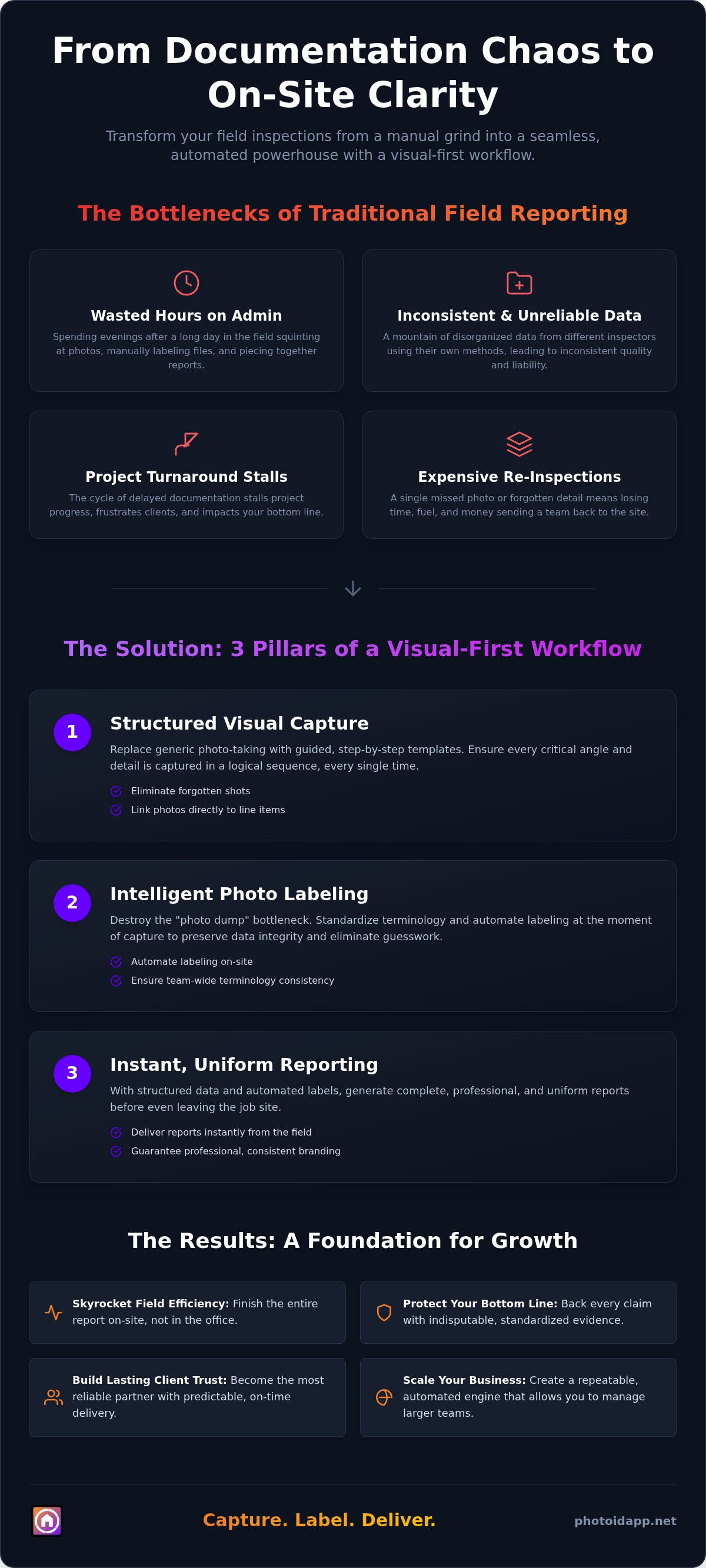
Implementing Your Workflow: A 5-Step Checklist
Implementing a new system does not have to be a headache. You need a clear path from chaos to clarity. Follow this 5-step checklist to turn your field operations into a high-speed engine. First, audit your current process. Find the leaks where photos get lost or mislabeled. Second, define your Master Template. This is your digital blueprint for every job type. Third, select inspection quality control software that supports automated photo labeling. Fourth, train your team on “Capture-Label-Close” habits. Finally, review your turnaround times and refine the process. Speed is the goal! Audit. Build. Scale!
A standardized workflow is only as good as its execution. By following these steps, you eliminate the guesswork that slows down your best inspectors. You are not just digitizing a checklist; you are building a repeatable system for excellence. When your team knows exactly what to capture and how to label it, the entire business moves faster. Stop wasting time on manual sorting and start delivering professional results instantly.
Steps 1 & 2: Mapping the Process
Start by mapping the physical journey. Identify the “critical path” photos required for every job type you perform. If you are assessing roof damage, define the specific angles for slopes, eaves, and penetrations. Your custom templates should mirror how an inspector actually moves through a site. This logical flow prevents missed data and unnecessary backtracking. Standardize your photo captions to match Xactimate requirements from day one. This alignment ensures your estimating desk can work at top speed without translating field notes. Consistency in the field leads to speed in the office.
Steps 3 & 4: Tool Selection and Training
The right tool must handle the reality of the jobsite. Your inspection quality control software must support offline mode and automatic cloud syncing. You cannot rely on a perfect signal in a basement or a remote rural area. Run a live test during your selection process. Can your team use the app with work gloves on? Does the interface stay snappy under heavy use? Focus your training on the Voice-to-Text feature. It is the fastest way to capture detailed descriptions while keeping hands free for tools. Habit is everything. Train your team to capture, label, and close the file before they leave the site. Ready to transform your field efficiency? Get the PHOTO iD Mobile App and build your first master template today!
How PHOTO iD Automates Your Quality Control
Standardize. Automate. Scale! This is the operational reality for teams using the PHOTO iD Mobile App. While generic platforms offer broad tools, we provide specialized inspection quality control software built for the grit of the jobsite. Our platform forces consistency across your entire national team through custom templates. You don’t have to worry about an inspector missing a corner or mislabeling a room. The engine categorizes evidence as you shoot, turning a day’s work into a finished product before you even leave the driveway. It is about speed, precision, and total documentation control.
Transitioning from field documentation to instant reporting is the ultimate goal. PHOTO iD acts as the engine for this shift. By automating the most tedious parts of the process, you empower your team to focus on their expertise. You are not just taking pictures; you are building a defensible, professional record in real-time. This is how you reclaim your evenings and skyrocket your field efficiency. Capture the data. Label the evidence. Deliver the result!
Voice-to-Text: The Secret to High-Speed Standards
Manual typing kills momentum. It is the primary reason documentation lags behind the actual inspection. With PHOTO iD, you maintain detailed documentation without ever putting down your tools or equipment. It is fast, hands-free, and intensely professional. Our Voice-to-Text feature ensures every photo has a standardized label that flows directly into the final estimate. You can capture critical details like “roof age,” “leak source,” or “material type” instantly while the evidence is right in front of you. This ensures your data is accurate, fresh, and perfectly compliant with your company’s high standards. No more guessing. No more delays. Just pure, high-velocity reporting.
Centralized Team Management
Scaling a field service business requires oversight without micromanagement. Our centralized dashboard hub lets you monitor project progress in real-time. You can review field photos as they are captured, allowing for immediate quality control from the office. If a shot is blurry or a label is missing, you catch it while the inspector is still on-site. This visibility prevents errors from reaching the client and protects your professional reputation. You can also coordinate with your team on aerial roof and wall measurements from the same unified platform. It is a game-changing partner that restores order to the chaos of onsite documentation. Inspection quality control software should do more than just store data; it should drive your business forward. Manage your team. Master your workflow. Move your business to the next level!
Take Command of Your Inspection Workflow
You’ve seen how a visual-first approach destroys reporting chaos. By mastering the three pillars of documentation and implementing a standardized 5-step checklist, you transform your field team into a high-velocity engine. Standardization isn’t just about checklists; it’s about building a repeatable system for excellence that protects your business and delights your clients. Capture the data. Label the evidence. Deliver the result!
High-performance teams don’t wait for the office to start their reports. They use inspection quality control software to capture, label, and deliver results instantly. Trusted by thousands of adjusters and contractors, the PHOTO iD Mobile App reduces report writing time by up to 75%. You can generate instant PDF and web reports before you even leave the site. It’s the ultimate tool for the modern professional who values speed and accuracy.
Stop the late-night manual labor. Start scaling your operations with confidence. Standardize your workflow today with the PHOTO iD Mobile App! Your time is valuable. Reclaim it now and lead your market with precision and power!
Frequently Asked Questions
What are the benefits of a standardized inspection workflow?
Standardized workflows eliminate reporting chaos and ensure total consistency across every team member. By following a repeatable process, you reduce company liability and build client trust through predictable, high-quality deliverables. This system serves as a digital blueprint for field accuracy. It stops expensive re-inspections caused by missing data or blurry photos. Implementing these standards allows your business to scale nationally without sacrificing the professional quality of your documentation.
How does automated photo labeling improve inspection speed?
Automated photo labeling removes the manual data entry that typically happens after a site visit. Instead of spending hours at night squinting at phone screens to label hundreds of files, the system categorizes evidence as you shoot. This transition from field documentation to instant reporting can reduce cycle times by up to 75%. It allows your inspectors to finish their office work while they are still on-site, keeping your project pipeline moving fast.
Can I create custom templates for different types of property inspections?
Yes, the PHOTO iD Mobile App allows you to build custom inspection templates tailored to your specific job types. Whether you are performing a roof assessment, a floor moisture check, or a full interior inspection, you can define exactly which angles and data points are required. These templates act as digital guardrails. They force consistency across your entire team, ensuring that every professional follows the same logical sequence and captures every critical detail.
Is a standardized workflow compatible with Xactimate or Verisk?
Our inspection quality control software is designed to align perfectly with industry-standard estimating platforms like Xactimate. By standardizing your photo captions and documentation categories in the field, your estimating desk receives organized data that is ready for immediate processing. This eliminates the friction between the field team and the office. It ensures that your visual evidence matches the line items required for professional property claims and assessments, speeding up the final delivery.
How do I train my field team to follow a new digital workflow?
The best way to train your team is through guided digital workflows that act as an on-the-job mentor. Focus your training on the “Capture-Label-Close” habit. Encourage your inspectors to use features like voice-to-text to capture details without putting down their tools. By running live tests on-site, you can ensure everyone is comfortable using the app with work gloves on. This hands-on approach reduces the learning curve and ensures rapid adoption of new standards across your organization.
What is the best app for organizing inspection photos on-site?
The PHOTO iD Mobile App is the premier solution for organizing inspection photos at the moment of discovery. It is built specifically for high-velocity field teams who need to eliminate reporting bottlenecks. Unlike generic photo apps, it offers automated labeling, custom templates, and instant report generation. This specialized inspection quality control software ensures that your documentation is professional, organized, and defensible before you even leave the driveway of the property. Capture, label, and deliver!
How does voice-to-text help with inspection documentation quality?
Voice-to-text labeling allows inspectors to record high-detail notes instantly while their eyes are still on the damage. This prevents the loss of critical information that occurs when trying to remember details hours later. It ensures every photo has a professional, standardized label that explains the “why” behind the visual evidence. This feature maintains high-speed standards without requiring the inspector to stop their physical work, resulting in a more comprehensive and accurate final report every single time.
Will a standardized workflow help reduce insurance claim cycle times?
A standardized workflow significantly reduces insurance claim cycle times by closing the gap between the site visit and the final report. When your field data is organized and labeled automatically, the estimating desk can produce a final document in minutes rather than days. This efficiency allows for faster project turnarounds and quicker payouts for your clients. By eliminating the manual photo entry backlog, your business can handle a much higher volume of claims without increasing overhead.