

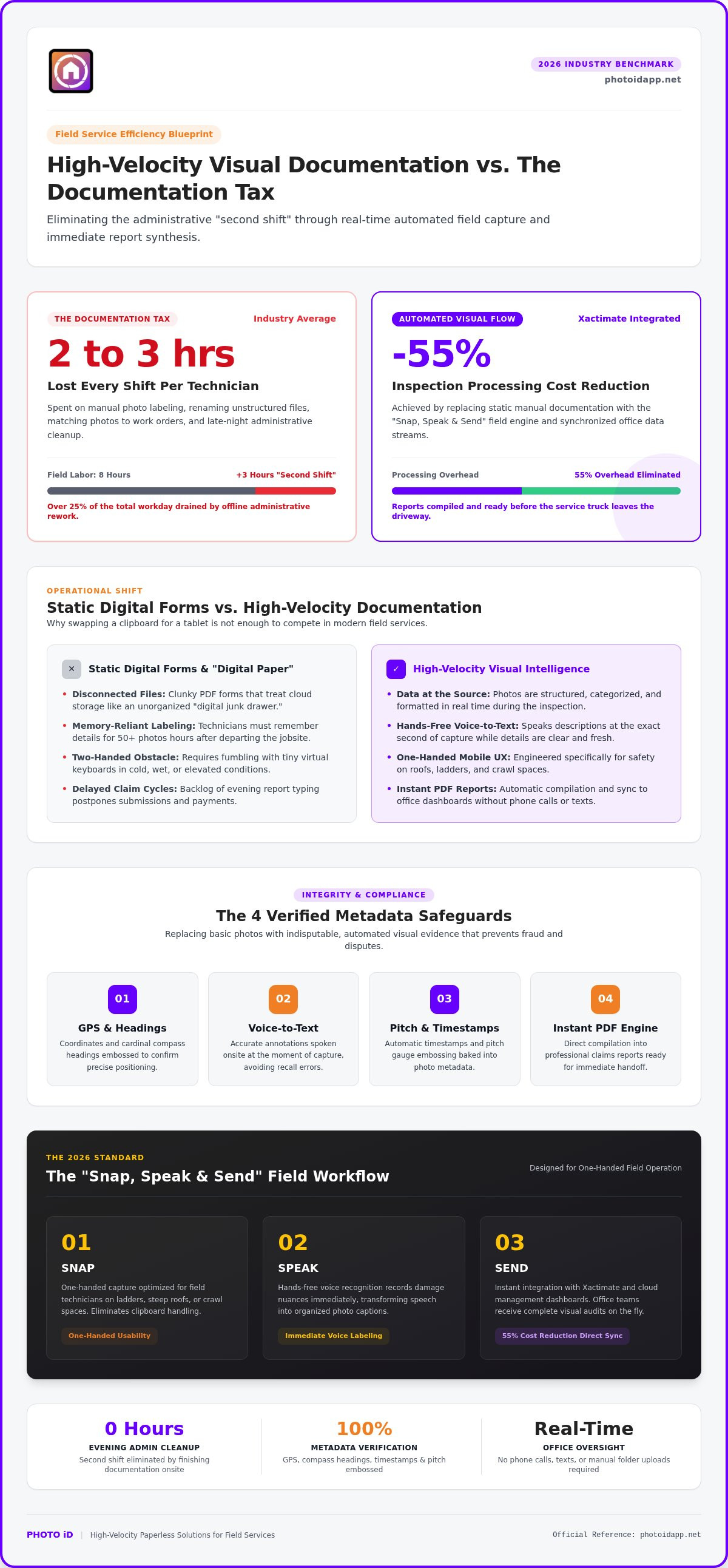
Field technicians and estimators are losing an average of 2 to 3 hours every single shift just to manual photo labeling and organization. That is a massive documentation tax on your productivity. Modern paperless solutions for field services shouldn’t just replace a physical clipboard; they must eliminate the “second shift” of administrative work entirely. You know the frustration of finishing a long day onsite only to spend your evening renaming files, matching photos to work orders, and struggling to remember specific inspection details. It’s exhausting, it leads to inconsistent reports, and it creates massive delays in your claim cycles.
Stop drowning in paperwork and reclaim your time. This 2026 guide shows you how automated visual documentation turns raw field data into instant, professional reports before you even leave the jobsite. We’ll explore how a “Snap, Speak & Send” workflow and seamless Xactimate integration can reduce your inspection processing costs by 55%. Discover how to capture data, generate reports, and sync files with total confidence. It’s time to restore order to the chaos of field documentation, empower your team, and accelerate your path to payment.
Key Takeaways
- Shift from static digital forms to high-velocity documentation that fuses mobile data with automated reporting for maximum onsite efficiency.
- Prioritize paperless solutions for field services that offer voice-to-text labeling and one-handed operation to keep your hands free for inspections.
- Learn why visual intelligence and automated photo organization are more valuable for documentation accuracy than generic checkbox-style apps.
- Audit your current documentation bottlenecks to pinpoint exactly where time is being lost before selecting a field-first mobile application.
- Leverage instant photo report generation to eliminate administrative “second shifts” and turn field data into immediate revenue drivers.
Why Digital Isn’t Enough: The Shift to High-Velocity Paperless Solutions
Going paperless used to mean swapping a clipboard for a tablet. In 2026, that simple swap isn’t enough to stay competitive. Modern paperless solutions for field services have evolved into high-velocity documentation systems. This is the powerful fusion of mobile data capture and automated reporting. While many companies think they’re digital because they use PDF forms, these static files are failing field teams. They’re clunky, slow, and disconnected from the visual reality of the jobsite. True efficiency requires a system that works as fast as you do.
Adopting a visual-first strategy is no longer optional. It’s the only way to manage the massive influx of data required for modern compliance and insurance standards. When you prioritize visual intelligence over manual data entry, you transform your field data from a liability into a professional asset. It’s about moving beyond “digital paper” and embracing true automation. For those looking to extend these efficiencies to general business documentation, Make It Mine offers insights into how OCR and document automation are evolving to support digital transformation.
The Death of the Manual Field Report
The “second shift” is the silent killer of field service profitability. You know the routine: you spend eight hours on a roof or in a basement, then spend another three hours at home labeling photos and typing up notes. This manual process is a massive drain on billable hours. Industry benchmarks show technicians lose 2 to 3 hours per shift just to administrative cleanup. That’s time you could spend on another job or with your family.
Relying on memory to label 50 photos hours after an inspection is a recipe for disaster. It leads to inconsistent quality, missed details, and delayed claim cycles. Real-time data capture is the only solution. Modern field service management systems must integrate documentation directly into the workflow. Capturing data at the source ensures every detail is accurate, every photo is labeled, and every report is ready before the truck leaves the driveway.
Transitioning from Storage to Automation
Stop treating your cloud storage like a digital junk drawer. Traditional storage apps just hold files; they don’t help you use them. Intelligent paperless solutions for field services focus on automation rather than just collection. Automated photo labeling changes the entire reporting landscape by organizing your evidence as you take it. This shift ensures total data integrity. In 2026, you need more than just a picture; you need verified metadata, including:
- GPS coordinates and cardinal compass headings
- Voice-to-text descriptions captured in the moment
- Automatic timestamps and pitch gauge embossing
- Instant PDF compilation for immediate sharing
This level of automation protects your business from fraud and disputes. It turns every technician into a top-tier reporter. When the software handles the organization, your team can focus on the labor. The result is a faster, cleaner, and more profitable operation that thrives on speed and accuracy.
Essential Components of a 2026 Paperless Field Service Tech Stack
Building a modern tech stack isn’t about collecting dozens of disconnected apps. It’s about selecting a few high-performance paperless solutions for field services that actually communicate with each other. In 2026, your field stack must prioritize mobility above all else. If a tool requires two hands and a physical keyboard, it doesn’t belong on a professional jobsite. You need interfaces specifically designed for one-handed operation while you’re standing on a ladder or navigating a tight crawl space. These tools must also include cloud-based team management dashboards to give office staff real-time project oversight without the need for constant phone calls or text check-ins. If you are managing residential properties, you can learn more about Build App | תוכנה לניהול בניינים — גבייה, אחזקה ודיירים במקום אחד to discover how specialized building management software streamlines maintenance and administration in one place.
Voice-to-text: The Hands-Free Documentation Revolution
Stop typing and start talking. Voice-to-text labeling is the single biggest speed multiplier in modern field work. When you learn how voice-to-text labeling speeds up field inspections, you eliminate the need to fumble with small screens in the rain or cold. You capture descriptions at the exact moment you snap the photo. This dramatically increases accuracy because the details are fresh in your mind. The US EPA has even provided guidance on the legal and regulatory use of mobile field inspection tools to ensure digital records are as reliable as traditional notebooks. It’s about maintaining data integrity while moving at lightning speed. Snap. Speak. Send. It’s that simple!
Integration with Industry Standards
Your documentation shouldn’t live on a digital island. To truly kill the paperwork monster, your field app must sync with the platforms that drive your revenue. This means native support for Xactimate and Verisk. When your field photos and labels flow directly into an estimate, you slash claim cycle times by 40%. You can also leverage built-in aerial roof and wall measurements to reduce your actual time on-site. This allows you to handle more volume without increasing your headcount.
Professional branding also matters for your long-term growth. Use custom report builders to turn your raw data into polished, client-ready PDFs instantly. Every report should look like it took hours of careful editing, even if it only took seconds of automated processing. High-velocity paperless solutions for field services ensure your team delivers consistent quality regardless of their individual experience level. If you’re ready to see how these components work together to restore order to your workflow, you can explore the PHOTO iD Mobile App to start automating your documentation today.
Visual Intelligence vs. Digital Forms: Choosing the Right Strategy
Many businesses assume that moving from a physical clipboard to a digital form is enough. It isn’t. Generic digital forms are often just electronic versions of the same slow, text-heavy processes that have plagued the industry for decades. To truly innovate, you must shift your focus toward visual intelligence. In 2026, paperless solutions for field services must prioritize the photo as the primary data point. Photos provide indisputable evidence, capture complex details instantly, and build a level of client trust that text-based checkboxes simply can’t match. When you lead with visuals, you eliminate ambiguity and accelerate every stage of the project lifecycle.
Why Photos Are the New Paper Trail
Photos are no longer just supplementary; they are the foundation of modern accountability. Geotagged, timestamped, and cardinal-direction-labeled photos create an airtight evidentiary trail. This visual intelligence is critical for reducing adjuster disputes and speeding up insurance claim approvals. By utilizing specialized photo organization software, you ensure that every image is legally defensible and contextually rich. We are also seeing a massive move toward virtual inspection software. This allows remote experts to conduct assessments without the travel time, contributing to a 23% decrease in physical inspection travel time. High-quality visual reports don’t just prove the work; they sell your professionalism.
The Hidden Costs of Generic Form Apps
Generic form apps often create more work than they save. They force technicians to exit the app, take photos with a standard camera gallery, and then manually re-upload and sort those images later. This “upload-and-pray” method is a massive productivity leak. Compare that to the PHOTO iD workflow: you capture, label, and organize in one seamless motion. Use specialized tools to achieve these results:
- Eliminate manual sorting: Stop digging through a messy phone gallery at 8:00 PM.
- Reduce human error: Voice-label every photo at the point of capture for 100% accuracy.
- Instant results: Achieve the “one-click” report generation goal before you even start the truck.
Standard mobile gallery uploads are the enemy of speed. They lead to lost files and forgotten details. Leading paperless solutions for field services treat the photo as the core of the record, not an afterthought. Switch to a system that builds the report for you while you work. Order restored. Chaos defeated. Revenue secured!
A Step-by-Step Blueprint for Transitioning to Paperless Documentation
Transitioning your team to a digital workflow shouldn’t feel like a chore. It requires a tactical approach that prioritizes speed and simplicity. To succeed, you must move beyond generic storage and adopt dedicated paperless solutions for field services. This isn’t just about going green. It’s about going fast. Follow this blueprint to eliminate administrative drag and restore order to your jobsite documentation.
Phase 1: Auditing the Bottleneck
You can’t fix what you haven’t measured. Start by auditing your current reporting cycle to find exactly where the clock stops. Most teams suffer from a massive “photo-to-report” gap. This is the dead time between snapping a photo and that photo appearing in a labeled, professional report. Use this checklist to measure your current performance:
- Track how many hours pass between site departure and final report delivery.
- Calculate the time technicians spend manually renaming and sorting image files.
- Identify how often office staff must request clarification on unlabeled or blurry photos.
Set clear KPIs for your transition. Aim for a 50% reduction in report turnaround times within the first 30 days. High-velocity documentation makes this goal achievable by finishing the work while you’re still on-site. Don’t settle for “good enough” when you can have “done instantly.”
Phase 2: Standardizing the Field Experience
Standardization is the backbone of professional growth. Implementing the right paperless solutions for field services allows you to build custom inspection templates that guide technicians through every job type step-by-step. These templates act as a digital guardrail. They ensure no critical photo is missed and every label follows company standards. A centralized team management dashboard allows you to monitor this progress in real-time. You’ll see exactly what’s happening in the field without making a single phone call.
Your documentation tools must also play well with others. Ensure your chosen platform integrates seamlessly with your construction management software. This creates a unified ecosystem where data flows from the camera to the project file automatically. Train your team on voice-to-text labeling immediately. It’s the fastest way to ensure compliance without slowing down the physical labor. Ready to stop the paperwork bleed? Download the PHOTO iD Mobile App and start your transition today.
PHOTO iD: Transforming Field Documentation into Automated Revenue Drivers
Generic paperless solutions for field services often fail because they’re too broad. They try to handle scheduling, CRM, and payroll while ignoring the most brutal bottleneck in the industry: the photo report. PHOTO iD is different. It’s a specialized tool built for high-velocity documentation. We don’t just store your data; we automate the intelligence within it. Our Instant Photo Report Generation feature is the ultimate time-saver for professionals who can’t afford to waste hours on administrative cleanup. It turns raw site data into a polished, professional PDF in seconds. You get faster approvals, happier clients, and immediate revenue.
Our platform also integrates powerful virtual tools to keep you ahead of the competition. Leverage built-in aerial roof and wall measurements to get precise data without the climb. Use our virtual inspection software to conduct remote assessments and slash your travel time. These features work together to create a seamless ecosystem where documentation is an immediate result, not a delayed chore. It’s about working smarter, moving faster, and securing your profits with indisputable visual evidence.
Built for the High-Volume Professional
PHOTO iD wasn’t built in a vacuum. It was founded by industry veteran Ken Perry, the “Claims Coach” himself. This heritage means the PHOTO iD Mobile App is designed for the reality of the jobsite, not the comfort of an office chair. It’s intuitive, rugged, and fast. The “Field-First” design ensures that even your newest team members can produce expert-level reports on day one. Don’t let disorganized files and missing labels stall your growth. Restore order to the chaos of your documentation today. Professionalism shouldn’t be a struggle. It should be your standard!
Ready to Scale Your Field Services?
Scaling a business requires total consistency across every job. Our team management dashboard gives you a bird’s-eye view of your entire operation. You can monitor inspection progress, review photo quality, and manage custom templates from one central hub. This automated workflow provides a 40% reduction in claim cycle times, giving you the capacity to handle more volume without adding more stress. Automated visual evidence is your new competitive advantage. It protects your liability and proves your value to every stakeholder. It’s time to lead the market with speed. Explore the PHOTO iD platform and start automating your success right now.
Master the High-Velocity Future of Field Documentation
The transition to 2026 standards requires more than just swapping clipboards for tablets. It demands high-velocity paperless solutions for field services that automate the heavy lifting of photo organization. By prioritizing visual intelligence and hands-free voice-to-text labeling, you eliminate the exhausting “second shift” and reclaim your billable hours. Standardize your workflow, audit your bottlenecks, and let automation turn raw field data into instant revenue drivers. It’s time to restore order to the chaos of onsite assessments.
Our platform is trusted by industry veterans and designed to deliver a 40% reduction in reporting time. With seamless Xactimate integration, you’ll close claims faster and more accurately than ever before. Don’t let manual data entry hold your team back from scaling. Take control of your documentation today and watch your productivity soar. Success in the field starts with the right partner.
Start Your High-Velocity Documentation Journey with PHOTO iD Today!
Stop fighting the paperwork monster and start leading your industry with digital precision. You’ve got the tools; now take the lead and dominate your market!
Frequently Asked Questions
What are the best paperless solutions for field services in 2026?
The best options are those that prioritize high-velocity documentation and mobile-first automation. PHOTO iD stands out because it focuses specifically on the photo-labeling bottleneck rather than just generic project management. Look for paperless solutions for field services that offer voice-to-text, instant report generation, and native integrations with estimating software. These tools restore order to your jobsite and ensure your documentation is professional, consistent, and ready for immediate review.
How does automated photo labeling save time during inspections?
It eliminates the “second shift” of administrative work by organizing evidence at the point of capture. Instead of spending hours renaming files and matching photos to work orders late at night, you label them instantly using voice commands. This workflow reduces manual sorting time and prevents the memory loss that often happens hours after leaving a jobsite. You finish the documentation while you’re still on the roof or in the crawl space.
Can I use paperless inspection apps without an internet connection?
Professional-grade apps use offline-first architectures to ensure you never lose data in remote basements or rural areas. You can capture photos, record voice labels, and fill out templates without a signal. The software caches all metadata and recordings locally on your device. Once you return to an area with connectivity, the platform automatically batch-syncs everything to the cloud for real-time office oversight and report generation. It’s reliability you can trust.
How do I integrate field photos with Xactimate or Verisk?
You should use a platform that offers native export workflows specifically formatted for these industry standards. PHOTO iD allows you to export your labeled photos and reports directly into Xactimate using ZIP or ESX formatting. This seamless integration ensures your visual evidence flows straight into your estimate without manual re-uploading. It’s the fastest way to slash your claim cycle times and accelerate your path to final payment without unnecessary clerical friction.
What is the difference between a generic form app and a specialized inspection app?
Generic form apps are essentially digital clipboards that treat photos as an afterthought. Specialized paperless solutions for field services like PHOTO iD treat visual intelligence as the core of the record. Specialized apps include voice-to-text labeling, metadata embossing, and automated report builders designed for high-volume professionals. They solve the specific bottleneck of photo organization, whereas generic apps often require tedious manual sorting and re-uploading after the job is done.
Is voice-to-text labeling accurate enough for professional property reports?
Modern voice-labeling engines are highly accurate and specifically tuned for industry jargon. Capturing descriptions at the moment of inspection actually increases accuracy because you don’t have to rely on memory later. It ensures every detail is recorded precisely as you see it. This professional level of detail reduces disputes with adjusters and builds massive trust with your clients by providing a clear, labeled, and indisputable visual narrative for every project.
How much time can my team save by switching to instant photo report generation?
Organizations deploying automated documentation record a 32% increase in field efficiency and a 40% reduction in reporting time. By generating reports instantly on-site, you eliminate the 2 to 3 hours typically lost per shift to manual administrative tasks. This speed multiplier allows your team to handle higher job volumes without increasing headcount. You stop wasting billable hours on paperwork and start focusing on the specialized labor that drives your revenue.
Do paperless solutions help with insurance claim cycle times?
Yes, they are the most effective way to shorten the gap between inspection and payment. High-velocity documentation provides adjusters with the verified visual evidence they need to approve claims without requesting additional information. By delivering a professional, labeled report the moment the inspection ends, you remove the administrative delays that stall the process. This efficiency can lead to a 55% reduction in annual inspection processing costs for your business through total automation.