


You’ve been there. You’ve spent hours on a hot roof or in a cramped crawlspace, snapping dozens of photos of hail dings or water damage. You submit your report, feeling like you’ve nailed it, only to get a call two weeks later from a desk adjuster or a carrier questioning the validity of your photos.
"When exactly was this taken?" "Are we sure this is the right property?" "These photos look a bit… altered."
It’s enough to make your blood boil. You’re a professional, not a fraudster. But in today’s world, "just taking a picture" isn't enough anymore. As insurance fraud rises and generative AI makes it easier than ever to fake damage, the industry is tightening its grip. If your data isn't "defensible," it might as well not exist.
To stay ahead, you need more than just a camera; you need Visual Intelligence. That means understanding the hidden layers of your photos: the metadata and audit trails that turn a simple JPEG into a legal-grade piece of evidence.
Here are 5 things you need to know about image metadata and audit trails to protect your business, get your claims approved faster, and stop leaving money on the table.
1. The Power of "When" and "Where": GPS and Timestamps
Let’s talk about the low-hanging fruit: EXIF data. Every time you snap a photo with a modern smartphone or digital camera, the device embeds a hidden layer of information called EXIF (Exchangeable Image File Format).
For field pros, the two most critical pieces of EXIF data are the GPS coordinates and the original timestamp.
Why does this matter? Because it’s your first line of defense against disputes. If a carrier claims the damage happened after the policy expired, or if there's a dispute about which side of the street a house is on, your metadata has the answer.
When you use a high-quality photo report app, this data is captured automatically and pinned to the image. It’s not just a "note" you wrote down; it’s hard-coded into the file. It proves, without a shadow of a doubt, that you were standing at this specific latitude and longitude at that specific second.
Pro Tip: If you’re just texting photos or downloading them from a messaging app, you’re likely stripping this metadata away. Messaging apps compress files and wipe the EXIF data to save space. Without it, your "evidence" just became a lot harder to defend.

2. Keeping the Digital DNA Intact
Think of metadata as the "Digital DNA" of your photo. Every time a file is edited, saved, or moved through a non-secure channel, that DNA gets mutated.
In the world of insurance inspection software, "Chain of Custody" is everything. If you take a photo, download it to your computer, open it in Photoshop to "brighten it up," and then upload it to a portal, you’ve broken the chain. Even if you were just trying to make the damage more visible, any hint of "modification" can trigger a fraud flag.
Advanced claims adjuster software solves this by maintaining a "source of truth." When you capture an image within the PHOTO iD app, the original, unedited file is stored in the cloud with all its metadata intact. If an adjuster needs to see the original to verify its authenticity, it’s right there: untouched and untampered with.
If you want to be taken seriously by major carriers, you have to stop treated photos like casual snapshots and start treating them like forensic evidence.
3. The Unbroken Chain: Why Audit Trails are Non-Negotiable
An image is a point in time. An Audit Trail is the story of how that image got from your camera to the final report.
An audit trail tracks every action taken on a file. Who captured it? When was it uploaded? Who labeled it "Wind Damage – Front Slope"? Was the label changed later? By whom?
This might sound like overkill until you’re sitting in a deposition or dealing with a high-stakes commercial claim. Having a clear, timestamped log of every interaction with your documentation makes your work bulletproof.
It’s not just about defending against fraud; it’s about professionalism. When you submit a report that includes a transparent history of the data, you’re telling the carrier: "I have nothing to hide, and my process is standardized." This builds a level of trust that "old-school" guys with digital cameras and SD cards just can't match.

4. Winning Over the Carrier: Speed Up the Payout
Let's get real for a second: Why do you care about metadata? Because you want to get paid.
Carriers are under immense pressure to settle claims quickly while also stopping the $38 billion lost to fraud every year. When they receive a messy folder of unlabeled photos with no metadata, they have to do the detective work themselves. That means your file sits on their desk longer.
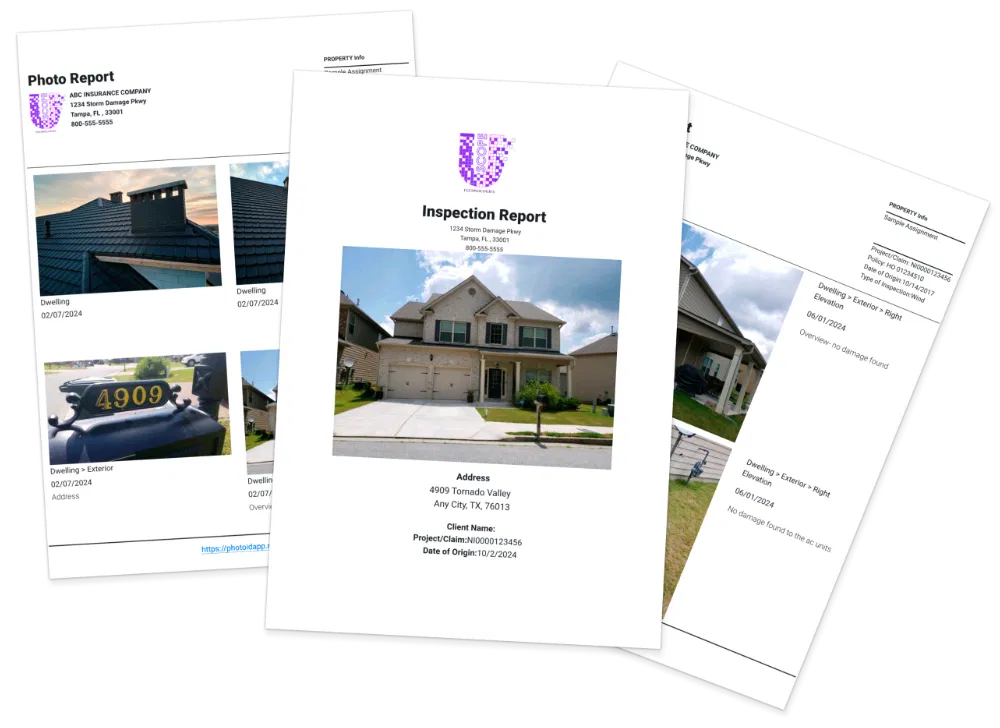
However, when you use a dedicated photo report app that generates organized, metadata-rich PDF reports, you’re doing their job for them.
- Standardized Workflows: You follow a template so nothing is missed.
- Instant Labeling: Photos are tagged with voice or text the moment they are taken.
- Defensible Data: Every photo has its location and time baked in.
When an adjuster opens a report generated by PHOTO iD, they see a professional, organized document that is easy to verify. The result? Fewer questions, fewer "supplements" for missing info, and much faster approvals. You’re not just an inspector; you’re a preferred partner.
5. Future-Proofing Against AI and "Deepfake" Skepticism
We are entering a weird era. AI can now generate a photo of a collapsed roof that looks 100% real. Because of this, insurance companies are becoming incredibly skeptical of any digital image.
In the near future, having a "pretty picture" won't be enough. You will need to prove the image hasn't been manipulated. This is where advanced metadata and secure cloud storage come into play.
By using insurance inspection software that captures images directly into a secure cloud environment, you create a "certified" capture. Since the image never sat on a local hard drive where it could be edited, its integrity is guaranteed.
Don't wait for the industry to demand this: start doing it now. Being the "tech-forward" pro in your market is a massive competitive advantage. While the other guy is struggling to explain why his photos look blurry and lack GPS tags, you’ll be closing your fifth deal of the day.
Stop Guessing. Start Documenting.
The "old way" of doing things: manually renaming files, dragging and dropping into Word docs, and hoping the carrier doesn't ask too many questions: is costing you time and money. It's creating a "data debt" that will eventually come due.
Switching to a professional workflow isn't just about "better photos." It's about building a defensible business.
At PHOTO iD by U Scope, we built our platform specifically to handle the heavy lifting of metadata and audit trails so you don't have to. From instant voice-labeling to automated GPS tagging and custom PDF reports, we give you the tools to look like the expert you are.
Ready to stop wasting 30-60 minutes per task on manual documentation?
Get Started with PHOTO iD for Free Today and see how easy it is to create defensible, professional reports in half the time.
Don't just take photos. Build a record that stands up to any scrutiny.
