
Why are you still losing three hours every night to manual photo labeling when the job was supposed to end at five? The inspection is the easy part, but the documentation is a chaotic bottleneck that leads to rejected claims and inconsistent reports. It is time to embrace inspection process automation to restore order to your onsite documentation! You deserve a workflow that moves as fast as you do.
This guide is your roadmap to mastering high-velocity digital workflows in 2026. You will learn how to transition from tedious manual logs to automated systems that slash reporting time and eliminate costly human error. We are talking about instant report generation, standardized photo documentation, and dramatically reduced cycle times for every claim. Stop settling for the after-hours grind and start delivering results with total precision.
Get ready to transform your field operations. We will dive into the latest FMCSA electronic reporting standards, voice-to-text labeling, and the digital tools that turn onsite chaos into professional excellence. It is time to capture, categorize, and complete your reports with total confidence!
Key Takeaways
- Distinguish between industrial machine vision and field-ready documentation automation to ensure you select the right tech stack for the jobsite.
- Leverage voice-to-text and computer vision to transform raw onsite data into structured, professional reports without typing a single word.
- Follow a proven 5-step implementation plan for inspection process automation to audit your current metrics and eliminate reporting bottlenecks.
- Learn to create custom inspection templates that guarantee consistent, high-quality documentation across your entire field team.
- Discover how instant photo report generation removes the burden of after-hours administrative work, letting you focus on the inspection itself.
What is Inspection Process Automation in the Field Context?
Forget the image of robotic arms on a assembly line. While manufacturing relies on Automated optical inspection (AOI) to scan circuit boards for microscopic defects, field professionals face a different beast. For you, inspection process automation is the high-speed engine that captures, labels, and organizes onsite data without manual intervention. It is the bridge between a physical site visit and a finished, professional report. It turns your mobile device into a powerful data processor that works as hard as you do.
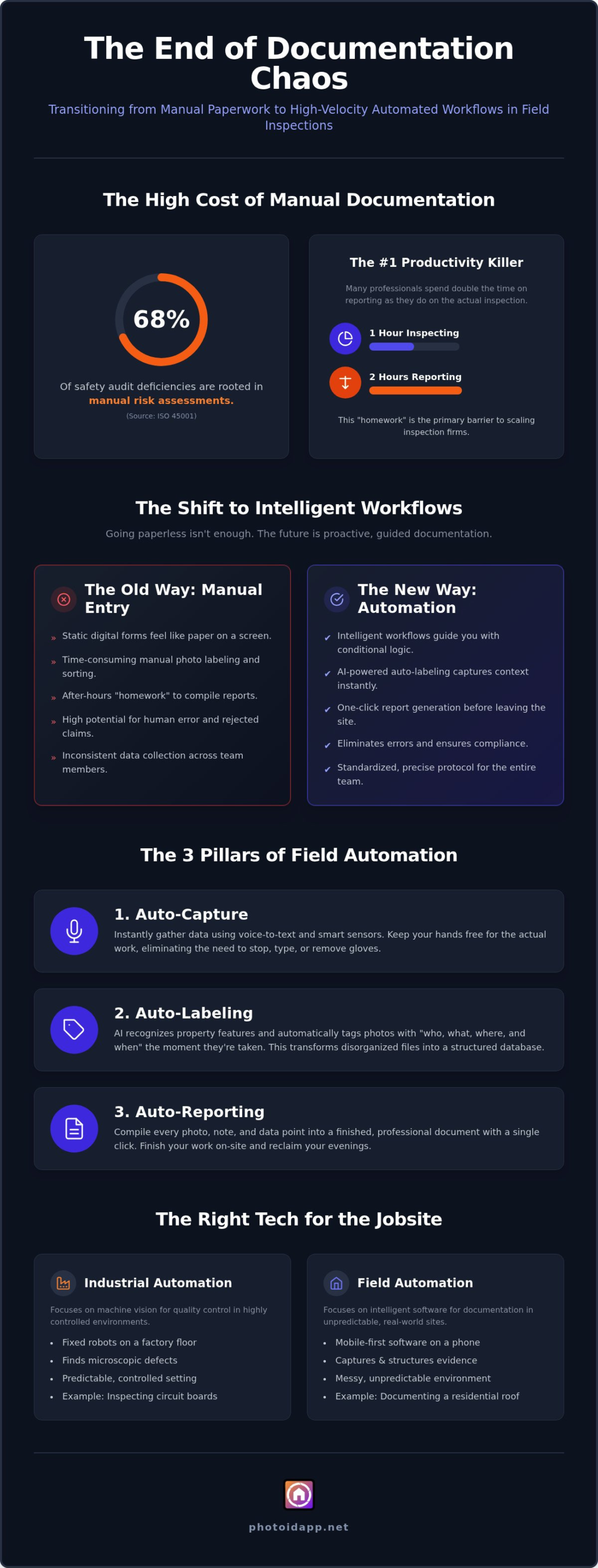
In 2026, we have reached a critical tipping point for the industry. The global inspection machines market is valued at $1.0855 billion this year, but the real power has shifted to mobile software. We have moved beyond simple digital forms and into the era of intelligent workflows. This transition is built on three unbreakable pillars. First, auto-capture ensures every data point is grabbed instantly. Second, auto-labeling uses AI to identify exactly what you’re looking at. Third, auto-reporting compiles everything into a client-ready document before you even leave the driveway. Capture. Categorize. Complete!
The Shift from Digital Forms to Intelligent Workflows
Stop thinking that “going paperless” is the finish line. A PDF on a tablet is just a digital version of a slow, manual process. Intelligent workflows are different. They use conditional logic to guide your team through complex sites in real time. If an inspector identifies hail damage, the software automatically triggers a specific set of required photos and measurements. This proactive guidance eliminates “missed shots” and ensures you never have to drive back to a site for a forgotten detail. It transforms your mobile device from a camera into a game-changing partner that enforces consistency across your entire team.
Why Manual Photo Entry is the #1 Productivity Killer
Manual documentation is a silent thief of your time and profit. Most field professionals spend two hours at a computer for every one hour spent on-site. This is the documentation bottleneck, and it is the primary barrier to scaling your inspection firm. Spending your evenings on “homework” isn’t just exhausting; it is expensive. When you spend hours typing labels and dragging files into folders, you aren’t being an expert; you’re being a data entry clerk. Automation restores order to this chaos. It lets you reclaim your nights, reduce cycle times, and focus on the specialized labor that actually pays the bills. Don’t let manual entry kill your momentum!
The Core Technologies Powering Modern Inspection Automation
Modern inspection process automation isn’t built on a single piece of software. It is a high-speed symphony of specialized technologies working in perfect synchronization. In 2026, the integration of AI and machine learning has moved from a luxury to a baseline requirement for field operations. These tools don’t just store data; they interpret it. They act as a digital partner that understands the difference between a minor scuff and a structural crack. This intelligence is what allows you to move from raw imagery to a finished report with zero manual friction.
Computer vision acts as your digital eyes, automatically recognizing property features like roof slopes, siding materials, and interior damage. This technology sorts your photos the moment you snap them, placing them into the correct categories without a single tap. Combined with real-time cloud synchronization, your data moves instantly from the jobsite to the home office. This connectivity ensures that your team management dashboard is always current, allowing for immediate oversight and faster decision-making. If you want to scale your business, you need these high-velocity documentation tools in your pocket today!
Voice-to-Text Labeling: The Hands-Free Revolution
Stop fumbling with your phone when you should be focusing on the inspection. Voice-to-text labeling is the ultimate hands-free solution for the mobile professional. You don’t have to remove your gloves or stop your momentum to type out descriptions. Simply speak, and the software converts your notes into structured, professional data. Unlike generic dictation tools, industry-specific NLP understands your jargon. It recognizes technical terms related to roofing, home inspections, and insurance claims. Learn more about How Voice-to-Text Labeling Speeds Up Field Inspections to see this tech in action. Speak, sort, and succeed!
Automated Photo Labeling and Organization
Your photos should tell a story, not create a puzzle. Automated photo labeling uses custom inspection templates to dictate the narrative of your report before you even start. Every image is automatically tagged with critical GPS metadata and timestamps, ensuring total compliance and transparency for every claim. This foundation is what makes instant report generation possible. By the time you walk back to your truck, the heavy lifting of organization is already done. It is the most efficient way to maintain a standardized documentation process across your entire team, regardless of their experience level. Capture the evidence and let the automation handle the rest!
Industrial vs. Field Automation: Choosing the Right Tech Stack
Don’t confuse shop-floor robotics with field-ready efficiency. While enterprise-grade industrial tools excel in climate-controlled factories, they usually fail the moment they hit the dirt. You need a tech stack built for the reality of the jobsite, not a laboratory. True inspection process automation in the field requires tools that are lightweight, resilient, and ready to work in the rain. Your equipment should survive a drop from a ladder, not require a clean-room environment.
Prioritize software over specialized, heavy hardware. Robotic scanners and high-end trackers are expensive, fragile, and impossible to lug through a crawlspace. Instead, lean into a SaaS-based mobile approach. It is faster to deploy, easier to update, and significantly more cost-effective than attempting a custom software build from scratch. Choose a partner that understands the daily grind of specialized labor. You need a tool that acts as a game-changing ally, not a technical liability that slows you down. High-velocity work demands high-velocity tools!
Mobile-First Automation for the Field
The smartphone in your pocket is the most powerful automation tool you own. It already has the GPS, high-resolution camera, and processing power required for high-velocity documentation. However, the software must be designed specifically for the field. Look for offline capability as a non-negotiable standard. You can’t stop working just because you’re in a remote basement or a post-disaster zone with no cell service. Additionally, utilize virtual inspection software to allow senior adjusters to provide remote oversight. This reduces travel costs and keeps your best experts focused on the most complex files without leaving the office. Capture the data, sync when you can, and keep moving!
Integration with Industry Standards (Xactimate & Verisk)
Your automation is only as good as its ability to talk to the rest of the industry. It must “speak the language” of claims by integrating with platforms like Xactimate and Verisk. When your documentation is standardized through inspection process automation, you eliminate the friction that causes administrative delays. Many industry professionals report that automated documentation helps reduce claim cycle times by up to 40%. This speed leads to faster approvals from carriers and significantly higher client satisfaction. Standardize your reports. Sync your data. Secure your profit!
5 Steps to Implement Automated Inspection Workflows
Implementing inspection process automation does not require a degree in software engineering. It is a practical transition that focuses on replacing manual friction with digital speed. Stop viewing automation as a complex IT project and start seeing it as a game-changing partner for your field crew. Follow these five steps to restore order to your documentation and reclaim your evenings.
- Audit your metrics: Track your current “Time-to-Report” for one week. Identify exactly where the bottleneck happens, whether it is photo labeling, sorting, or data entry.
- Standardize with templates: Build custom inspection templates before you deploy the tech. A standardized process ensures every team member captures the same high-quality data every time.
- Select a Tech Champion: Pick your most tech-savvy field professional to pilot the new workflow. Their success will drive adoption across the rest of the team.
- Centralize oversight: Connect your field data to a real-time team management dashboard. This eliminates individual silos and gives you instant project visibility.
- Automate the delivery: Use the “Instant Photo Report” feature to generate and send the final document to the client the moment the inspection ends.
Ready to eliminate the documentation bottleneck for good? Start your inspection process automation journey today and finish your first automated report in minutes!
Building Your Template Library
Your digital templates should do more than just collect data; they should “think” for your inspectors. By Building Custom Inspection Templates for Faster Reporting, you translate your years of expertise into a guided workflow. Use required fields to enforce 100% compliance on every jobsite. This prevents the dreaded “return trip” because an inspector forgot a critical shot. When the software guides the camera, the results are always consistent, professional, and ready for approval. Capture the right data the first time, every time!
The Role of the Team Management Dashboard
Real-time project oversight is the secret to scaling a modern inspection firm. Stop waiting for your team to return to the office to review their work. A centralized dashboard allows managers to review field photos and labels while the inspector is still on-site. This immediate feedback loop ensures accuracy and slashes cycle times. Explore the 5 Benefits of a Team Management Dashboard for Inspections to see how real-time data transforms your collaborative efficiency. Move from chaos to clarity with one centralized view!
PHOTO iD: The Solution for High-Velocity Documentation
Stop letting manual paperwork dictate your schedule. PHOTO iD is the specific answer to the documentation bottleneck that has historically crippled field growth. By centralizing every stage of the workflow into one mobile-first ecosystem, we provide the ultimate tool for inspection process automation. You don’t just need a camera; you need a game-changing partner that understands the high-velocity nature of your work. Restore order to your onsite documentation chaos today!
The Instant Photo Report generation is the crown jewel of this system. It represents the final stage of a truly automated workflow, where the data you capture is immediately ready for stakeholder review. Whether you’re conducting home inspections or adjusting complex insurance claims, the ability to deliver a professional, branded report before you leave the site is a massive competitive advantage. Combine this with our aerial roof and wall measurements to ensure every dimension is captured with total accuracy. One app. One workflow. One result!
Game-Changing Features for Field Pros
Our features are designed to eliminate friction at every turn. Voice-to-text labeling and automated organization turn spoken notes into structured data in seconds. You won’t have to spend hours at your computer dragging files or typing repetitive descriptions. The Custom Report Builder then takes that data and creates professional outputs that mirror your brand’s expertise. PHOTO iD acts as a game-changing partner for field adjusters who need to move from one job to the next without leaving a trail of unfinished paperwork. It is efficient, authoritative, and intensely practical!
Start Your Automation Journey Today
It is time for a mindset shift. Stop thinking about “doing inspections” and start “managing automated data.” The ROI of implementing inspection process automation is undeniable. By saving two to three hours on every report, you can increase your daily volume without increasing your stress. You’ll eliminate human error, reduce rejected claims, and provide a level of consistency that builds long-term trust with your clients. Don’t let the documentation bottleneck hold you back any longer. Revolutionize your inspection process with PHOTO iD and experience the power of high-velocity documentation today!
Master the Future of Field Documentation
The era of losing your evenings to manual photo labeling is over. By embracing inspection process automation, you transition from a data entry clerk back to a high-velocity field expert. You’ve seen how mobile-first tools, voice-to-text labeling, and intelligent templates eliminate the documentation bottleneck. These technologies don’t just save time; they restore order to your entire operation. It is time to work smarter, not harder!
Join the leading home inspectors and adjusters nationwide who have already reclaimed their freedom. Founded by “The Claims Coach” Ken Perry, our platform is built specifically for the daily grind of specialized labor and property assessment. Stop settling for slow, inconsistent reporting and start delivering instant results that command respect. Our instant report generation feature ensures you finish the job before you even leave the driveway. Capture the data, categorize the evidence, and complete the report!
Start Automating Your Inspection Reports with PHOTO iD
Take control of your workflow today. You have the tools, the plan, and the partner needed to succeed in 2026. Go out there and dominate the field with total confidence!
Frequently Asked Questions
What is the difference between digital inspections and automated inspections?
Digital inspections simply move paper forms to a mobile screen, but automated inspections remove the manual labor from the entire workflow. Digital still requires you to type labels and sort files manually. True inspection process automation uses AI to recognize features, apply labels, and generate reports instantly. It is the difference between having a digital clipboard and having a digital assistant that does your homework for you!
How much time can I really save with inspection process automation?
You can save approximately two hours of office work for every one hour spent in the field. By automating the documentation pipeline, you eliminate the “after-hours” workload of labeling photos and dragging files into folders. This efficiency allows you to increase your daily inspection volume without working longer hours. Stop being a data entry clerk and start being a high-velocity expert!
Does automated inspection software work without an internet connection?
Yes, professional automation tools are designed with a robust offline mode for remote or disaster-zone inspections. You can capture photos, use voice-to-text labeling, and follow your templates without any cellular service. The software stores all data locally on your device and automatically synchronizes with the cloud the moment you return to a stable connection. Never let a dead zone kill your productivity!
Can automated photo labeling integrate with Xactimate or Verisk?
Yes, automated documentation is designed to “speak the language” of the insurance industry. Professional apps integrate seamlessly with platforms like Xactimate and Verisk, allowing you to export standardized photo reports that adjusters can use immediately. This compatibility is a core component of inspection process automation, as it ensures your data flows directly into the claims ecosystem without manual re-formatting or administrative headaches.
Is voice-to-text labeling accurate enough for professional inspection reports?
Modern voice-to-text is incredibly accurate because it utilizes industry-specific Natural Language Processing (NLP). Unlike generic phone dictation, these tools recognize technical jargon related to roofing, home inspections, and structural damage. This ensures your labels are professional and precise. Simply speak your findings clearly, and the software will handle the transcription while you keep your eyes on the property and your hands on the ladder!
Do I need special cameras to use inspection automation apps?
No, you do not need expensive specialized hardware to implement automation. The high-resolution cameras and GPS sensors in modern smartphones are more than sufficient for professional-grade documentation. While some firms use inspection cameras or aerial drones for specific views, the primary automation happens within the software on your mobile device. Your phone is already the most powerful tool in your truck; you just need the right app!
How does automated documentation help with insurance claim approvals?
Automated documentation provides the transparency and standardization that carriers demand for fast approvals. Every photo is automatically tagged with GPS metadata and timestamps, creating an airtight audit trail that eliminates disputes. When your reports are consistent and professional, you build trust with adjusters and reduce the likelihood of rejected claims. Standardized data leads to faster payments and happier clients every time!
What is the best way to train a field team on new automation software?
The best way to train your team is to identify a “Tech Champion” who can lead by example. Start by standardizing your process with custom inspection templates so everyone follows the same path. Once your champion masters the workflow, have them train the rest of the crew in the field. Focus on the immediate benefit of “zero homework” to ensure high adoption rates and enthusiasm across the entire team!