
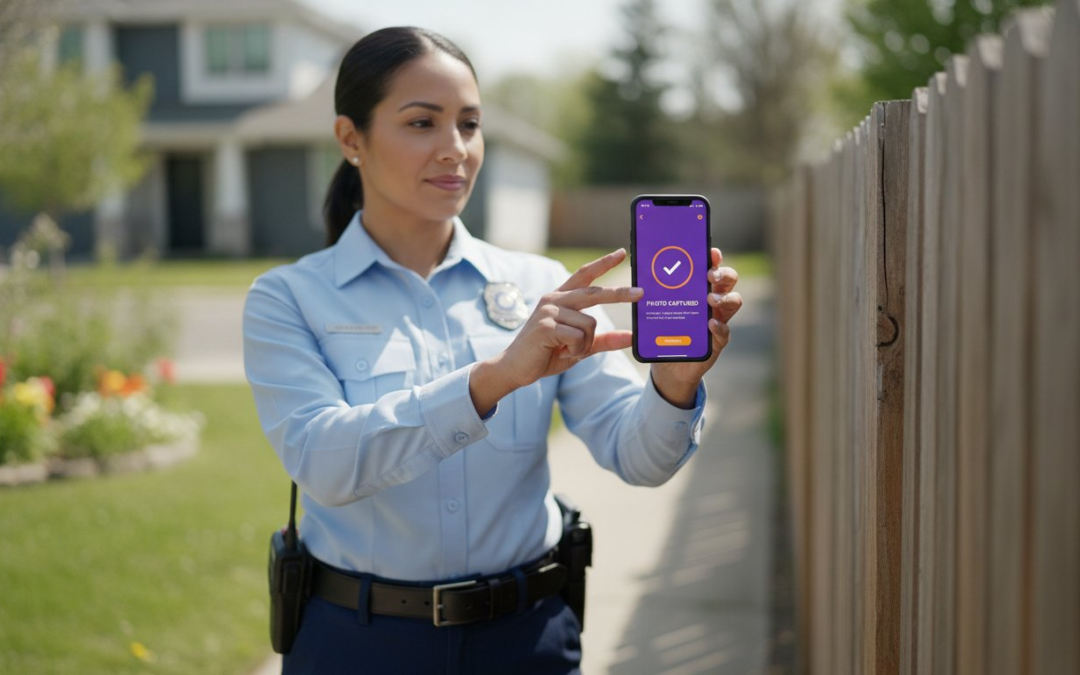
A single blurry photo can be the difference between a $1,000 city ordinance fine being upheld or tossed out of court. You know the frustration of documenting code violations with photos only to realize later that the images are mixed up or missing critical metadata. It is a tedious, manual grind that eats your evening and leaves your evidence vulnerable to legal challenges. You shouldn’t have to choose between thorough documentation and getting home on time. The mental load of organizing hundreds of files is a burden you no longer need to carry.
This guide changes the game. You’ll learn how to capture, organize, and label inspection photos that stand up to legal scrutiny while slashing your reporting time in half. We will show you how to build a self-labeling, metadata-rich evidence trail that eliminates office-side work entirely. From establishing shots to instant report generation, it is time to master a workflow that is fast, professional, and bulletproof. Get ready to reclaim your time and transform your field inspections into a seamless, digital powerhouse.
Key Takeaways
- Master the “Wide-to-Tight” sequence to capture context and specific defects that bridge the gap between technical citations and property owner understanding.
- Secure your evidence with tamper-proof timestamps and GPS metadata to ensure every violation stands up to legal scrutiny in court.
- Streamline your field inspections by documenting code violations with photos using standardized walking paths and mobile templates.
- Shut down property owner objections instantly by presenting real-time, geotagged evidence directly from the jobsite.
- Eliminate office-side reporting forever by using PHOTO iD to generate professional PDF inspection reports the moment you finish your walk.
Why Professional Photo Documentation is the Backbone of Code Enforcement
Documenting code violations with photos creates an objective, undeniable record. It freezes property conditions in time. A photo doesn’t just show a hole in a roof; it proves the history of neglect or compliance. This process bridges the gap between complex technical codes and what a layperson understands. When an owner sees a high-resolution image of a structural defect, the technical citation becomes a tangible reality. It’s about clarity, speed, and results.
High-quality visual evidence slashes the likelihood of contested violations. It’s hard to argue with a geotagged, timestamped photo. Chronological logs establish a clear pattern over time. They show if a property is deteriorating or if remediation efforts are actually working. This protects the inspector. It eliminates claims of bias by documenting the entire site context, not just the “bad” parts. You aren’t just taking pictures. You’re building an ironclad case file.
The Legal Weight of Visual Evidence
Courts rely on clarity. In property maintenance cases, your photos are your testimony. They must follow established legal principles of evidence to be defensible. Precise visuals support Notice of Violation (NOV) accuracy with indisputable proof. Use before and after photos to verify remediation. This closes cases faster. It moves the process from a messy dispute to a closed file. Capturing the right data points ensures your work stands up to the toughest legal scrutiny.
Protecting the Integrity of the Inspection
Standardize your photo logs to avoid claims of selective enforcement or bias. This isn’t just about the violations. When documenting code violations with photos, capture “no violation” zones to provide a complete and fair property context. If you encounter access limitations or safety hazards, document them immediately. This justifies skipped inspection areas and keeps your report professional. Use a consistent approach to ensure every site is treated with the same level of scrutiny.
- Document context: Show the whole property.
- Prove location: Use GPS and landmarks.
- Verify time: Use tamper-proof timestamps.
This level of detail protects your reputation. It ensures that every report you file is accurate, honest, and beyond reproach. By maintaining a standardized workflow, you eliminate the chaos of disorganized files. You transform your field work into a streamlined, digital asset that serves the community and the law with equal precision.
The Anatomy of a Defensible Violation Photo
Stop taking mystery photos. A close-up of a cracked foundation is worthless if you can’t prove which wall it’s on. Master the Wide-to-Tight sequence to ensure every shot counts. Start with a wide context shot of the property. Move to a medium shot to show the location of the defect. Finally, capture the tight macro shot of the violation itself. This progression creates an undeniable narrative for anyone reviewing the file. It turns a simple image into a piece of professional evidence.
Clarity is king. Use reference objects or scales to show the actual size of a violation. A three-inch gap looks different than a one-inch gap in a vacuum. Place a ruler or a standard reference tool in the frame to provide immediate scale. Don’t let poor lighting sabotage your work. When documenting code violations with photos in shadows or crawlspaces, use high-output flashes or external light sources. If the violation isn’t visible, it doesn’t exist in the eyes of the law. Capture. Contextualize. Confirm.
Essential Metadata for Compliance
Metadata is your digital fingerprint. When documenting code violations with photos, GPS geotagging is non-negotiable. This is especially true for multi-unit complexes or large commercial sites where one building looks exactly like the next. Hard-coded timestamps maintain the chain of evidence. They prove exactly when you were there. Following forensic imaging best practices ensures your digital files remain admissible and untampered. Leverage this data to automate your organization and save hours of manual sorting.
Framing the Violation for Clarity
Apply the Three-Photo Rule on every site. This simple workflow includes a context shot, a medium shot, and a macro close-up. The Context Shot serves as the anchor for all subsequent evidence. It identifies the property and the general area of concern. From there, your medium and macro shots drill down into the specifics. Avoid common mistakes like blurry images or shots without a clear point of focus. If you can’t see the defect clearly, neither can the judge. Using a professional photo app ensures your framing is sharp and your evidence is ready for the report.
Efficient Field Workflows for Documenting Violations
Efficiency in the field is a survival skill. If you take 200 photos per property and wait until you return to the office to organize them, you’re losing time. Documenting code violations with photos must be a real-time process. Adopt a standardized walking path. Start at the front curb, move clockwise around the exterior, and finish with the interior. This systematic approach ensures every code section is checked and every violation is captured without backtracking. You move faster. You miss nothing. You win.
When documenting code violations with photos, utilize mobile inspection templates to categorize your images as you take them. Instead of a messy camera roll, your images should land directly into folders labeled “Exterior Walls,” “Roofing,” or “Sanitation.” This eliminates the Office Trap. When you label in the field, the details are fresh. You don’t have to guess which window had the broken pane. You’ve already marked it. Leverage team dashboards for real-time oversight of large-scale projects. This allows supervisors to track progress and ensure quality control without leaving their desks.
The Power of Voice-to-Text Labeling
Speak your labels aloud. It’s significantly faster than typing on a small mobile screen. Voice-to-text labeling saves minutes per photo during the walkthrough. It reduces documentation errors because you record findings while the violation is right in front of you. These voice descriptions integrate directly into the metadata. This makes your photos instantly searchable by keyword. Search “structural cracks” and find every relevant image in seconds. Speed is your greatest asset in the field.
Using Custom Inspection Templates
Consistency is the foundation of a defensible report. Build your templates based on International Property Maintenance Code (IPMC) standards. This ensures your entire team follows the same protocol across every property. Standardized reports prevent gaps in evidence and protect against claims of inconsistency. These templates guide inspectors to capture mandatory shots for specific violation types automatically. If the code requires specific angles, the app prompts for them. It’s a fail-safe system that guarantees professional results every time.
- Standardize: Use IPMC-aligned templates.
- Label: Use voice-to-text for instant clarity.
- Sync: Use dashboards for team-wide visibility.
Overcoming Common Documentation Challenges and Disputes
Inspections aren’t just technical; they’re often interpersonal. Tensions rise when property owners feel targeted or misunderstood. You need a way to diffuse these objections before they escalate into formal appeals. Present real-time, geotagged evidence on-site. Show the owner exactly where the violation exists on their digital map. This transparency builds immediate trust. It shifts the conversation from a heated argument to a clear, data-driven reality. Documenting code violations with photos becomes your most powerful negotiation tool during every walkthrough.
Managing high data volume is the next hurdle for the modern professional. Complex commercial inspections or multi-family housing projects generate thousands of files. You can’t afford to lose a single image to a hardware glitch or a sync error. Prevent data loss with secure cloud backups that save your work as you go. This ensures your progress is protected even if your device fails in the field. Track long-term remediation with Work in Progress (WIP) documentation. This chronological trail proves whether an owner is making a good-faith effort or simply stalling for time. Capture, sync, and defend your findings with total confidence.
Dealing with Contested Violations
Owners often claim a violation was already fixed or never existed. Use time-stamped evidence to disprove these claims instantly. Professional, labeled photo logs build massive credibility with judges and hearing officers. They see a systematic process rather than a collection of random snapshots. When you enter an administrative hearing with an organized report, you tell a story that is impossible to ignore. It shows you are an expert who values precision, fairness, and facts. Stop the guesswork and start winning your cases with ironclad visual proof.
Managing Massive Data Volume
Stop the nightmare of manual folder organization. You shouldn’t spend your evening renaming files or dragging images into subfolders. Automated systems ensure office staff see violations before you even leave the site. This real-time visibility speeds up the entire enforcement cycle. Find any specific violation photo among thousands using keyword-based search. If a supervisor asks for proof of a specific structural crack from six months ago, you can pull it up in seconds. Organize, search, and succeed! Efficiency is not a luxury; it is a requirement for modern enforcement agencies.
Equip yourself with a professional photo app to handle these high-pressure moments and high-volume projects with ease.
Automating Your Reports with PHOTO iD
Stop the manual grind. You have spent the day in the field documenting code violations with photos. You have captured the evidence. Now, let the technology finish the job. PHOTO iD is the specialized partner you need for automated site documentation. It transforms your raw images into professional PDF reports instantly. No more office work. No more manual labeling. Just pure efficiency. You provide the expertise; the software provides the structure.
Utilize advanced voice-to-text labeling to eliminate manual typing entirely. Speak your findings as you see them. Watch the labels appear in real time. Move to the next violation without breaking your stride. It is that simple. Manage your entire team through a centralized dashboard for full project oversight. Gain total visibility into every inspection without leaving your vehicle. You stay in control while the software handles the heavy lifting. No more late nights. No more reporting stress. No more lost data.
Built for the Field Professional
Leverage a tool designed by industry veteran Ken Perry for real-world conditions. This is not a generic app built by people who have never stepped onto a jobsite. It is a precision instrument built for the specialized labor and assessment industries. Integrate it seamlessly with your current protocol using custom inspection templates. Empower your team to produce defensible, labeled reports without the administrative overhead. Your expertise belongs in the field, not behind a desk. Restore order to the chaos of onsite documentation with a partner that understands your daily grind.
Get Started with Smarter Documentation
Reduce your inspection cycle times by automating the busiest parts of your day. Every minute saved in the office is a minute you can spend closing cases or getting home to your family. Adopt the Capture, Label, Report mantra for maximum efficiency! This three-part process ensures every site walk is productive and every report is perfect. It is time to work smarter, move faster, and deliver results that stand up to any challenge. Don’t let paperwork slow you down. Experience the relief of technological efficiency today!
Transform your code enforcement workflow with PHOTO iD today!
Reclaim Your Time and Protect Your Evidence
Professional reporting shouldn’t be a source of stress. You’ve learned how the right metadata and systematic framing create bulletproof evidence. Mastering the art of documenting code violations with photos ensures your findings are legally defensible and professionally organized. By adopting standardized workflows and ditching manual labeling, you eliminate the chaos that slows down enforcement. It is about speed, precision, and professional integrity.
Now it’s time to put these tools into action. PHOTO iD was designed by industry veteran Ken Perry to meet the specific needs of field professionals like you. With automated voice-to-text labeling and instant professional report generation, you can finally say goodbye to the office grind. Capture. Label. Report! It’s a simple mantra for a modern, high-velocity workflow that restores order to your day.
Start your PHOTO iD subscription and automate your inspection reports!
Stop settling for slow, manual processes. Take control of your documentation and watch your productivity soar. You have the expertise; now get the partner that works as hard as you do! Experience the relief of technological efficiency today!
Frequently Asked Questions
How many photos are typically needed to document a single code violation?
You need at least three photos for a single violation: a context shot, a medium shot, and a macro close-up. This “Three-Photo Rule” ensures that anyone reviewing the file can see the property address, the location of the defect, and the specific code violation clearly. Capturing multiple angles prevents disputes and provides a complete narrative of the site conditions without leaving room for interpretation.
Can I use my regular phone camera app for code enforcement documentation?
You shouldn’t rely on a regular phone camera app for professional documentation. Standard apps lack the ability to hard-code GPS data and timestamps directly into the image file. They also force you to manually organize and label every photo later in the office. Using a specialized app ensures that documenting code violations with photos is organized from the moment you tap the shutter.
What is the best way to label photos while wearing gloves or in the rain?
Voice-to-text labeling is the best way to document findings in harsh weather or while wearing gear. You don’t have to fumble with a touchscreen or remove your gloves. Simply speak your observations aloud to create instant, accurate labels. This keeps your momentum high and your hands free for safety while navigating a jobsite in the rain. It’s about maintaining speed regardless of the environment.
How do I ensure my violation photos are legally defensible in court?
Ensure your photos are legally defensible by including tamper-proof metadata and clear context. Every image must have a hard-coded timestamp and GPS coordinates to prove the exact time and location of the inspection. Avoid mystery close-ups. Always link the specific defect back to the property with a wide-angle establishing shot that identifies the building and street address clearly.
What metadata is most important for property inspection photos?
GPS coordinates and tamper-proof timestamps are the most critical metadata points for property inspection photos. These digital signatures verify that you were physically present at the site on the date reported. User ID data is also vital for team accountability. This information creates a secure chain of evidence that is much harder for opposing parties to challenge during a municipal hearing or administrative review.
How does automated photo labeling save time compared to manual entry?
Automated photo labeling saves hours by eliminating the need for manual data entry back at the office. Instead of renaming files and dragging them into folders, the app categorizes them as you walk. This allows for instant report generation the moment you finish your inspection. You get home faster while your reports remain more accurate and professional than manual logs ever could be.
Is cloud storage necessary for code enforcement photo logs?
Cloud storage is essential for maintaining secure, accessible photo logs. It prevents data loss if your mobile device is damaged or lost on a jobsite. Cloud-based systems also allow office staff to view findings in real time. This speeds up the enforcement process and ensures that your entire team has access to the latest evidence without the need for manual file transfers or emails.
What should I do if a property owner refuses to let me take photos?
If a property owner refuses access, you should document the refusal and take photos from public property. Generally, you can legally photograph anything visible from the street or public sidewalk. Never enter a restricted area without a warrant or permission. Documenting code violations with photos from a public vantage point provides the evidence you need while keeping you safe and compliant with local privacy laws.