

Quality disputes often start before the work does. Avoiding client disputes over work quality begins with agreeing on standards, scope, deadlines, and change procedures before a project starts. Put decisions and approvals in writing, respond promptly to concerns, and address problems without blame.
Even solid work can frustrate a client when expectations and results do not match. Make the target visible, keep communication moving, and maintain a reliable record of what was agreed and completed. Set clear quality criteria, document project details, handle concerns constructively, and apologize accountably when something goes wrong. These steps help resolve misunderstandings early and keep the work and client relationship on track.
Key Takeaways
- Set understandable quality criteria before work begins, and agree on how updates and changes will be communicated.
- When a client raises a concern, respond promptly, hear their perspective, and focus the conversation on a practical resolution.
- Record the scope, responsibilities, payment terms, deadlines, and approvals in writing to keep project expectations clear.
- If something goes wrong, acknowledge the client’s experience without shifting blame, then explain the steps you’ll take to address it.
1. Transparent communication and expectation management
Mediation, arbitration, and small-claims court have no single typical total cost. Expenses depend on mediator or arbitrator fees, filing charges, case complexity, preparation time, and whether either party has legal representation.
Refusing revisions, withholding payment, or ending a project can escalate a quality dispute. Each action may conflict with written terms or lead to claims about incomplete work, unpaid invoices, or unauthorized changes. Before acting, compare the complaint with the agreement, document the issue, and propose a resolution in writing.
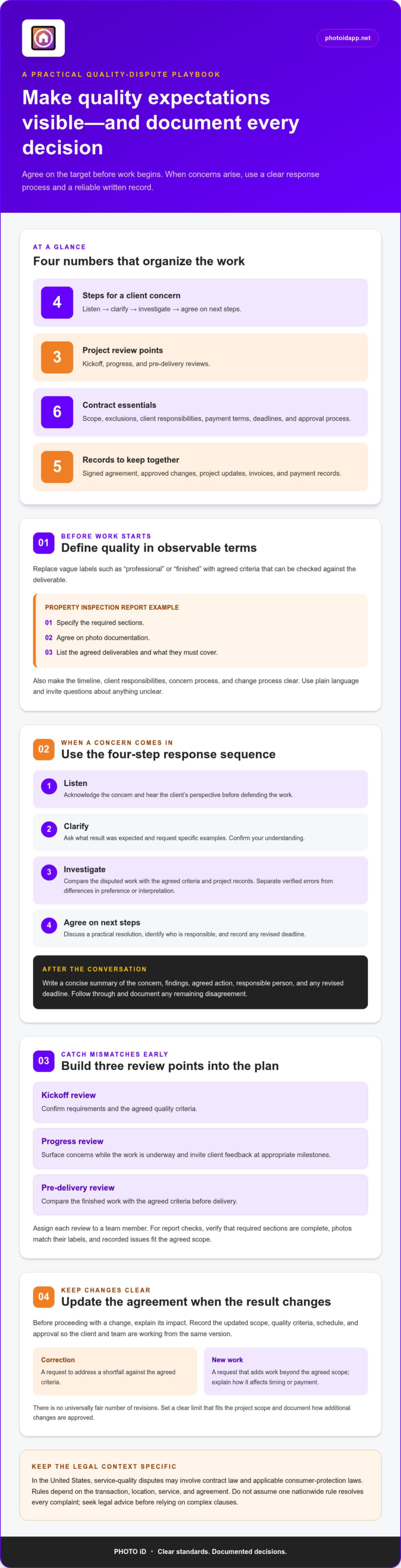
Set expectations before work starts. Describe the deliverable, quality criteria, timeline, client responsibilities, and process for concerns or changes. For example, define what a complete property inspection report includes, such as the areas, observations, and photos it must cover. Use plain language and invite the client to clarify anything that is unclear.
Agree on communication routines, too. Identify the main contact, choose a channel, and set expectations for progress updates. After an important call, send a written recap of decisions, assigned actions, and deadlines. Keep it with the signed agreement, approved changes, project updates, invoices, and payment records.
Make quality checks repeatable. Freelancers and agencies can turn each agreed criterion into a checklist item. For a report, verify that required sections are complete, photos match their labels, and recorded issues fit the agreed scope. Record the reviewer, findings, corrections, and final approval. Check the finished work against the list before delivery, then share relevant results with the client.
When a change affects the result, explain the impact before proceeding. Update the scope, quality criteria, schedule, and approval record so the client and team work from the same version. This practical process supports avoiding client disputes over work quality by replacing assumptions with visible standards and documented decisions.
There is no standard total cost. Expenses vary with mediator or arbitrator fees, filing charges, case complexity, preparation time, and legal representation.
2. Responding quickly to client concerns
A client raising a quality problem needs a clear response, not silence or an immediate defense. Acknowledge the concern, ask what result they expected, and invite specific examples. For instance, ask which report section or completed task differs from the agreed outcome. Confirm your understanding before discussing causes or solutions.
Use a simple response sequence: listen, clarify, investigate, and agree on next steps. Review the project records and compare the disputed work with the agreed criteria. If the concern involves a property inspection report, examine the specific observation, supporting photo, and report entry together. Separate verified errors from differences in preference or interpretation.
Discuss the issue directly when a conversation could clear up confusion. A meeting lets both sides explain their views and consider a practical correction. Afterward, send a concise written summary of the concern, findings, agreed action, responsible person, and any revised deadline. Stay professional, even when you disagree. Use evidence to explain your position calmly.
Catch problems before final delivery by building review points into the project plan. For example, use a kickoff review to confirm requirements, a progress review to surface concerns, and a pre-delivery review to compare finished work with the agreed criteria. Assign each review to a team member and invite client feedback at appropriate milestones. These checkpoints make it easier to discuss corrections while work is underway.
If a client says the result misses expectations, ask what outcome would address the concern. Distinguish requested corrections from new work, explain the options, and record the agreed resolution. Follow through, share the result, and document any remaining disagreement. Prompt, specific communication offers a way forward before frustration grows into a larger dispute.
Contractors should respond promptly and start a constructive conversation focused on a solution. When a client raises a problem, ask for their perspective and how they would like the situation resolved. These questions keep the discussion grounded in the client’s experience and desired outcome.
Listen before discussing a possible response, and use the conversation to understand what resolution the client considers useful. A calm, solution-focused exchange can help both sides identify a next step without turning the initial concern into an argument.
3. Using a contract to record project details
In the United States, service-quality disputes may involve contract law and applicable consumer-protection laws. The rules depend on the transaction, location, service, and agreement, so do not assume one nationwide rule resolves every complaint. Put project terms in writing and seek legal advice before relying on complex clauses.
Define quality through observable criteria, not labels such as “professional” or “finished.” For a property inspection report, specify required sections, photo documentation, and agreed deliverables. State the scope, exclusions, client responsibilities, payment terms, deadlines, and approval process. Then define acceptance criteria: what must be present, how the client reviews it, and how either party records approval or a specific defect.
Make revisions predictable. The contract should explain how clients submit requests, how you determine whether a request corrects an agreed shortfall or adds new work, and how that decision affects timing or payment. There is no universally fair number of revisions. Set a clear limit that fits the project scope, then explain how additional changes are approved and documented.
For quality disagreements, set out a practical resolution path. The contract can require written notice describing the concern, a review of the disputed work, and a good-faith discussion before mediation or arbitration. Identify how the parties select a neutral, where proceedings take place, and how applicable fees are handled. Small-claims court may also be relevant, depending on the claim and local rules. Have a qualified attorney review dispute-resolution terms.
Keep the signed agreement with approved change requests, work records, and acceptance notes. For example, if a client requests additional inspection photos, record the request, revised scope, and approval before doing the extra work. Save the final deliverable alongside the client’s response. A clear paper trail helps both sides assess what was promised, changed, delivered, and accepted.
Disputes are assessed under the parties’ contract and any consumer-protection rules that apply to the transaction and location. The service and agreement help determine which rules are relevant.
4. Apologizing without blaming others
When a client describes a poor experience, start by acknowledging it from their perspective. Say, “I’m sorry this caused frustration,” rather than opening with a defense. This recognizes the impact without asserting facts you have not investigated or assigning fault prematurely.
Then take ownership of the response. You might say, “I’ll review the report and the agreed requirements, then explain what I find.” That commits you to a specific action, not a conclusion. Avoid blaming a subcontractor, colleague, supplier, or client. Even if someone else contributed, focus on understanding the issue and coordinating a fix.
Investigate before promising a remedy. Compare the client’s example with the approved scope, relevant work records, and quality criteria. If a property report contains a mislabeled photo, identify the affected section, establish how the error occurred, and determine the correction needed. Keep the explanation factual. Do not minimize the concern or argue about the client’s feelings.
After reviewing the evidence, explain the next step plainly. For example: “The photo label doesn’t match the observation. I’ll correct the entry and send the revised report for review.” If the concern reflects a preference outside the agreed scope, explain the difference respectfully and discuss options before starting extra work. Record the client’s approval and any revised project details.
Close the loop. Send the correction, confirm what changed, and ask whether the specific concern is resolved. If it is not, invite the client to identify what remains outstanding and continue the review. Document the apology, findings, agreed remedy, and follow-up. This record helps your team learn from the incident without turning the apology into a search for someone to blame.
Make clear visual records part of that follow-through. Use organized inspection photos to help your team review documented work and address client concerns with specific examples.
A measured apology shows concern for the client without claiming responsibility before the facts are clear. Avoiding blame keeps the response focused on resolving the complaint.
PHOTO iD: PHOTO iD Mobile App Subscription
PHOTO iD Mobile App Subscription supports organized inspection documentation when clear, consistent records matter. Automated Photo Labeling organizes images, while Instant Photo Report Generation turns documented photos into reports. Custom Inspection Templates structure inspection information around project requirements. Together, these tools help field professionals keep visual records easier to review and share.
Consider PHOTO iD when your inspection workflow relies on photos and repeatable reporting. Use templates to guide documentation, label images for clear reference, and generate reports from the photos you collect. These tools support an organized record of completed work, making it easier to discuss observations with clients using specific documentation.
Visit photoidapp.net to explore PHOTO iD.
Build a stronger process with every project
Make your next project a fresh start. Define what good work looks like before kickoff, then build review and documentation into the workflow. A brief alignment check can reveal a gap while there is still time to clarify expectations. Treat each completed job as a chance to improve how your team communicates, records decisions, and handles concerns. Avoiding client disputes over work quality depends on repeatable habits, not memory or good intentions.
PHOTO iD offers a PHOTO iD Mobile App Subscription, Automated Photo Labeling, and Instant Photo Report Generation. These tools help organize inspection photos and make reporting part of a consistent documentation process. Choose a workflow that fits how your team captures and shares project information, then refine it as you learn what clients need to see.
Contact PHOTO iD today to explore a practical next step for your inspection documentation. Clear processes start with one deliberate change, and you can put that change to work on your next project.
Frequently Asked Questions
What should a project scope and statement of work include to prevent quality disputes?
Include enough detail for both parties to recognize the agreed result. Describe each deliverable, exclusion, responsibility, dependency, and applicable quality standard. For a design project, for example, identify the required file formats and intended use, not just “finished artwork.” Distinguish approval to begin from acceptance of completed work so each decision has a clear meaning.
How should businesses document client approvals, feedback, revisions, and change requests?
Keep a dated record connecting each decision to the relevant deliverable and version. Note who approved it, what they approved, and any conditions or requested edits. For example, replace “looks good” with a recap that identifies the specific draft and approved elements. Track revision status and preserve the client’s original feedback alongside your response, final file, and any written change authorization.