

For U.S. federal contracts, progress payments are generally calculated at 80% of total incurred costs, subject to the contract’s conditions, according to the Federal Acquisition Regulatory Council. To document work for progress payments, connect each claimed cost to the contract, the work performed, and clear supporting records. Private construction contracts may instead base payments on completed work, milestones, quantities, or an agreed billing schedule.
A progress payment application can stall when costs, field progress, and supporting records do not line up. Clear documentation shows what work is complete, what was spent, and how you calculated the requested amount.
This article explains how construction progress payments work and what to include in an application, from schedule-of-values details to progress photos and retainage. You’ll also learn how incurred costs inform a federal progress-payment calculation, how prior payments affect the amount due, and how organized field records help reviewers follow the numbers.
Key Takeaways
- Match documented work to contract line items so reviewers can see what was completed and avoid billing disputes.
- Understand how the contract’s pricing structure affects the calculation, including how incurred costs shape federal progress payments.
- Build a stronger payment application with organized cost records, progress evidence, approved changes, and a clear payment summary.
- Use PHOTO iD Mobile App Subscription to label inspection photos and generate reports that make field documentation easier to organize.
What Is a Progress Payment in Construction?
Construction progress payments are partial payments for work completed during a project. Contracts may tie them to milestones, measured quantities, percentage completion, or an agreed billing schedule. For example, a contract can set payment milestones at 25%, 50%, and 75% completion. The schedule defines what qualifies as earned work and when the contractor can submit a pay application.
Subcontractors should document each completed scope item against the general contractor’s schedule of values. Record the work location, completion status, supporting photos or reports, and any quantities used to calculate the invoice. Submit this evidence with the pay application so the general contractor can compare the claim with conditions in the field.
A schedule of values divides the contract into defined work categories, each with an assigned value. Track completion by line item, not just for the project overall. For example, report completed site work separately from framing that is still underway. This makes earned value easier to review and helps prevent billing for unfinished work.
Field verification connects the application to the work actually completed. The project manager or designated reviewer can compare reported quantities, dated photos, and progress reports with visible conditions. Document the review by identifying which line items are supported, which need correction, and whether each claimed percentage matches completed work. Keep any revisions traceable to the relevant billing period.
To prevent overbilling disputes, separate completed work from stored materials, pending changes, and future tasks. For each invoice line, show both the work completed during the current period and cumulative completion to date. Compare these figures with previous applications before submitting. If a reviewer disputes a percentage, location-specific records and dated evidence can clarify what was complete at billing time.
For U.S. federal contracts, the estimate to complete must be developed or updated within six months of a progress-payment request, according to the Federal Acquisition Regulatory Council. This estimate gives reviewers context for incurred costs and remaining work. Keep it aligned with current reports, approved changes, and the contract’s defined scope.
Contract pricing structures and progress billing
Contract terms determine whether billing is based on costs, milestones, quantities, or measured work. State prompt-payment laws and retainage rules vary by jurisdiction, so applicable statutes and contract terms govern payment deadlines, notices, and withheld amounts.
Line-Item Progress Billing
A schedule of values divides the contract into priced work items, giving each line a basis for progress billing. Track actual completed work against each item, then bill only the supported portion. Under FAR 52.232-16, the U.S. Government generally computes federal contract progress payments at 80 percent of the contractor’s total incurred costs, subject to the clause’s conditions, according to the Federal Acquisition Regulatory Council. This cost-based approach differs from billing solely by milestones.
Avoiding Progress-Billing Documentation Mistakes
Documentation mistakes include billing uncompleted work, using inconsistent line-item descriptions, and carrying forward amounts already billed. Reconcile each application with the contract terms, prior billing, current work, and approved changes. Under FAR 52.232-16, federal contract progress payments may not exceed 80 percent of the total contract price, according to the Federal Acquisition Regulatory Council. For a U.S. federal contract with a small business concern using Alternate I to FAR 52.232-16, the customary progress-payment rate is 85 percent, according to the Federal Acquisition Regulatory Council. Keep waivers aligned with the applicable payment period.
Submission and Approval Deadlines
Submission and approval deadlines establish when the contractor bills and when the reviewer processes the request. For federal contracts, the Federal Acquisition Regulatory Council says contractors must submit progress-payment requests on Standard Form 1443 or its electronic equivalent as required by agency regulations. For private projects, compare the application cycle, required attachments, review steps, and payment terms in the signed contract. A single intake format helps reviewers identify missing cost support or unresolved changes before approval. Consistent report layouts can help keep those records organized as billing moves through review.
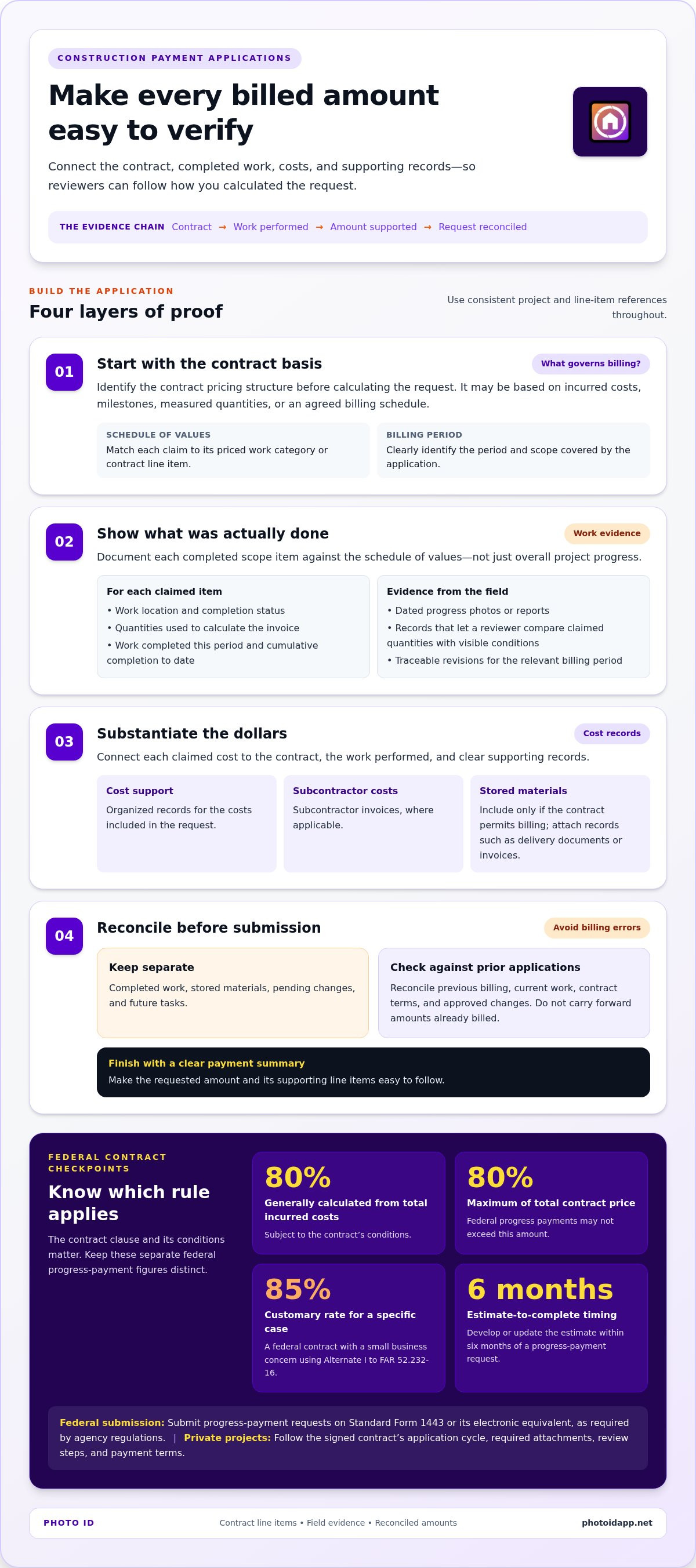
Payment applications and supporting documentation
A pay application turns completed construction work into a documented payment request. Owners and general contractors use its line items and supporting records to verify the amount billed. Knowing how to document work for progress payments starts with matching each claim to clear project records.
Pay Applications and Construction Draw Requests
A pay application, sometimes called a construction draw request, summarizes the amount requested for work completed during a billing period. Subcontractors submit it to the general contractor, who reviews the scope, amounts, and supporting records before approving or forwarding it. Follow the contract’s billing cycle and clearly identify the period and scope, so reviewers can distinguish current work from earlier requests.
Supporting Pay Application Documents
Supporting documents substantiate the work and amounts described in the application. Attach progress photos or reports, subcontractor invoices where applicable, approved change orders, and records for stored materials if the contract permits billing for them. Include delivery records or invoices for those materials. Use consistent project and line-item references so reviewers can match each attachment to the claimed work.
AIA G702 and G703 Forms
AIA G702 summarizes the payment application and contractor’s certification, while AIA G703 provides continuation details for the schedule of values. Together, the forms organize current billing, prior payments, completed work, and retainage. Check that totals on G703 reconcile with the G702 summary before submission. If the contract uses another form, follow its required layout and include equivalent supporting details.
Schedules of Values in Pay Applications
A schedule of values allocates the contract sum across defined work items, giving every billed amount a traceable basis. To document work for progress payments, track each line’s previously completed value, work completed this period, and cumulative progress. Compare those entries with field reports and approved orders before submitting, so owners can verify the application without confusing new charges with earlier billing.
What are the deadlines and payment terms for submitting and approving progress payment requests?
Contract terms set the submission cycle, required records, review process, and payment deadline. Map the key dates from the contract calendar: identify the cutoff, assemble the application, submit it through the required channel, and track approval. A complete request gives the reviewer what they need to assess billed work and identify missing support.
Under FAR 52.232-16, the U.S. federal framework governs progress payments, while the specific contract and agency procedures guide the request’s submission details. Use the required form and attachments, and retain proof of delivery so the submission date is clear.
Under FAR 52.232-16, the U.S. federal government’s default progress-payment due date is the 30th day after the designated billing office receives a proper request, unless the agency head prescribes another date, according to the Federal Acquisition Regulatory Council. The receipt date and proper-request status matter. A missing attachment or incomplete field can affect whether the request qualifies as proper for processing.
For private construction contracts, review the payment clause for the application deadline, reviewer, approval steps, and due-date trigger. Note whether the payment clock starts at submission, certification, or receipt of a complete application. Track each stage in a billing log: submitted, returned for correction, approved, and paid. This makes delays visible and helps the team respond to a specific outstanding item.
Before each cutoff, compare the application with the contract’s required supporting documents, prior billing, and approved changes. Assign one person to reconcile totals and another to confirm field records. Keep dated submission receipts and written review comments together. A consistent file makes it easier to show when the request was received and what remains unresolved.
Keep field evidence organized for each billing cycle with tools for inspection documentation by PHOTO iD, so records are ready to support timely applications.
PHOTO iD: PHOTO iD Mobile App Subscription
The PHOTO iD mobile app helps teams organize inspection photos and turn field records into reports. Automated photo labeling keeps images associated with the right inspection details, and instant report generation supports project documentation. Custom inspection templates structure the information captured in the field, making records easier to review alongside payment applications.
Use PHOTO iD when field photos and notes are difficult to organize into consistent documentation. Clearly labeled images and organized reports help reviewers understand the work shown, while contract records and cost documentation support the payment amount. Keep the evidence connected: field records show progress, and the application explains the billing.
Contact PHOTO iD to learn more about using its mobile app for inspection documentation.
Make Documentation Part of the Workday
Make documentation part of the job, rather than a scramble before billing. Decide who captures field evidence, who reviews it, and where approved records are stored. Build those actions into the daily workflow so project information stays current as work progresses.
A consistent routine also helps onboard new staff and keep project records clear when responsibilities shift. The practical answer to how to document work for progress payments is to capture evidence close to the work, keep it organized, and assign clear ownership. Small field habits can support smoother coordination across the project team.
If you want to explore a field-documentation workflow with PHOTO iD, contact PHOTO iD to discuss your needs. Choose a process your team can use consistently, then keep building on it. Clear records start with a steady habit, and your next workday is a good time to begin.
Frequently Asked Questions
What documents are required to support a progress payment application?
Include the payment application, schedule of values, billing summary, and evidence supporting the amount requested. Depending on the contract, supporting documents may include progress reports, site photos, subcontractor invoices, approved change orders, retainage calculations, lien waivers, or records for stored materials. Label attachments by project and line item, then reconcile totals before submission. This makes every claimed amount easier to trace during review.
How do you prepare a schedule of values for progress billing?
Break the contract sum into distinct, identifiable scopes, such as site preparation, concrete, and framing. Assign each scope a value that matches the agreed work breakdown, then track prior billing, current-period work, and cumulative completion for every line. Use descriptions specific enough to compare with field records. Avoid combining unrelated tasks, so reviewers can see what each billed amount represents.
How do you calculate the percentage of work completed for a progress payment?
Use the measurement method specified in the contract. For quantity-based work, divide the accepted quantity completed by the total quantity in that line item. For a value-based item, compare the supported value of completed work with its scheduled value. For example, count installed units against the contract quantity. Keep incurred costs distinct from physical completion unless the contract uses a cost-based method.
What evidence proves work is complete, such as photos, inspection reports, or timesheets?
Use evidence that connects the claimed scope to its location, timing, and completion status. Dated photos should provide enough context to identify the area, while inspection reports can record observed conditions or accepted work. Timesheets support labor charges—which independent subcontractors often organize alongside their billing using Timebook—and delivery records document materials. Match each record to the relevant pay application item. A photo may show progress, but not establish quantity or contractual acceptance on its own.
What are typical progress payment application forms, such as AIA G702 and G703?
AIA G702 and G703 are commonly used together: G702 presents the payment application summary, and G703 lists continuation details by schedule-of-values item. ConsensusDocs 710 is another standardized subcontractor payment application form. The contract identifies the required format and any supplemental attachments. Before using a form, align its fields with the project’s billing categories so reviewers can reconcile totals and supporting records efficiently.
How should change orders, credits, and disputed work be documented in a payment application?
Show approved change orders as separate, traceable entries and attach the approval record. Record credits as distinct adjustments with a brief explanation and supporting documents, rather than silently reducing another line. Identify disputed work separately and preserve relevant correspondence, field notes, and photos. Do not present a pending change as payable unless it is approved or leadership explicitly authorizes an exception.