
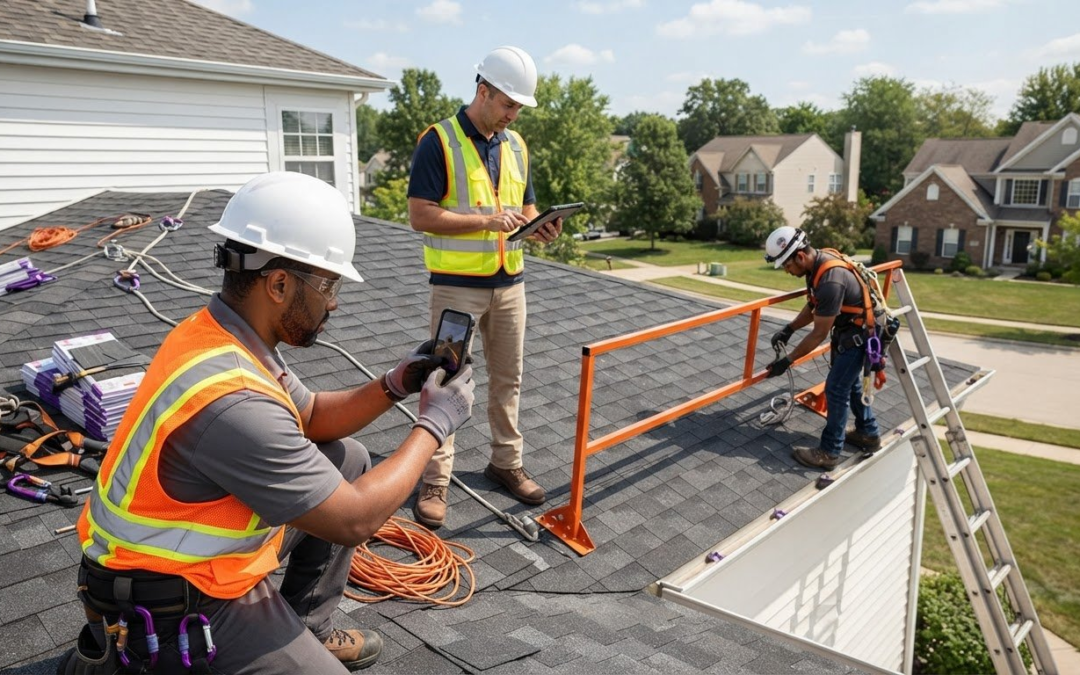
A useful safety record does more than identify a hazard: it shows what happened, where it happened, who saw it, and what changed afterward. To learn how to document safety violations on site, record the date, time, location, and conditions; add clear photos or diagrams, witness details, and any injury or near-miss information. Then report the issue promptly and track who is responsible for the correction.
Field notes can become scattered, vague, or disconnected from the photos that explain them. A consistent record makes a hazard easier to understand, supports timely follow-up, and helps teams assess whether corrective action addressed the cause.
This guide covers a practical process: inspect the site, capture clear evidence, gather witness accounts, report the concern, and document corrective actions. You’ll also learn how to organize records and communicate outstanding issues, so each report gives your team a clear next step.
Key Takeaways
- Inspect tools, equipment, and work areas systematically, and record hazards before conditions change.
- Build a clear evidence trail with precise locations, photographs, and witness accounts.
- Report unsafe conditions promptly and understand the available options for raising a concern.
- Look beyond the immediate hazard to identify its cause and whether similar conditions exist elsewhere.
- Document who owns each correction, what action is planned, and how the team will confirm the issue is resolved.
Inspecting tools, equipment, and site conditions
Reporting requirements vary by state and industry. Federal OSHA standards, OSHA-approved State Plans, and state recordkeeping rules may apply differently depending on your jurisdiction. While federal OSHA maintains broad oversight, local public-sector projects may be governed by distinct state-level agencies rather than federal guidelines.
- Set the inspection route. Start with active work zones, access points, tools, machinery, and temporary structures. Follow the sequence workers use to do their tasks instead of inspecting only from the perimeter. For example, trace a material lift from loading through travel and unloading. Note the area, task, equipment involved, and workers exposed. Following the work helps reveal hazards caused by the interaction between equipment and site conditions.
- Check equipment in operation. Look for damaged guards, exposed moving parts, unstable setups, blocked controls, and visible defects. Record the tool or equipment identifier, its location and condition, and the task underway. Compare what you observe with the written safety program and actual work practices. If a hazard could cause an accident or serious injury, document the exposure and promptly alert the responsible supervisor.
- Assess the wider work area. Inspect walking surfaces, access routes, material storage, overhead work, and changing site conditions. Construction employers must provide fall protection for employees exposed to heights of six feet or more, according to the Occupational Safety and Health Administration (OSHA). Record the location and work activity when a guardrail, cover, or other protection appears missing. Revisit affected areas after site conditions change, such as when crews move equipment or materials.
- Capture findings clearly. For each hazard, record what you saw, where it was, what task was underway, and which workers were exposed. Add photographs or a diagram if they clarify the condition. Separate direct observations from information provided by another worker. Note whether the hazard is still present, whether work has stopped, and who received the report. A precise inspection record helps reviewers understand the issue without guessing about the scene.
- Understand the inspection pathway. Workers who believe a serious hazard exists or an employer is not following OSHA standards may file a confidential safety and health complaint and request a workplace inspection. OSHA reviews complaints, and a signed complaint is more likely to result in an onsite inspection. Be sure to keep any applicable local or state-specific recordkeeping and walkaround requirements distinct from standard federal OSHA procedures in your documentation.
- Record the compliance stakes accurately. OSHA lists a maximum penalty of $16,550 per violation for a serious violation. The Occupational Safety and Health Administration (OSHA) also lists a maximum penalty of $165,514 per violation for a willful or repeated violation. These figures reinforce why inspection notes should identify the condition and its location precisely, rather than make unsupported conclusions about how a violation should be classified.
Reporting unsafe or unhealthy workplace conditions
Use a clear reporting process: alert the responsible person, preserve evidence, and organize the records. For serious incidents, act promptly and distinguish immediate hazard reports from required injury reporting.
-
Report Hazards to a Supervisor or OSHA
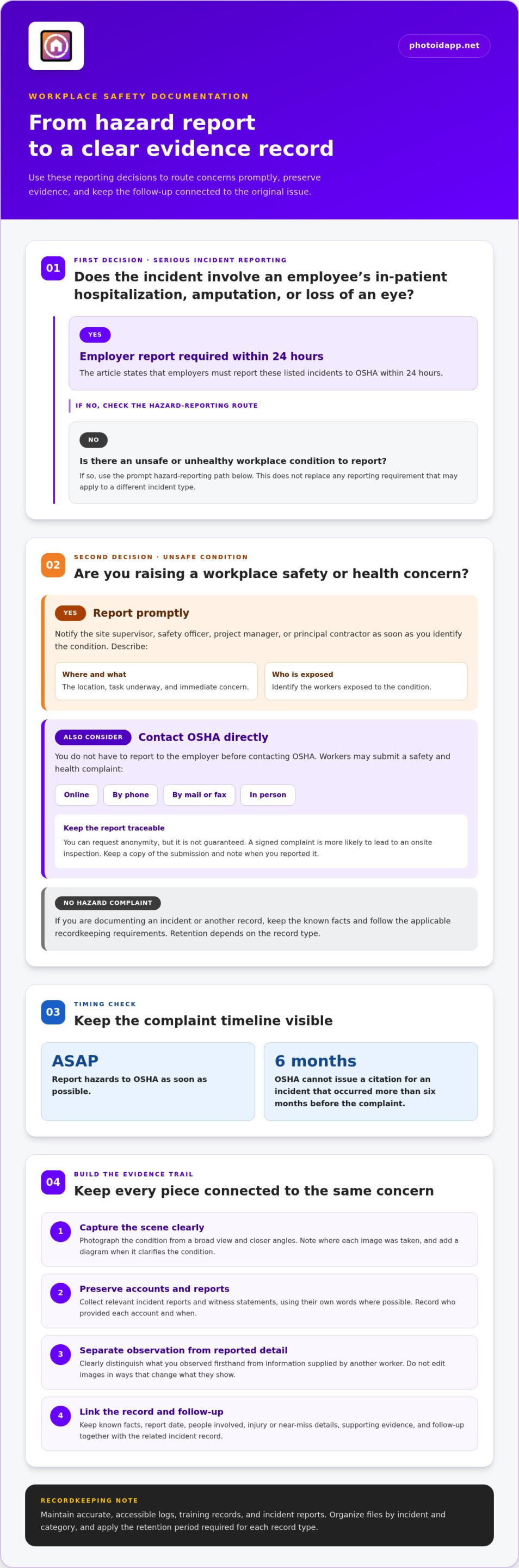
Notify the site supervisor, safety officer, project manager, or principal contractor as soon as you identify an unsafe condition. Describe the location, task, workers exposed, and immediate concern. You do not have to report to the employer before contacting OSHA.
Workers may submit an OSHA safety and health complaint online, by phone, by mail or fax, or in person. They can request anonymity, but it isn’t guaranteed. A signed complaint is more likely to lead to an onsite inspection. Keep a copy of the submission and note when you reported it.
-
Collect Photos, Reports, and Witness Accounts
Gather supporting evidence while the scene is clear and safe to document. Photograph the condition from a broad view and closer angles, and note where each image was taken. Collect relevant incident reports and witness statements, using their own words where possible.
Separate firsthand observations from details supplied by others. Record who provided each account and when, then link the material to the same hazard or incident record. Don’t edit images in ways that change what they show. A consistent evidence file helps explain the condition and supports follow-up.
-
Document Logs and Incident Records
Maintain accurate, accessible OSHA logs, training records, and incident reports. Include known facts, the report date, the people involved, and any follow-up. Keep injury and near-miss details with the related incident record, along with supporting photos and witness accounts.
How long should workplace safety violation records be kept? Retain each record for the period required by the applicable recordkeeping rule; the requirement depends on the record type. Organize files by incident and category so staff can find them. Don’t assume every document has the same retention period.
-
Check Reporting Requirements and Timing
For an employee’s in-patient hospitalization, amputation, or loss of an eye, employers must report the incident within 24 hours, according to the Occupational Safety and Health Administration (OSHA). Workers should report hazards to OSHA as soon as possible; OSHA cannot issue a citation for an incident that occurred more than six months before the complaint.
What are OSHA’s documentation and reporting requirements? Keep accurate, accessible records and report covered incidents promptly; workers may also file a safety and health complaint about hazards. Report serious hazards immediately through the workplace process, then document the response. The deadline for filing an OSHA whistleblower complaint is 30 to 180 days, depending on the applicable statute, according to the U.S. Department of Labor. Raise suspected retaliation through a separate whistleblower complaint within the applicable deadline.
Recording hazards with dates, locations, photographs, and witness statements
Protect worker privacy by documenting the condition and exposure, not unrelated personal details. When possible, frame photos to avoid faces, badges, and private information. For teams documenting safety violations on site, keep identifying witness details in a restricted record and share them only with people handling the report.
- Build a precise incident record. Write the date, time, exact location, and work activity underway. Describe the hazard in observable terms, such as an uncovered floor opening beside a work area. Note who recorded it and which workers may have been exposed. Keep facts separate from conclusions about causes or responsibility. A reliable documentation process links each observation to a specific place and task.
- Photograph the condition from useful angles. Take a wide view that establishes the location, followed by closer images showing the unsafe detail. Include nearby landmarks or equipment when they help locate the issue. Add a diagram if a photo can’t clearly show the scene. Don’t stage the hazard, move equipment, or capture unrelated personal information. Label each image with its location and incident reference.
- Capture witness accounts accurately. Ask witnesses to describe what they personally saw, heard, or did. Securely record identifying details and when each account was provided. Use direct quotations for important observations, and don’t combine separate recollections into one statement. For example, distinguish a worker who saw a guard missing from someone who learned about it afterward.
- Connect evidence to corrective actions. Record who will address the hazard, what action they plan to take, and the expected completion point. If a crew removes debris from an access route, document the change and who completed the work. Keep the original condition record alongside the correction record. This creates a clear timeline and helps show whether the action addressed the unsafe condition.
- Verify abatement before closing the record. Revisit the location after the correction or review clear evidence that the work is complete. Compare the new condition with the original photos and description. Note any remaining exposure, temporary controls, or outstanding work. Employers should follow abatement deadlines and document corrective actions for cited hazards. Don’t mark a hazard resolved solely because someone says action was taken.
Common examples include fall exposures, struck-by risks near moving equipment, and missing protective measures. Keep each record factual and accessible to the people responsible for follow-up.
Communicating violations and corrective actions
- Send a direct, factual report. Identify the hazard, exact location, task, and workers exposed. State what you observed, not what you assume caused it. Attach the relevant record or photo, and describe any immediate protection already in place. For example, report an unguarded opening near an active work area and identify who received the notice. Clear wording helps supervisors understand the concern and decide what needs attention first.
- Assign a responsible person and action. Document who owns the correction, what they will do, and which steps they must follow. Specify whether the action addresses the hazard itself or only temporarily limits exposure. For a blocked access route, name the person responsible for clearing it and recording the completed work. Don’t leave responsibility with “the crew” or “management.” Naming an owner makes follow-up clear.
- Set the response and share the status. Communicate the expected completion point and how workers will learn about changes. In the complaint-response process described, an employer has five days to inspect the workplace, identify problems, and explain in writing how the employer plans to fix them. Keep the inspection findings and written response together. Tell affected workers about temporary controls and any changes to work procedures.
- Match the correction to the hazard. Where possible, choose an action that removes the unsafe condition rather than relying only on reminders. If equipment lacks a guard, address the guard before treating the issue as resolved. Record interim protection separately from the lasting correction. Compare the planned action with applicable safety and health standards, and explain any remaining exposure in plain language.
- Verify completion and close the loop. Recheck the work area, review evidence of the correction, and record who verified the result. If the repair is incomplete, identify the outstanding task and update the responsible person. Share the final status with workers affected by the hazard. Keep the original report, response, corrective actions, and verification connected, so a later reviewer can follow the sequence without relying on memory.
- Keep communications professional and consistent. Use the same incident reference across messages, reports, and follow-up notes. Separate documented facts from opinions, and avoid blaming workers before the circumstances are reviewed. If a concern involves possible noncompliance with Occupational Safety and Health Administration (OSHA) standards, describe the observed condition and the response. This creates a traceable record of the concern, decisions, and actions.
Identifying the root cause and extent of violations
Look beyond the immediate condition. A useful review connects what happened, why it happened, and where the same exposure could occur again.
- Separate observations from conclusions. Start with the documented condition, task, location, and people exposed. Then list possible contributing factors without presenting a theory as proven. For example, a missing machine guard is an observed condition; removal during maintenance is a possible cause. Keep the statements distinct until records, work procedures, and worker accounts support a conclusion.
- Trace how the hazard developed. Review the work sequence, equipment condition, maintenance history, instructions, and supervision. Ask what changed before the unsafe condition appeared. In construction, a temporary barrier might have been moved to bring materials through, then left down. Check who needed access and whether the work plan addressed restoring the barrier.
- Check training and actual work practices. Compare written procedures with what workers were taught and what the task required. Employers must ensure proper training and supervision. OSHA inspectors may interview workers to assess their understanding of workplace hazards and procedures. Record differences between the written rule and observed conduct, such as a required equipment check that workers weren’t taught to perform.
- Determine the full extent of exposure. Look for the same condition in other work areas, equipment, crews, or task stages. If one access route lacks protection, inspect comparable routes and areas where materials are moved. Note where the hazard exists, who may encounter it, and whether work continues nearby. This scope check helps employers address a recurring system problem, not just one visible spot.
- Review records for patterns. Compare incident reports, inspection notes, maintenance records, and training documentation related to the condition. Repeated reports about the same equipment or procedure can point to a process weakness. Record the dates and source documents, then explain how each item relates to the possible cause. Don’t treat missing paperwork alone as proof that an action never occurred.
- Keep findings fair and traceable. Give workers a chance to describe the task and conditions without blame. Preserve their reporting rights, distinguish firsthand accounts from secondhand information, and limit access to sensitive records. A signed OSHA complaint is more likely to result in an onsite inspection, but internal cause analysis should still rely on evidence. State what remains unresolved and who will investigate it.
- Turn the cause into prevention. Recommend actions that address the underlying process, such as revising a work sequence, restoring equipment safeguards, or improving task-specific instruction. Assign an owner and document how the change will be checked. For a clearer evidence trail, organize inspection findings and photos in a consistent record that supports review and follow-up.
PHOTO iD: PHOTO iD Mobile App Subscription
PHOTO iD helps teams organize inspection photos and turn field documentation into clear reports. With the PHOTO iD Mobile App Subscription, capture inspection information and use Automated Photo Labeling to keep images connected to their details. Custom Inspection Templates structure recurring inspections, while Instant Photo Report Generation compiles findings for review. The app’s voice-to-text labeling and real-time collaboration tools can also support field teams documenting hazards and corrective actions. Keep records factual, and ensure every report reflects what was observed and verified. Explore PHOTO iD’s mobile app subscription to make your documentation process more organized.
Make Strong Documentation Part of Every Site Routine
Knowing how to document safety violations on site gives your team a repeatable way to turn observations into informed action. Make the process part of everyday work so records remain useful after a hazard is spotted. Consistent documentation helps teams compare conditions over time, identify recurring issues, and connect follow-up to the original finding.
PHOTO iD supports field documentation with its PHOTO iD Mobile App Subscription, Automated Photo Labeling, and Instant Photo Report Generation. These tools organize inspection photos and compile findings into reports, giving teams a clearer record to review and share. Use them to support your process while grounding observations and corrective-action decisions in what happened on site.
Ready to bring more structure to your inspection documentation? Contact PHOTO iD to explore a practical next step for your team. Build a clearer record, strengthen follow-through, and keep moving forward with confidence.
Frequently Asked Questions
What details should be included when documenting a workplace safety violation?
Include the date, time, exact location, condition observed, work activity, and people who may have been exposed. Add the equipment or area involved, along with any injury or near-miss details. For example, describe a loose handrail on a specific stairway during material movement rather than writing “unsafe access.” Keep observations separate from assumptions, and identify who recorded the report.
How do you photograph and record safety hazards on a worksite?
Take a context photo first, followed by closer images that show the hazard clearly. Include a fixed landmark, such as a doorway or equipment label, to help locate the scene later. Add the capture time, area, and a short factual caption. Avoid photographing unrelated personal details. If one image can’t show the hazard’s layout, add a simple diagram and label the relevant points.
What forms or logs are used to report safety violations?
Use the workplace incident or hazard report, and attach photos or witness statements when relevant. Employers should also maintain accurate, accessible OSHA logs, training records, and incident reports. Workers who want OSHA to review a concern can submit a safety and health complaint through the eComplaint Form or another accepted method. Keep a copy of each submission with its date and related evidence.
How should workers report safety violations to a supervisor or safety officer?
Tell the supervisor or safety officer what the hazard is, where it is, and which task or workers it affects. Give a concise example, such as a damaged ladder at the loading area, then provide a written report so the concern is traceable. Ask that the report be recorded and keep your own copy. Workers can also file an OSHA complaint without first notifying the employer.
What should you do if a supervisor ignores a documented safety violation?
If the hazard remains, submit a safety and health complaint to OSHA and include the worksite location, employer details, hazard description, and supporting records. Workers may request that OSHA keep their names anonymous, though anonymity isn’t guaranteed. If reporting leads to retaliation, file a separate whistleblower complaint. The U.S. Department of Labor says the deadline is 30 to 180 days, depending on the applicable statute.