
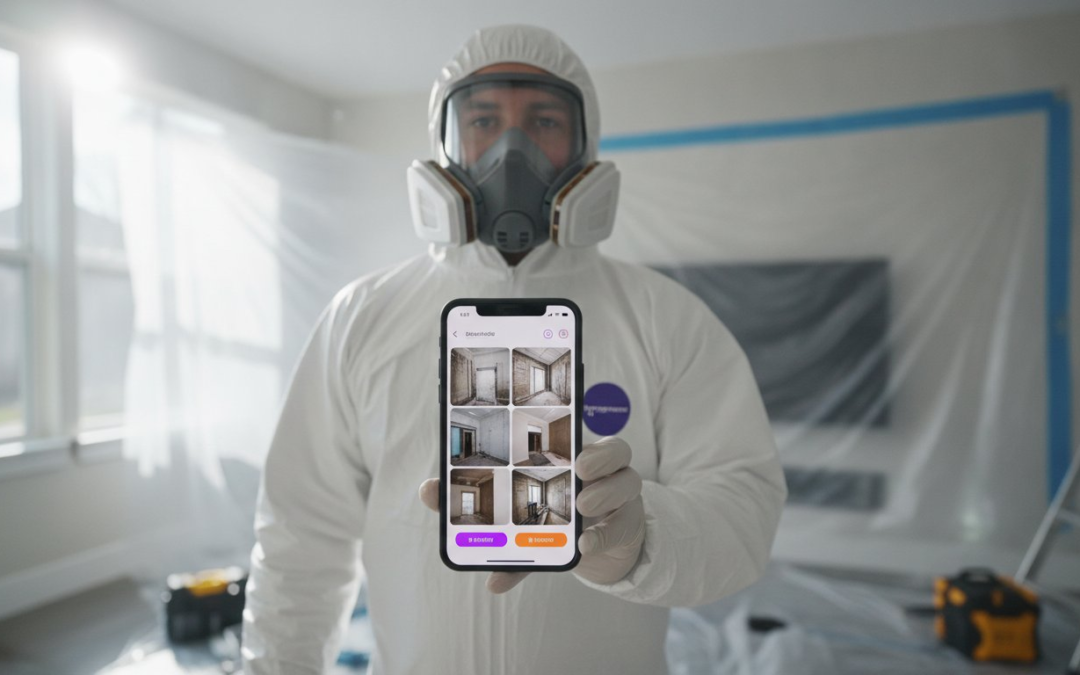
Nearly 47% of residential buildings in the U.S. have visible mold or a detectable odor, yet a single missing photo can still sink your entire insurance claim. You know the frustration of finishing a grueling job only to spend hours in the office labeling blurry images. It’s a bottleneck that drains your energy and delays your paycheck. Mastering how to document mold remediation isn’t just about taking pictures; it’s about building a legal and financial fortress around your work. Stop letting paperwork eat your profits.
We understand the pressure of new 2026 regulations like the MOLD Act and Connecticut’s strict IICRC S520 mandates. This guide provides a professional blueprint to master high-velocity documentation workflows. You will learn to satisfy insurance carriers, protect against liability, and close claims 40% faster. We’ll cover everything from standardized field processes to instant report generation. Get ready to transform your onsite chaos into digital order. Capture, label, and report with total confidence. Let’s turn your documentation from a post-job chore into a real-time defense strategy.
Key Takeaways
- Understand why adherence to the ANSI/IICRC S520 Standard and the 2026 MOLD Act is now a critical legal requirement for professional contractors.
- Learn exactly how to document mold remediation in real-time to eliminate the hours spent manually labeling photos back at the office.
- Identify the specific visual evidence and data points required to satisfy insurance adjusters and secure full claim approval without delays.
- Discover how to implement high-velocity workflows that allow your field teams to close mold claims up to 40% faster.
- Master a standardized, repeatable documentation protocol that protects your business from liability and ensures consistency across every job site.
The Critical Role of Documentation in Mold Remediation
Professional documentation is the backbone of your business. It is a comprehensive legal and financial record that proves your value. In 2026, the industry mantra is absolute: if it isn’t documented, it didn’t happen. Mastering how to document mold remediation transforms your field work into a defensible asset. The shift toward digital-first standards is here. It’s fast, efficient, and mandatory. Quality documentation doesn’t just look good; it directly dictates your insurance claim approval rates. With new federal mandates like the MOLD Act coming into play, your records are now subject to higher scrutiny than ever before. Without bulletproof evidence, you’re working for free.
Mitigating Liability and Legal Risks
Liability is a constant shadow on every remediation project. Detailed photo logs act as your primary defense against “hidden mold” lawsuits that can surface years after the job is closed. You must document existing conditions before your crew touches a single wall. This sets a clear baseline and protects your team from being blamed for pre-existing structural issues. Establish a clear chain of custody for every site photo, voice note, and moisture reading. This level of precision ensures that your data is admissible and undeniable in any legal setting. Consulting a Mold Remediation Overview reinforces the importance of following strict assessment and cleanup protocols to avoid long-term exposure. Capture the truth. Protect your brand. Secure your future.
Meeting Insurance Carrier Requirements
Insurance carriers reject claims for one primary reason: insufficient evidence. Adjusters are looking for specific proof of containment, air filtration, and post-remediation verification. If your records are disorganized, your claims will be denied. A professional mold remediation report must align with the ANSI/IICRC S520 Standard to be accepted. This standard is the benchmark for the 2026 market, especially with new state laws in places like Connecticut requiring strict adherence. When you master how to document mold remediation, you provide the exact data points adjusters need to hit the “approve” button. It’s about speed and accuracy. Clear records reduce friction, eliminate endless emails, and get you paid 40% faster. Don’t leave your revenue to chance. Document with intent. Deliver with data. Close with confidence.
The Anatomy of a Professional Mold Documentation Protocol
Every remediation file is a story. It needs a clear beginning, middle, and end. Your core components must include initial assessment data, daily progress logs, and final clearance results. Stakeholders like insurance adjusters, industrial hygienists, and property owners will scrutinize every pixel of your report. They want to see the “why” behind your invoice. Understanding how to document mold remediation requires a shift from taking random snapshots to creating a structured narrative. Update your site logs daily. Real-time data prevents disputes, builds trust, and keeps the project moving toward closure. Don’t wait until the job is done to start your paperwork.
Visual Evidence and Photo Sequences
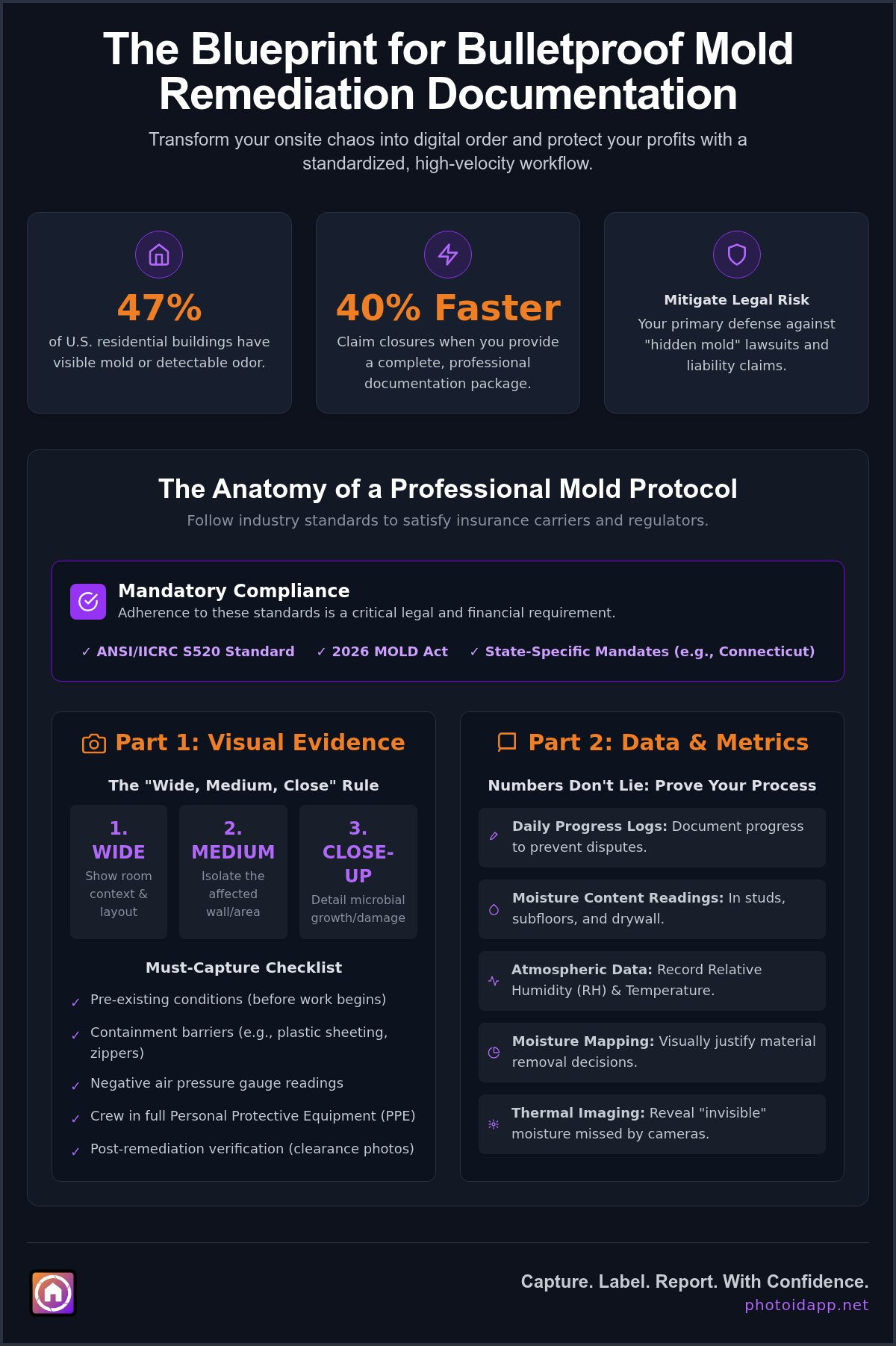
Follow the “Wide, Medium, Close” rule for every affected area. Start with a wide shot to show the room’s context. Move to a medium shot to identify the specific assembly or wall section. Finish with a close-up to reveal the microbial growth or structural damage. This sequence leaves no room for interpretation. Document your containment barriers and negative air pressure gauges to prove you followed University Mold Remediation Guidelines for safety and cross-contamination control. Don’t forget worker safety. Capture photos of your crew in full PPE. It proves compliance and protects your business from future health-related claims. Capture it. Tag it. Done.
Atmospheric and Moisture Data
Numbers don’t lie. Record relative humidity (RH) and temperature readings at every site visit. Document the moisture content in studs, subfloors, and drywall using calibrated meters. Use moisture mapping to visually justify why you removed certain materials or kept others in place. Thermal imaging photos add a layer of professional depth that adjusters love. They show the “invisible” moisture that traditional cameras miss. When you provide this level of detail, you eliminate guesswork and stop claim denials in their tracks. If you want to simplify this entire process for your team, consider using a professional photo documentation app to keep your data organized from day one.
Consistency is king. Whether you have one crew or ten, the protocol must be identical. Standardize your workflow to ensure every job file looks like it was created by an expert. This level of detail isn’t just a best practice; it’s your primary defense. High-quality data closes claims. Low-quality data creates headaches. Choose the data. Build the report. Get paid faster.
Manual vs. Automated Documentation: Solving the Bottleneck
Manual documentation is a silent profit killer. Every hour your technicians spend sorting through messy camera rolls is an hour you can’t bill. This administrative bottleneck is the primary hidden cost of the old way. In 2026, the industry benchmark is High-Velocity Documentation. It’s about capturing data once and never touching it again. You might think your crew will resist new tech, but the opposite is true. They hate office work as much as you do. Give them a tool that eliminates the paperwork, and they’ll never go back. Mastering how to document mold remediation means moving at the speed of the job site. Stop the bleeding. Start the automation.
The Failure of Traditional Photo Management
Disorganized camera rolls are a liability nightmare. When photos live on personal devices, you lose control of your data. Security risks skyrocket. Vital evidence gets lost in the shuffle. A single missing photo of a containment barrier or a negative air machine can lead to a rejected insurance claim. You spend hours at the kitchen table trying to remember which blurry stud belongs to which job. It’s exhausting. It’s inefficient. It’s dangerous. Traditional management fails because it relies on human memory, and memory fades under pressure. You need a system that works as hard as your crew does.
The Power of Automated Photo Labeling
Automated labeling provides instant context. Every photo is tagged the moment it’s taken. With voice-to-text technology, technicians can narrate their findings while wearing full PPE. This is a total game-changer for field efficiency. Your office sees the data in real-time. There’s no more waiting for the crew to return to the shop to sync files. This transparency ensures you meet the strict administrative procedures of the IICRC S520 Mold Remediation Standard without the manual grind. High-impact reporting becomes a byproduct of the work, not a separate task. Capture. Label. Sync. It’s that simple. When you understand how to document mold remediation with automation, you restore order to the onsite chaos. You protect your time. You grow your business. You win the claim.
Step-by-Step: Capturing the Remediation Journey
Standardize your field operations now. Every crew must follow the same path to ensure consistency and defense. Documentation isn’t an afterthought; it’s the evidence that gets you paid. Mastering how to document mold remediation means integrating these steps into your physical labor. Move from intake to clearance with a structured plan. Defensive documentation anticipates the carrier’s questions before they even ask. It eliminates friction. It builds trust. It secures your revenue. Stop guessing and start following a repeatable roadmap for every job site.
Phase 1: Pre-Remediation and Intake
Capture the source of moisture immediately. You must show the leak, the flood, or the condensation point. Document the full extent of visible growth with precision. Use moisture maps to visualize the damage inside the walls. Always photograph unaffected rooms. This proves you didn’t cause cross-contamination during the project. These initial records set the baseline for the entire claim. Without a clear “before” story, your “after” results carry less weight. Establish the truth from day one.
Phase 2: Execution and Containment
Document your containment build-out with total transparency. Show the plastic, the tape, and the HEPA filtration units in action. Capture “during” photos of material removal and cleaning as they happen. This is where most contractors fail. They do the work but forget to prove it. Log daily atmospheric readings to demonstrate drying progress. This data proves you maintained control of the environment and followed professional protocols. If you want to make this process seamless for your technicians, use the PHOTO iD Mobile App to capture and label these stages in real-time.
Phase 3: Post-Remediation Verification (PRV)
Final cleaning is your last chance for proof. Document the application of any encapsulants or antimicrobial treatments. Capture the independent third-party clearance testing process. This is your ultimate shield against future liability. Once the site is cleared, generate the final Certificate of Completion report instantly. A professional report delivered the moment the job ends is the hallmark of an elite contractor. For example, Dryrite Restoration exemplifies this standard by providing comprehensive documentation that ensures every project meets high safety and quality benchmarks. Close the loop. Finalize the file. Get paid. Your remediation journey is only as strong as the data you leave behind.
PHOTO iD is your game-changing partner in the field. It bridges the gap between physical labor and professional reporting by automating the most tedious parts of the job. If you want to master how to document mold remediation without the administrative headache, this is the solution. It turns hours of office work into minutes of onsite efficiency. Stop the documentation bottleneck. Start the flow. This app restores order to the chaos and puts the power of instant report generation in the palm of your hand.
Voice-to-Text and Automated Labeling
Label 200 plus photos in minutes using simple voice commands. You can document the entire site while wearing your respirator and gloves. It is fast, accurate, and essential for maintaining momentum. Custom mold-specific templates ensure your reports stay consistent across every job, no matter which technician is on the site. You eliminate the need for manual data entry back at the home office. Your teams stay productive in the field. Automated labeling provides the context every stakeholder needs without the manual grind. Capture the truth. Speak the label. Close the file!
Real-Time Oversight and Team Management
Monitor every remediation crew from a single screen. The team management dashboard gives you real-time oversight of project progress across multiple locations. You ensure every technician follows the same high standards without ever leaving your desk. Check out our guide on Mastering Construction Management Software to see how field-first tools lead the industry. Total transparency builds total trust. When you see the work as it happens, you catch errors before they become expensive liabilities. It is the ultimate tool for scaling your operations.
Seamless Integration with Estimating Platforms
Export your labeled photos directly into your preferred estimating software. This seamless integration reduces friction between field documentation and your billing department. You stop wasting time on file transfers and manual uploads. By streamlining the connection to property claims software, you can submit your files the moment the job is finished. Instant report generation means you get your claims closed and your team paid 40% faster! Every saved hour is a direct boost to your bottom line. Don’t just work harder; work smarter with a digital-first strategy.
Master the 2026 Documentation Standard
The days of manual photo labeling and rejected claims are over. You now have the blueprint to transform your job records into a legal and financial fortress. By standardizing your workflow from intake to clearance, you build a bulletproof record that insurance carriers can’t ignore. Mastering how to document mold remediation isn’t just a best practice; it’s the foundation of a profitable restoration business. Stop letting paperwork drain your energy and kill your momentum.
Leading restoration professionals nationwide trust our technology to restore order to the onsite chaos. PHOTO iD was built by industry experts for field-first efficiency, allowing you to focus on the work instead of the camera roll. You can reduce your report generation time by up to 75% while ensuring every file is compliant and professional. It’s time to work smarter and get paid faster.
Stop wasting hours on reports; start your PHOTO iD trial today!
Take control of your workflow and reclaim your time. Your team is ready for a tool that works as hard as they do. Let’s close those claims with total confidence!
Frequently Asked Questions
What are the essential photos needed for a mold remediation report?
You need a visual sequence of wide, medium, and close shots for every affected area. Capture the source of moisture, the full extent of microbial growth, and your containment barriers. Don’t forget worker safety; document your crew in full PPE. These photos prove you followed professional protocols and prevented cross-contamination. Every image should tell a story that leaves no room for carrier disputes or future liability claims.
How do I document mold remediation for an insurance claim?
Mastering how to document mold remediation for insurance requires real-time data and labeled visual evidence. You must provide initial moisture maps, daily atmospheric readings, and post-remediation verification results. Carriers want to see the “why” behind every line item in your estimate. Use automated tools to sync field data instantly, ensuring your reports are ready the moment the job ends. Clear, professional records can reduce claim cycle times by up to 40%.
What is the IICRC standard for mold documentation?
The ANSI/IICRC S520 Standard for Professional Mold Remediation, Fourth Edition, is the current industry benchmark. It mandates strict administrative procedures, comprehensive documentation, and risk management protocols. You must record every phase from the initial assessment to the final clearance. This standard is now a legal requirement in several states and a federal guideline for military housing. Following these rules protects your business and ensures your work meets professional health requirements.
Can I use my smartphone for professional mold documentation?
Yes, smartphones are powerful tools for documentation when paired with professional software like the PHOTO iD Mobile App. Don’t rely on your personal camera roll; it creates security risks and organizational nightmares. A dedicated app allows you to label photos via voice commands and sync data to a central dashboard. This transforms your phone into a high-velocity reporting tool that maintains professional standards and keeps your project files organized and secure.
How do I document moisture mapping in a mold project?
Document moisture mapping by creating a visual floor plan that identifies specific reading locations. Record the moisture content of structural materials like studs and subfloors using calibrated meters. You must also log a “dry standard” from an unaffected area for comparison. These maps justify the scope of your work and prove that the drying process was successful. Clear moisture data is the most effective way to prevent denials regarding material removal or structural drying.
What happens if I don’t have ‘before’ photos of the mold damage?
Missing “before” photos can lead to denied claims and increased liability. If you lack initial images, document the current conditions immediately and use secondary evidence like moisture meter readings or thermal imaging. Provide detailed written notes explaining the extent of the damage upon arrival. The best way to avoid this bottleneck is to implement a standardized intake protocol. Every technician must capture the site’s condition before any physical remediation work begins.
How does automated photo labeling save time on-site?
Automated labeling eliminates the “documentation gap” by tagging photos the moment they are taken. When you learn how to document mold remediation with voice-to-text, your technicians can label hundreds of photos in minutes while wearing full PPE. This saves hours of administrative work in the office and ensures every image has instant context. It restores order to the chaos and allows you to close claims much faster than manual sorting methods.
Is digital documentation legally admissible in mold litigation?
Digital documentation is absolutely legally admissible if it follows a structured chain of custody. Your records must include original metadata, time stamps, and GPS coordinates to prove authenticity. Using a professional platform ensures that your data is tamper-evident and organized according to industry standards. These records act as your primary defense in mold litigation, protecting your business from claims of negligence. Professionalism starts with bulletproof data. Capture. Document. Defend.