

The cheapest software on the market is often the most expensive mistake your business can make. When your field team struggles with slow apps or manual data entry, you aren’t saving money; you’re burning billable hours. Decoding inspection software pricing models requires looking past the monthly fee to see the hidden “time-tax” that drags down your profit margins. You need a solution that scales with your ambition, not one that penalizes your growth with every new report.
You’ve likely felt the sting of unpredictable per-report fees or paid for bloated features that your team refuses to use. It’s frustrating to watch 67% of property managers adopt digital tools only to see their efficiency stall because of complex licensing. This guide empowers you to master these costs and select a model that prioritizes your field efficiency and profit. A picture used to be worth a thousand words, but today, an automated report is worth a thousand saved minutes!
We will analyze flat-rate vs. tiered structures, expose hidden costs for support, and show you how tools like automated photo labeling transform your ROI. Snap, Sync, Succeed! Stop settling for “good enough” and start demanding software that works as hard as you do. Prepare to turn your documentation process into a high-velocity engine that allows for more jobs every single day.
Key Takeaways
- Identify the four core inspection software pricing models to ensure your overhead remains predictable as your team scales.
- Calculate your true ROI by measuring the labor hours lost to manual photo organization and office-work backlogs.
- Avoid the “scaling trap” of per-report fees that penalize high-volume teams during peak inspection seasons.
- Leverage high-velocity tools like automated photo labeling and voice-to-text to maximize the number of inspections your team finishes daily.
- Protect your profit margins by spotting hidden costs like storage upsells and complex licensing tiers before committing to a contract.
Understanding the 4 Core Inspection Software Pricing Models
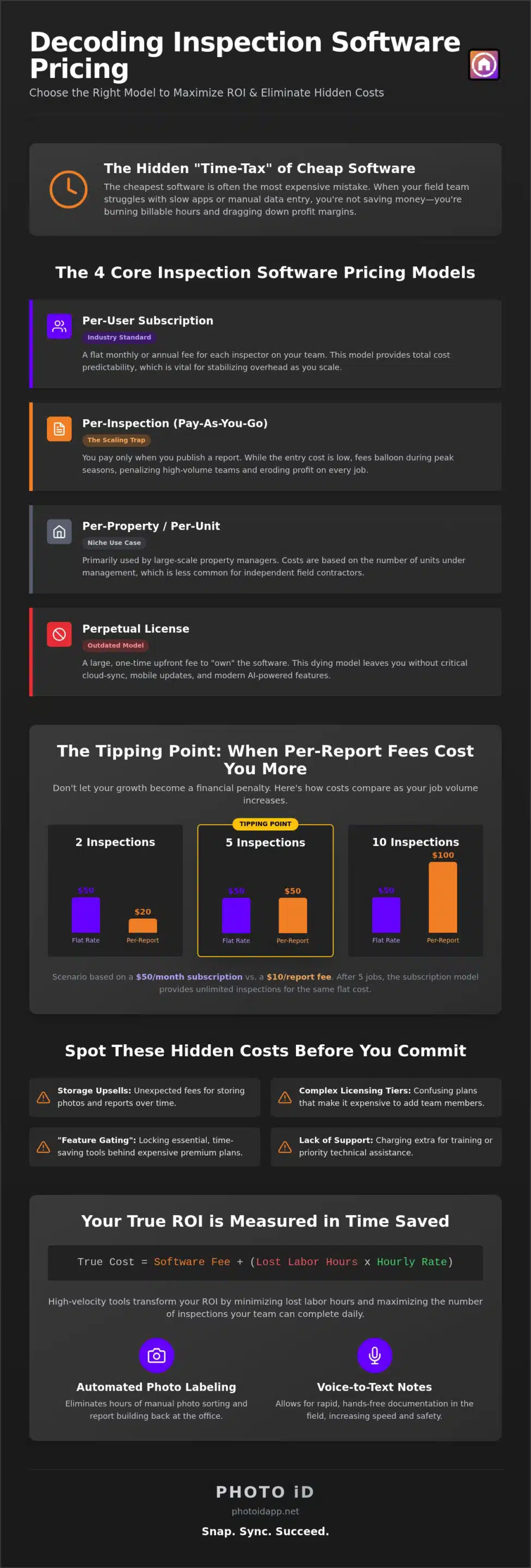
Choosing the wrong financial structure can sink your margins before you even step onto the jobsite. Modern inspection software pricing models generally fall into four distinct buckets. Each has a specific impact on your cash flow and operational speed. You must select a model that aligns with your volume to avoid leaving money on the table.
- Per-User Subscription: This is the 2026 industry standard. You pay a flat monthly fee for each inspector. It provides total cost predictability, which is vital for growing teams that need to stabilize their overhead.
- Per-Inspection (Pay-As-You-Go): You pay only when you publish a report. While this has a low barrier to entry for beginners, it is a scaling trap. High-volume teams often find these costs ballooning during peak seasons, eating into the profit of every job.
- Per-Property/Unit: Mostly used by property managers, this model charges based on the number of units under management. It is rare for independent contractors but remains common for large-scale housing assessments.
- Perpetual License: This is a dying breed. You pay a large upfront fee to “own” the software. However, you miss out on cloud-sync, mobile updates, and essential AI features that keep you competitive.
The SaaS Revolution in Field Inspections
The industry has shifted toward SaaS pricing models for a very practical reason. Cloud-based subscriptions ensure your team always has the latest tools without manual installs. In 2026, high-velocity features like voice-to-text labeling and automated photo labeling require massive server-side processing. A recurring model funds these continuous updates. It keeps your field team fast, sharp, and connected. Don’t get stuck with stagnant software that can’t handle modern data loads. Snap, Sync, Succeed!
Enterprise vs. Individual Licensing
Scaling your business requires a shift in how you view licenses. Individual plans are great for solo operators, but teams need centralized control. Enterprise plans often unlock a team management dashboard. This allows you to oversee multiple inspectors and virtual assessments without micromanaging every report. Look for volume discounts that kick in as you add more seats. Watch out for hidden storage limits or archiving fees that can creep up on you. High-volume teams should prioritize “all-in-one” subscriptions that include measurements and virtual tools. This avoids “app fatigue” and keeps your overhead streamlined. Focus on the result, not the license count!
Monthly Subscription vs. Per-Inspection Fees: Which Scales Better?
Don’t let your growth become a financial penalty. Choosing between various inspection software pricing models often feels like a gamble between upfront savings and long-term profitability. Flat monthly rates offer the ultimate protection for your margins during peak seasons. When the work floods in, your software cost stays static. Conversely, per-inspection fees act like a tax on your productivity. The more you work, the more you pay. It’s time to rethink your pricing strategy if you find yourself hesitating to take on a new job because of the software toll.
Pay-as-you-go models might seem attractive for part-time adjusters or low-volume startups. They offer a low-stakes entry point. However, these plans often come with “feature gating.” You might find yourself locked out of premium tools like automated photo labeling or custom report builders unless you upgrade to a higher tier. This restriction slows your field team down, creating a bottleneck that costs more in labor than you save in subscription fees. Efficiency is the engine of profit; don’t starve it to save a few dollars on a report fee.
The Tipping Point Analysis
Run the numbers before you sign. If a platform charges $10 per report and a subscription is $50 per month, your tipping point is exactly five inspections. Once you hit that sixth job, the per-report model starts draining your bank account. High-volume photo labeling math makes this even more lopsided. Beyond the sticker price, consider the administrative cost. Managing fifty separate invoices per month is a logistical nightmare. A flat-rate approach to inspection software pricing models consolidates your overhead into one predictable line item. This clarity allows you to forecast your profit with precision. Don’t let a “cheap” per-report plan create a hidden backlog of office work.
Software That Grows With Your Team
Scaling from a solo inspector to a crew of ten requires a platform that rewards volume. Unlimited reports are essential for documentation-heavy industries like roofing or restoration. Your software should integrate seamlessly with your existing estimating platforms to keep your workflow moving from the field to the final file. As your team expands, use a centralized dashboard to maintain oversight without per-user micromanagement. Experience the difference of a high-velocity documentation tool that scales at your pace. Snap, Sync, Succeed!
The Hidden Costs of Cheap Inspection Tools
Bargain software often hides a “time-tax” that bleeds your company dry. While you might save a few dollars on the monthly bill, you’ll lose hundreds in wasted labor. Understanding common SaaS pricing models is only the first step in evaluating inspection software pricing models. You must also account for the friction that slow, manual tools introduce to your workflow. If your team spends more time fighting the app than inspecting the property, the “cheap” option is actually your most expensive liability.
The “Time-Tax” is the most dangerous hidden fee in modern inspection software pricing models. Imagine an inspector earns $50 per hour. If they spend two hours manually labeling photos in the office after every job, you’ve just added $100 to the cost of that inspection. Over a month of 20 jobs, that’s $2,000 in lost revenue. This manual labor is a silent drain on your resources. You need a model that values your time as much as your talent. Stop the office-work bleed and start reclaiming your billable hours.
- Storage Upsells: Many budget plans offer tiny cloud tiers. Once your team starts uploading high-res photos, you’re hit with massive storage fees. It’s a bait-and-switch that punishes your success.
- Training Friction: Complex software is a productivity killer. If your field team finds the app too slow or confusing, they’ll skip steps. This leads to missing data and unpaid claims.
- Report Rework: Poor templates lead to extra site visits. If your documentation isn’t clear enough for an adjuster to approve, you’re doing the work twice for the price of once.
Manual vs. Automated Documentation
Break the 2:1 office-to-field cycle. Spending two hours in the office for every one hour in the field is a profit killer. Automated photo labeling acts as a profit-multiplier by organizing your evidence as you shoot. Instant photo report generation removes the post-inspection backlog entirely. You leave the jobsite with the report already finished. Capture the data. Label the defect. Finish the job!
Technical Support and Reliability
Reliability is your most valuable asset on a jobsite. An app crash during a critical roof inspection isn’t just an annoyance; it’s a professional failure. Cheap tools often lack the specialized support needed for field professionals. You need a partner that understands the high-stakes world of aerial roof and wall measurements. Free support is only valuable if the person on the other end knows your industry. Don’t gamble your reputation on a bargain-bin tool that fails when the pressure is on.
Calculating ROI: How Documentation Speed Dictates Your Real Cost
The true cost of your tech stack is measured in minutes, not just dollars. When you evaluate inspection software pricing models, you must look at the labor hours consumed by the interface. If a platform is difficult to navigate, it effectively lowers your hourly earning potential. Use this four-step calculation to find your real operational return and stop the silent drain on your bank account.
- Step 1: Determine your hourly rate. Assign a dollar value to both your field time and your office time. Most pros find that every hour spent behind a desk is an hour they aren’t earning top-tier field rates.
- Step 2: Track manual organization. Measure exactly how long it takes to move, rename, and sort photos after you leave the site. This “dead time” is a direct subtraction from your daily profit.
- Step 3: Apply voice-to-text gains. Voice-to-text labeling allows you to document defects as you see them. This eliminates the “memory gap” and cuts labeling labor by more than half.
- Step 4: Measure delivery speed. Instant report generation means you can bill immediately. Faster delivery leads to quicker approvals and higher referral rates from satisfied clients.
The High-Velocity Documentation Formula
Capacity is your most valuable asset. By reclaiming just 30 minutes per job, a busy field professional creates space for an additional site visit every single day. Over a standard month, that is twenty extra revenue-generating opportunities recovered from the administrative abyss. In the world of home inspection apps, ROI is defined as the total billable revenue recovered through the elimination of digital friction. Speed doesn’t just save money; it generates it. Capture, Categorize, Complete!
Case Study: From Chaos to Streamlined Profit
Manual organization is a profit killer that leads to burnout and missed deadlines. Contrast a traditional workflow with an automated labeling system that organizes evidence as you capture it. One model leaves you with a mountain of office work; the other lets you finish the report before you leave the jobsite. This provides a massive psychological relief, allowing you to end your workday when you leave the site. Furthermore, leveraging virtual inspection software reduces travel overhead, saving high-volume teams significant resources in fuel and vehicle wear. Stop paying for slow inspection software pricing models and start maximizing your documentation ROI today. High-velocity tools don’t just reduce costs; they multiply your earning power.
PHOTO iD: High-Velocity Documentation That Pays for Itself
Stop paying for software that slows you down. PHOTO iD isn’t just another line item in your budget; it’s a productivity engine that pays for itself by reclaiming your billable hours. Most inspection software pricing models fail because they ignore the high cost of manual office work. We solve this by providing an all-in-one platform that handles reports, measurements, and team management in a single high-velocity environment. You get the tools to finish the job while you’re still on the ladder. Capture, Categorize, Complete!
Automated photo labeling destroys the office-work backlog that keeps you up late at night. Our voice-to-text features are built specifically for “busy hands” in the field. You speak, we label, and the report builds itself in real-time. This instant report generation ensures immediate client satisfaction and faster payment cycles. Why wait days for a report when you can deliver it in seconds? Efficiency is the only way to protect your margins in a competitive market. We help you turn every site visit into a finished product before you even start your truck.
Why Field Teams Choose PHOTO iD
Field teams choose PHOTO iD because it was built by industry veterans who understand the daily grind. It’s not just an app; it’s a game-changing partner that restores order to the chaos of onsite documentation. Our platform offers seamless integration with roof software workflows, making it the perfect fit for hybrid teams. Whether you’re conducting onsite assessments or virtual inspections, our centralized team management dashboard gives you total oversight. You can manage high-volume crews without the friction of per-user micromanagement or complex licensing tiers.
Start Your High-Velocity Journey Today
Transitioning from manual tools is easier than you think. You won’t lose data, but you will lose the headache of manual photo organization. Start using custom inspection templates that match your specific workflow today. These templates ensure consistency across your entire team and reduce the need for report rework. Statistics show that automated inspection-to-maintenance routing can save an average of 3.2 days per issue. This speed allows you to take on more jobs and grow your business without increasing your administrative overhead. Don’t let another day of profit slip through your fingers. Join the pros using PHOTO iD today!
Take Control of Your Profit Margins Today
Mastering the complexity of inspection software pricing models is the first step toward a more profitable 2026. You’ve seen how “cheap” per-report fees act as a tax on your growth and how manual labeling creates a silent backlog of office work. True ROI isn’t found in a low sticker price; it’s found in the hours you reclaim for the field. By prioritizing speed and automation, you transform your documentation from a chore into a competitive advantage.
Join the top adjusters and roofers nationwide who have already ditched the “slow-tech tax.” PHOTO iD offers a high-velocity solution where automated labeling saves up to 50% of reporting time. Every subscription includes instant report generation, ensuring you leave every jobsite with a finished product. Stop fighting your software and start scaling your business with a partner that understands the grind. Snap, Sync, Succeed!
As you reclaim your time and scale your business to new heights, remember that professional presentation extends beyond the field; for your next corporate event, SnapJoy Photo Booth Co. provides a luxury photo booth rental miami to help showcase your brand’s success.
Eliminate manual labeling—Download PHOTO iD now!
Frequently Asked Questions
Is per-inspection pricing better for new businesses?
Per-inspection models offer a low entry cost for startups with very low volume. If you conduct fewer than five jobs a month, this model keeps your overhead minimal. However, it quickly becomes a scaling trap as your business grows. Successful teams usually transition to subscriptions to ensure total cost predictability and protect their profit margins during busy seasons.
Does inspection software pricing usually include cloud storage?
Most modern inspection software pricing models include a baseline tier of cloud storage for your reports and photos. You must check the fine print for data limits. Some providers offer unlimited storage; others charge “overage fees” once you exceed a specific gigabyte threshold. High-resolution photos can fill up basic tiers faster than you might expect.
What are the hidden costs of free inspection apps?
The biggest hidden cost is your own billable time. Free apps lack high-velocity features like automated labeling, forcing you into hours of manual photo organization. You also sacrifice technical support and data security. “Free” software often results in a massive office-work backlog that prevents you from taking on more field jobs. You pay with your labor instead of your wallet. However, for simple tasks like digitizing physical receipts or documents, you can learn more about mobile tools that help bridge the gap between paper and digital files.
How much can I save by switching to automated photo labeling?
You can save up to 50% of your total reporting time by automating your documentation. Labeling as you go eliminates the need for post-inspection office work entirely. For a high-volume team, this efficiency creates enough capacity to fit at least one extra inspection into every workday. It turns a two-hour administrative headache into an instant, onsite result.
Do most pricing models charge extra for team management features?
Yes, many inspection software pricing models gate team features behind “Professional” or “Enterprise” tiers. These higher tiers typically include a centralized dashboard for oversight. This allows you to manage multiple inspectors and virtual assessments without the friction of per-user micromanagement. It is a vital investment for maintaining quality control as you scale your crew.
Is virtual inspection software usually a separate add-on cost?
It depends on the provider’s philosophy. Legacy platforms often treat virtual tools as a separate module with an extra monthly fee. Modern, all-in-one subscriptions bundle virtual tools with onsite documentation features. Choosing a bundled model offers better value because it eliminates “app fatigue” and keeps your digital overhead streamlined under a single subscription.
Can I get a discount for annual billing on inspection software?
Most SaaS providers offer a significant discount for annual commitments. You can typically save between 10% and 20% compared to month-to-month billing. This is a smart move for established businesses with steady volume. It locks in your software overhead and simplifies your accounting for the entire year. Pay once and focus on the work!
What is the ROI of voice-to-text labeling for field adjusters?
The ROI is found in immediate documentation accuracy and massive time savings. Voice-to-text eliminates manual typing, allowing you to capture defects while your hands are busy on a ladder or roof. This reduces the “memory gap” and prevents costly errors. Faster reporting leads to shorter claim cycles and higher referral rates from satisfied contractors and clients.