
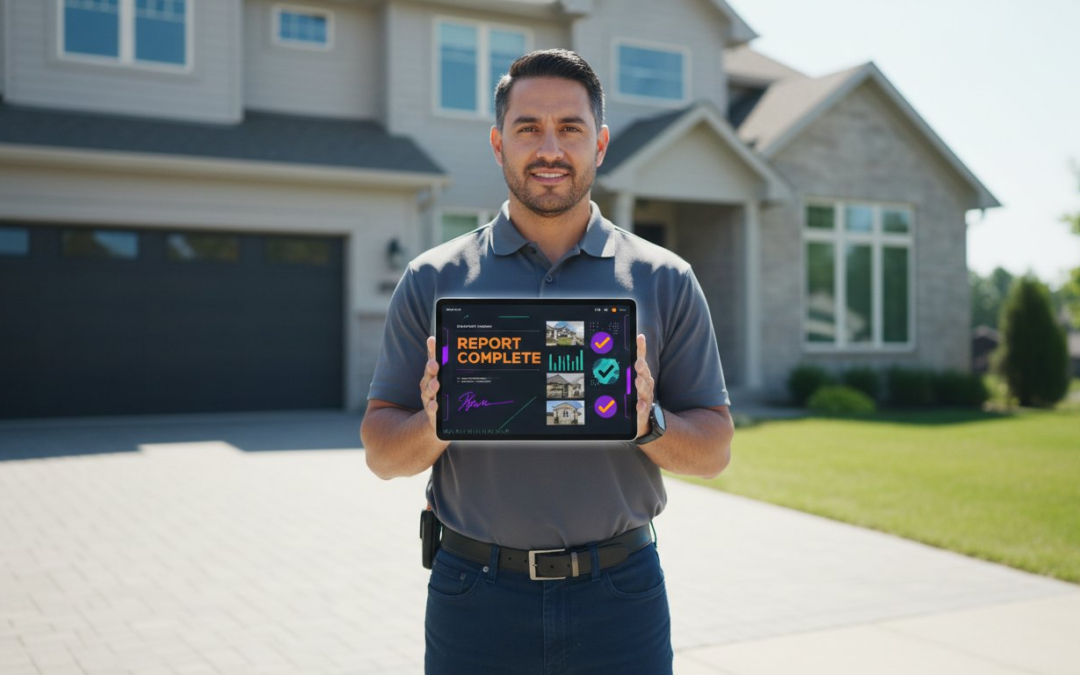
In 2026, a high-quality inspection is no longer defined by the depth of your checklist, but by the speed and visual clarity of the documentation you deliver. You know the frustration of finishing a long day on-site only to face four hours of manual photo labeling and disorganized data at your desk. It’s a tedious, profit-killing cycle that leaves your clients questioning your clarity and your team’s output inconsistent. Mastering the art of creating professional inspection reports for clients shouldn’t cost you your evenings or your sanity. You need a system that captures, labels, and delivers in real-time!
You deserve a workflow that works as hard as you do. This guide shows you how to capture site data, automate your documentation, and eliminate office work entirely. We’ll explore the high-velocity tools and strategies that restore order to your onsite chaos and win client trust through instant, crystal-clear reporting. It’s time to stop the manual grind and start scaling your business with confidence. Learn how to turn every onsite visit into a polished, professional deliverable before you even leave the driveway. Inspect, document, and succeed!
Key Takeaways
- Transition from basic checklists to visual-heavy, mobile-friendly reports that serve as essential risk-mitigation tools for your clients.
- Structure your executive summaries for the “60-second reader” to ensure your most critical findings are instantly accessible and understood.
- Master the high-velocity workflow of creating professional inspection reports for clients to reclaim your evenings and eliminate manual photo labeling.
- Leverage voice-to-text technology to narrate findings in real-time, turning physical observations into digital documentation instantly.
- Implement automated photo organization to deliver polished, high-impact reports to your clients before you even leave the job site!
The New Standard: Why Professional Inspection Reports Drive Referrals
In the 2026 inspection market, your report is your reputation. It’s no longer just a summary of findings; it’s a high-stakes tool for risk mitigation. When you focus on creating professional inspection reports for clients, you aren’t just checking boxes. You are providing a comprehensive home inspection that protects the buyer’s investment and the agent’s commission. High-quality documentation eliminates ambiguity. It stops the frantic back-and-forth phone calls. It positions you as the expert who sees what others miss!
Think about the “Referral Loop.” Every report you send is a digital business card for your next job. Realtors and insurance adjusters are busier than ever. They don’t want to dig through 50 pages of unorganized text; they want visual-heavy data they can scan in seconds. A polished, automated report makes them look good to their clients. When you make their job easier, your phone keeps ringing. Conversely, poor documentation is a profit killer. It leads to liability claims, lost time, and a damaged brand that no amount of marketing can fix. Clean. Clear. Concise. That is the 2026 standard!
Meeting Client Expectations in a Digital-First Market
Static PDF attachments are becoming obsolete. Today’s clients live on their phones and expect interactive, cloud-based data they can pinch, zoom, and share instantly. The psychology is simple: visual proof drives confidence. A client might skim a paragraph about a foundation crack, but a clear, high-resolution photo with a precise label creates instant trust. You are moving from being a mere data collector to a professional consultant. Your report must reflect that authority by being mobile-ready and visual-heavy.
The Administrative Burden vs. The Field Reality
The “Reporting Gap” is where most inspectors lose their profit. If you spend two hours on-site and another three hours at your desk labeling photos, you are bleeding money. In 2026, a professional report should take minutes, not hours. High-velocity pros deliver their findings before they even leave the driveway. This speed directly impacts your satisfaction scores. Clients are anxious and want answers now. By closing the gap between the physical inspection and the digital delivery, you secure your margins and your reputation. Speed. Accuracy. Profit!
Anatomy of a High-Impact Report: The Visual Narrative
Stop burying the lead under walls of text. In the fast-paced 2026 market, your report is a visual story. Clients don’t want to read a novel; they want to see the evidence. This “Photo First” philosophy transforms your documentation from a static list into a dynamic narrative. When you focus on creating professional inspection reports for clients, the image must be the primary driver of information. Every photograph should serve a purpose. Every shot needs to tell a story. Every finding needs visual proof. Capture the defect, provide the context, and move to the next item!
Mastering the Executive Summary
Most readers spend less than 60 seconds on your summary. You must make those seconds count. Highlight critical deficiencies immediately using color-coded severity ratings. Red indicates immediate hazards. Yellow signals maintenance needs. This visual shorthand guides client decision-making without causing unnecessary panic. A high-impact summary distills complex structural data into a prioritized action list that any homeowner can understand in under a minute. It’s about clarity, not just data.
Choose your structure based on the client’s needs. While room-by-room reports are common for residential buyers, system-by-system structures often provide better clarity for commercial clients or contractors. It groups all electrical, plumbing, or HVAC findings together. This allows a specialist to see the entire scope of work in one section rather than hunting through every room’s notes. This level of organization is what separates a basic checklist from a high-impact professional deliverable. It saves time. It reduces confusion. It builds trust!
The Science of Professional Photo Labeling
Professionalism lives in the labels. A caption like “Kitchen 1” is lazy and unhelpful. It forces the reader to guess the context. A professional label like “Kitchen: Moisture intrusion under sink” provides instant value. It tells the reader exactly what they are looking at and why it matters. Adding timestamps and GPS data further validates your findings, providing an airtight audit trail for insurance adjusters or realtors.
Automated labeling prevents “Photo Fatigue” by keeping the narrative tight and relevant. It eliminates the chaos of a 200-photo dump that overwhelms the reader. If you want to scale your output and eliminate the office grind, consider using a photo organization app to handle the heavy lifting while you stay focused on the field. Organize. Label. Deliver! This approach ensures your documentation is both professional and actionable, keeping you ahead of the competition in a digital-first industry.
Manual vs. Automated Reporting: The ROI of Your Time
Stop paying the “Manual Tax” on your business. Every minute you spend resizing photos, dragging files into folders, or typing out descriptions at your desk is a minute you aren’t getting paid for. Manual reporting creates a massive bottleneck that limits your growth. When you compare the lifecycle of a traditional PDF template to a mobile-first app, the difference is staggering. One requires a second shift of office work; the other is finished before you put the truck in gear. Efficiency is the only way to scale!
The “Cost Objection” is a myth that keeps pros stuck in the slow lane. A monthly subscription for high-velocity software might look like an expense, but it pays for itself in just two saved hours. If your time is worth $100 an hour, and you save two hours per job, the math is undeniable. You also eliminate the “Error Rate” factor. Manual entry leads to mislabeled photos and client disputes that can cost you your reputation. Automated systems ensure your data is airtight and your documentation is professional every single time. Creating professional inspection reports for clients shouldn’t be a gamble; it should be a guarantee.
Calculating Your Hourly Worth
Do you know your true hourly rate? Take your job fee and divide it by the total time spent on-site plus your time in the office. If you spend two hours on-site and two hours at home, you’ve cut your profit in half. Automation changes the game. By creating professional inspection reports for clients in real-time, you can often fit an extra inspection into your daily schedule. This allows for a 20% increase in revenue without adding more stress to your life. Stop the “Sunday Night Dread” and reclaim your weekend!
Consistency Across the Team
Scaling a business requires a unified standard. If your reports look different depending on which team member performed the inspection, you are confusing your clients and hurting your brand. Use custom inspection templates to ensure every inspector follows the same high-velocity workflow. A centralized team management dashboard allows you to perform real-time quality control. You can see exactly what is happening in the field without leaving your office. Standardize. Monitor. Grow!
The On-Site Workflow: Delivering Reports Before You Leave
Finish the job before you even start the engine. That is the goal of a high-velocity workflow. In 2026, the gap between “on-site” and “office work” has vanished for top-tier professionals. You start by pre-loading custom inspection templates tailored to your specific job type. Whether it’s a multi-family unit or a single-family home, your structure should be ready before you step out of the truck. This preparation ensures you never miss a required photo or a critical system check. Prepare. Perform. Prevail!
Next, you move into real-time narration. Stop taking notes on paper or trying to remember details for later. Use voice-to-text labeling to describe every finding as you see it. This is the core of creating professional inspection reports for clients without the midnight desk grind. You capture the photo, speak the label, and the software does the rest. By the time you reach the final room, your report is 95% complete. You can then use instant photo report generation to review the findings with the client on your tablet before you leave. Show them the defects. Explain the risks. Close the job!
Voice-to-Text: The Secret to Rapid Documentation
Narration is your secret weapon for speed. Talk while you walk. It ensures every detail is captured while it’s fresh in your mind. Modern industry-specific voice recognition reduces typing errors by 90%, even in noisy environments like HVAC rooms or busy construction sites. Just speak clearly into your mobile device. The system filters the background noise and places your text exactly where it belongs. It’s the ultimate shortcut for creating professional inspection reports for clients while you’re still on the move. Capture. Narrate. Complete!
Integrating Advanced Measurements
Professionalism in 2026 requires more than just ground-level photos. Your reports must include aerial roof and wall measurements to provide a complete property profile. Embed moisture mapping and thermal imagery directly into the project folder as you work. This visual data proves your findings and eliminates the need for costly return trips to verify measurements. When the client sees aerial data and thermal maps integrated into a single report, they see a professional who uses the best technology available. It validates your expertise and justifies your fee instantly.
Ready to transform your field workflow and eliminate office work? Start using a home inspection app that handles everything from voice-to-text to instant report generation today!
Elevate Your Reports with PHOTO iD’s Automated Engine
Stop fighting your data and start commanding it. PHOTO iD is the game-changing partner that handles the heavy lifting of photo organization while you focus on the inspection. The days of dragging files and guessing locations are over. Our automated engine categorizes every shot instantly. When you are creating professional inspection reports for clients, you need a system that thinks as fast as you move. Capture. Label. Deliver!
The engine powers your workflow by turning field data into structured assets. For larger firms, the Team Management Dashboard provides a bird’s-eye view of every active project. You can monitor field progress, verify photo quality, and maintain a unified standard without leaving your office. The software ensures your data is ready for immediate export into your preferred estimating or claims platforms. This seamless handoff eliminates the friction between field work and final submission. Sync. Organize. Succeed!
The ‘Claims Coach’ Advantage
PHOTO iD wasn’t built in a vacuum. It was forged by industry veterans who lived the field grind and understood the true cost of a missed detail. We focus on defensive documentation. This means every photo is a shield against liability and a proof point for your expertise. You can easily build custom inspection templates for any niche, from roof assessments to interior mold checks. Your reports will look like they took hours to write, even though you finished them in minutes. Protect your brand. Prove your value!
Get Started: From Chaos to Clarity
Transitioning to a better way of working is easier than you think. You can migrate your existing templates into the PHOTO iD ecosystem in minutes. Our five-minute setup allows you to start labeling your first 100 photos automatically. There’s no steep learning curve and no complex manual to study. Just pure, high-velocity efficiency that restores order to your workday. It’s time to reclaim your evenings and impress your clients with the most professional reports in the industry. Start creating professional reports with PHOTO iD today!
Master the Future of Field Reporting
The 2026 inspection industry demands more than just accuracy; it requires speed and visual impact. You’ve seen how the shift toward a “Photo First” philosophy and real-time delivery transforms your reputation with realtors and adjusters. By embracing an on-site workflow, you eliminate the reporting gap that drains your profit margins and your personal time. The days of losing hours to manual office work are over when you focus on creating professional inspection reports for clients using high-velocity tools. Capture the data, speak the findings, and finish the job before you leave the site!
Founded by industry veteran Ken Perry, PHOTO iD handles the heavy lifting of documentation. Our automated photo labeling saves you over two hours per report, while the real-time team management dashboard keeps your entire firm synchronized. Stop the manual grind and start scaling your business with a partner that understands the field reality. It’s time to take back your evenings and impress every client with crystal-clear results. Streamline your inspections with the PHOTO iD app! Your path from onsite chaos to digital clarity starts now. Inspect, document, and succeed!
Frequently Asked Questions
What should a professional inspection report for clients include?
A professional report must include high-resolution photos, descriptive labels, and a prioritized executive summary. It should cover all major systems like HVAC, plumbing, and electrical while providing clear visual proof for every finding. Including aerial roof data and moisture maps adds a layer of 2026-standard expertise that builds instant trust. Clear. Concise. Comprehensive!
How can I speed up the photo labeling process during an inspection?
Use voice-to-text labeling to narrate your findings as you walk the site. This eliminates the need to type manually or remember specific details later at your desk. Capturing and labeling in real-time ensures that your documentation is finished before you leave the driveway. It is the fastest way to handle high-volume photo counts without the office grind!
Is it better to use a PDF template or an inspection app?
An inspection app is far superior to a static PDF template because it automates the organization and delivery process. While PDFs require manual photo dragging and resizing, an app handles these tasks instantly. For those focused on creating professional inspection reports for clients, the automation provided by a mobile-first app saves hours of administrative work and reduces human error.
How do I organize hundreds of inspection photos efficiently?
Leverage photo organization software that categorizes images into specific project folders automatically. Instead of a massive photo dump, the software should group images by room or system as you capture them. This structured approach prevents photo fatigue for the client and ensures every defect is easy to locate. Organize. Label. Deliver!
Can I create custom inspection templates for different types of properties?
Yes, you should use a custom report builder to create specific templates for residential, commercial, or multi-family properties. Pre-loading these templates before you arrive on-site ensures you follow a consistent standard of practice for every job. This level of customization allows you to adapt to any niche while maintaining a professional, high-velocity workflow.
How does professional reporting help with insurance claim approvals?
Professional reporting provides defensive documentation that offers undeniable proof of property conditions for adjusters. Clear labels, timestamps, and GPS data create an airtight audit trail that speeds up approvals. Integrating your report data with industry standards ensures that your findings are formatted for seamless claims processing and fewer disputes. Protect your business and your client!
What is the best way to deliver an inspection report to a client?
Deliver reports through a cloud-based link rather than as a bulky email attachment. This allows clients to view interactive, mobile-friendly data on any device instantly. Using instant photo report generation enables you to review the final document with the client on-site, providing immediate clarity and answering questions before you even put the truck in gear.
How can voice-to-text technology improve my inspection reports?
Voice-to-text technology improves reports by allowing you to capture more detail without slowing down your physical inspection. It reduces typing errors by 90% and ensures that complex observations are recorded exactly as you see them. This technology is essential for creating professional inspection reports for clients that are both highly detailed and delivered at high velocity. Capture. Narrate. Succeed!