
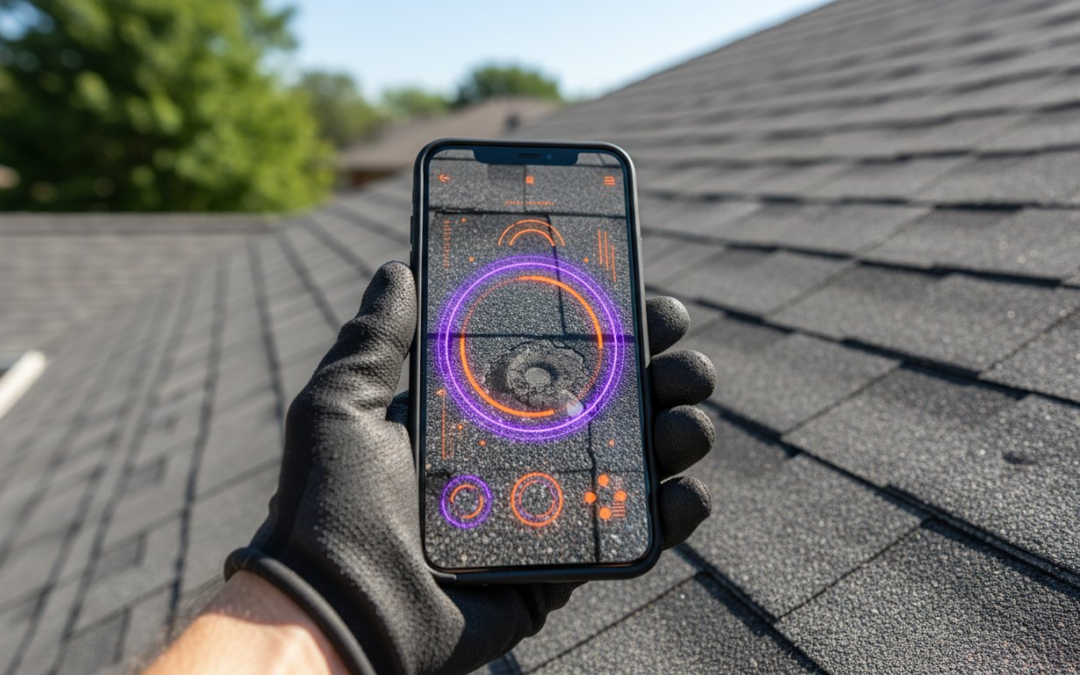
Documentation speed is the only metric that matters in 2026; if your software doesn’t label photos as you take them, it is already obsolete. You didn’t get into this business to spend four hours every night hunched over a laptop manually tagging hail hits and wind creases. It is a massive time sink that drains your energy and delays your paychecks. You know that accurate documentation is the only thing standing between a quick approval and a denied insurance claim, but the manual grind is unsustainable.
Stop the administrative bleeding. This guide shows you how to leverage modern software for roof damage assessment reports to eliminate manual typing and generate professional results in half the time. Capture, label, and report! We will explore the tools that provide instant documentation, zero field typing, and seamless integration with estimating platforms like Xactimate. It is time to restore order to the chaos of onsite documentation and get back to what you do best!
Key Takeaways
- Stop wasting 60% of your time on post-inspection desk work by switching to a real-time documentation engine.
- Discover how the right software for roof damage assessment reports eliminates manual photo labeling to cut your reporting time in half!
- Master voice-to-text labeling and custom templates to document critical roof components accurately even in high-wind environments.
- Understand why high-resolution, close-up photos are still mandatory for insurance claim approval despite the convenience of aerial tools.
- Implement a high-velocity workflow that moves from onsite capture to instant report generation without manual field typing.
Beyond the Shingles: Why Your Current Roof Reporting Workflow Is Costing You Hours
Stop viewing your documentation as a chore. In the high-velocity market of 2026, your software for roof damage assessment reports is actually a real-time documentation engine. It is the pulse of your entire operation. If you are still snapping photos on a standard camera and waiting until tonight to organize them, you are bleeding profit. This outdated approach creates a massive bottleneck that slows down your team, frustrates your clients, and delays your revenue stream. Documentation is not just a record; it is the fuel for your cash flow.
The “Manual Labeling Trap” is the silent killer of roofing margins. Industry data reveals that field professionals spend approximately 60% of their total project time on post-inspection administrative tasks. This is time you could spend closing new leads or inspecting more properties. High-quality evidence is the non-negotiable core of a professional Building inspection. When your documentation is sloppy or delayed, claim approval rates plummet. Carriers look for any reason to deny a file, and disorganized photos give them exactly what they want. Precision in the field equals profit in the bank.
The Hidden Cost of Manual Documentation
Calculate the true drain on your business. If you take 100 photos per roof and spend just 30 seconds labeling each one manually, that is nearly an hour of desk time per inspection. Multiply that by five inspections a day, and you have a full-time administrative job you never signed up for. Disorganized files lead to re-inspections that cost you gas, labor, and precious daylight hours. Beyond the money, the mental fatigue of desk-heavy reporting is real. Field pros belong on the roof, not tethered to a laptop until midnight. This friction causes burnout and team turnover. Restore your sanity by automating the grind.
The 2026 Standard for Roof Assessments
The days of basic checklists are over. Filling out a static PDF is no longer enough to satisfy modern adjusters or tech-savvy homeowners. They want transparency, speed, and total precision. Instant Photo Report Generation is the new industry baseline. If you can’t deliver a professional, labeled report the moment you climb down the ladder, you are already behind the curve. Top-tier firms use mobile-first, cloud-synced software for roof damage assessment reports to stay ahead. They prioritize speed because they know the first contractor to submit a complete, accurate report is usually the one who gets the job approved. Move fast, document accurately, and win more claims!
The Engine of Efficiency: How Automated Photo Labeling Transforms Damage Assessments
Reporting is not just about filling forms. It’s about data integrity. Most software for roof damage assessment reports treats photos like an after-thought. That is a massive mistake. Modern tools turn your smartphone into a high-velocity data capture device. Every click is a data point. Every photo is a piece of evidence. When your software organizes these files in real-time, you eliminate the “which photo was this?” nightmare before you even climb down the ladder.
Voice-to-Text: The End of Field Typing
Climbing a 10/12 pitch is hard enough. Trying to type “hail impact on south-facing slope” while balancing on a ridge is dangerous and slow. Voice-to-text labeling changes the game. Modern apps recognize industry-specific jargon with incredible precision. Even in high-wind environments, you can dictate findings instantly. This keeps your eyes on the roof and your hands on the ladder. It is safer. It is faster. It is smarter. This level of hands-free documentation ensures that every detail is captured while it’s right in front of you.
Recent research into automated roof inspections shows that digital integration reduces human error significantly. By speaking your notes as you see the damage, you eliminate the risk of forgetting critical details later. You don’t have to spend hours at your desk trying to match notes to a camera roll. The software does the heavy lifting for you. Capture the damage. Dictate the details. Move to the next slope!
Template-Driven Consistency
Standardization is your best friend. Custom inspection templates ensure you never miss a critical component. Whether it is the valley, the flashing, or the drip edge, the software guides you through a logical sequence. You can even customize these templates for specific storm types, such as hurricane or hail events. This creates a “guided tour” for the insurance adjuster. When they see a perfectly structured report, their confidence in your estimate grows. Approvals happen faster because you have left no room for doubt.
Credibility is built on metadata. Every photo captured through professional software for roof damage assessment reports includes automated timestamps and GPS coordinates. This proof of presence is vital for insurance compliance and prevents denied claims. Your photos are organized the moment they are taken. If you want to experience this level of speed, see how automated photo labeling can reclaim your evenings. Efficiency is the only way to thrive during the current labor shortage of 40,000 unfilled positions. Empower your team to work smarter, not harder!
Choosing the Right Tool: Aerial Measurements vs. On-Roof Photo Documentation
Don’t fall into the “drone-only” trap. While aerial technology has revolutionized the industry, it is only one piece of the puzzle. In 2026, the most successful contractors use a hybrid approach. They combine the safety of remote sensing with the undeniable proof of on-roof photography. Your software for roof damage assessment reports must be able to handle both worlds. If your tool only looks from the sky, you are leaving money on the table. If it only works on the ground, you are moving too slow. Balance is the key to high-velocity reporting.
The current roofing industry faces a labor shortage of 40,000 unfilled positions. This means your team must be more efficient than ever. You cannot afford to send an inspector back to a site because a drone shot was too blurry to confirm a hail hit. Modern satellite and aerial measurement tools now claim over 95% accuracy for dimensions. This is incredible for initial takeoffs. However, measurements don’t prove damage. Photos do. You need a documentation engine that captures the granular details that satisfy even the toughest adjusters.
When to Use Aerial Measurements
Aerial tools are your best friend for safety and speed. Use them for initial roof takeoffs and to generate quick estimates for simple replacements. Modern AI-driven aerial roof and wall measurements provide a massive head start on your project scope. They allow you to stay off the ladder during the bidding phase, which reduces your liability and speeds up the sales cycle. When you need a fast, high-level view of a property, aerial data is the gold standard. It populates your estimating software in seconds, allowing you to present a professional bid before the competition even arrives.
The Power of the Close-Up: Documenting Real Damage
Drones are fast, but they have limits. They often miss subtle hail bruises, mechanical damage, or specific material failures that require a tactile perspective. High-resolution, close-up photos are still mandatory for significant insurance payouts. Adjusters require “hands-on” evidence to justify large claims. They want to see the granule loss and the fractured matting up close. This is where your software for roof damage assessment reports becomes your most valuable asset.
PHOTO iD bridges this gap perfectly. It allows you to take the broad data from an aerial report and supplement it with granular, labeled, and timestamped field photos. This creates a comprehensive evidence package that is impossible to ignore. Capture the overview. Document the detail. Secure the approval! By using automated photo labeling and voice-to-text, you can document these close-ups in the same time it takes to walk the slope. Don’t settle for “good enough” imagery when you can have undeniable proof. High-resolution documentation is the bridge between a denied claim and a signed contract!
Building the Perfect Report: A Step-by-Step Workflow for High-Velocity Adjusters
Speed is your ultimate competitive advantage. A structured workflow turns a chaotic inspection into a streamlined production line. By using professional software for roof damage assessment reports, you can move from the ladder to the invoice without the typical midnight desk grind. Stop guessing and start executing. Follow this high-velocity process to ensure every claim is documented, labeled, and ready for submission before you even leave the driveway.
- Step 1: Pre-load the template. Open your custom inspection template before you even park the truck. Having your categories ready ensures you don’t miss a single valley or pipe boot.
- Step 2: Dictate your findings. Utilize voice-to-text to capture damage descriptions during the walk. Speak the damage as you see it to maintain total accuracy.
- Step 3: Label in real-time. Auto-label photos instantly. This keeps every image in perfect chronological and spatial order, eliminating post-inspection guesswork.
- Step 4: Sync to the office. Upload everything to the team dashboard for immediate review. Your office staff can start the estimate while you are driving to the next lead.
- Step 5: Export the report. Generate the instant photo report and push it directly into your estimating software. One click, zero typing, total professionality!
Maximizing the Team Management Dashboard
Visibility is the key to scaling your roofing firm. With a centralized team management dashboard, office admins can monitor field progress in real-time. If a field tech forgets a critical photo of the drip edge, the office sees it immediately. You can even utilize virtual inspection software to have a senior expert consult on complex damage from hundreds of miles away. This centralization prevents data loss across multiple devices and keeps your entire team on the same page. No more lost SD cards. No more text-threaded photos. Just pure efficiency!
Integrating with Xactimate and Verisk
Carriers hate friction. When your photo report aligns perfectly with your Xactimate line items, you eliminate the “kickbacks” that delay your payments. Professional software for roof damage assessment reports ensures that your evidence matches your estimate. This seamless export process saves hours of manual uploading and dragging-and-dropping files. You provide a clear, undeniable evidence package that adjusters can approve with confidence. Ready to master this workflow? Get started with PHOTO iD today and reclaim your evenings! High-velocity documentation is the only way to thrive in the 2026 market.
PHOTO iD: The Definitive Choice for Roof Damage Documentation
Stop fighting the clock every night. PHOTO iD is the only software for roof damage assessment reports designed to kill the “Desk Time” crisis once and for all. While other apps leave you sorting through hundreds of mystery photos at midnight, our platform organizes your evidence while you are still on the roof. It is a game-changing partner that restores order to the chaos of onsite documentation. By automating the most tedious parts of the reporting process, PHOTO iD helps you close claims 40% faster. You don’t just save time; you gain a massive competitive edge!
Efficiency is the core of our DNA. Our unique voice-to-text labeling and automated photo labeling features mean you never have to type a single word in the field. Just snap the photo and speak the damage. The app handles the rest. We also know that the most critical jobs are often in the most remote locations. That is why our platform maintains total reliability in “offline” mode. You can document remote sites without a cell signal, and the software will sync everything the moment you hit a hotspot. Capture, label, and report with total confidence!
The Claims Coach Advantage
Experience matters in this industry. PHOTO iD was built under the guidance of industry veteran Ken Perry, also known as the “Claims Coach.” This software for roof damage assessment reports wasn’t dreamed up in a corporate boardroom; it was forged in the field. It is built “by adjusters, for adjusters” who understand the grit and grind of storm restoration. When the high-pressure storm season hits, you need more than just a tool. You need a partner that understands your specific workflow. Our customer support is tailored specifically for these peak periods, ensuring you never face a technical hurdle alone during a catastrophe event.
Get Started with PHOTO iD Today
Take control of your documentation workflow right now. The PHOTO iD mobile app subscription is available for immediate use. You can download it and start saving hours on your very next inspection. If you lead a team, explore our management dashboard to oversee multi-inspector projects with total transparency. Centralize your data, empower your techs, and dominate your market. Stop wasting your nights on paperwork and start focusing on your growth. Streamline your roof reports with PHOTO iD now! High-velocity documentation is just one click away!
Reclaim Your Evenings with High-Velocity Reporting
The era of manual photo management is over. You’ve seen how the right software for roof damage assessment reports transforms a grueling midnight chore into a streamlined, real-time process. By balancing high-resolution on-roof documentation with precision aerial data, you provide the undeniable proof adjusters demand while maintaining the speed your business needs to scale. Stop the administrative bleed. Inspect the site. Capture the damage. Secure the approval!
Founded by industry veteran Ken Perry, PHOTO iD is built to withstand the intense pressure of catastrophe season. Leverage advanced voice-to-text for field efficiency and utilize instant photo report generation to eliminate the bottleneck between the ladder and the estimate. You don’t have to choose between accuracy and speed. This platform delivers both, ensuring your documentation is ironclad and your workflow is unstoppable. Don’t let disorganized files or manual labeling hold your revenue hostage any longer. It’s time to work smarter, move faster, and win bigger!
Start your PHOTO iD subscription and eliminate manual labeling today!
Frequently Asked Questions
How does automated photo labeling save time on roof reports?
Automated photo labeling eliminates the need to manually sort and rename hundreds of images after you leave the jobsite. It organizes your documentation in real-time as you capture evidence. This process removes the “Desk Time” crisis where inspectors spend hours every night tagging hail hits or wind damage. You finish the report while you are still onsite. It’s fast, efficient, and professional!
Can I use roof inspection software without an internet connection?
Yes, you can capture and document damage in remote areas without a cell signal. Our software for roof damage assessment reports includes a robust offline mode that stores all data locally on your device. Once you return to a zone with service or Wi-Fi, the app automatically syncs your photos and labels to the cloud. You never have to worry about data loss in the field. Capture now, sync later!
Does PHOTO iD integrate with Xactimate for insurance claims?
Absolutely. PHOTO iD is designed to bridge the gap between field documentation and the estimating process. You can export your organized, labeled photo reports directly into Xactimate or other platforms like Verisk. This integration ensures that your evidence matches your line items perfectly. It reduces carrier kickbacks and speeds up the entire claim approval cycle. Align your data. Accelerate your payments!
Is voice-to-text accurate enough for technical roofing terms?
Modern voice-to-text engines are specifically trained to recognize industry jargon like “drip edge,” “step flashing,” and “granule loss.” Even in high-wind environments on a steep slope, the technology delivers high accuracy. This allows for hands-free documentation while you maintain three points of contact on the ladder. It is a safer and faster way to record detailed findings without fumbling with a keyboard. Speak it. See it. Save time!
What is the difference between a roof inspection app and a standard camera app?
A standard camera app just captures raw images with no context or organization. In contrast, a specialized roof inspection app embeds critical metadata like GPS coordinates and timestamps while automatically labeling the photos. It follows a structured workflow that ensures you don’t miss a single slope or valley. Standard apps create a mess of unsorted files; our software for roof damage assessment reports creates a finished evidence package.
How do custom templates help with roof damage assessments?
Custom inspection templates act as a digital “guided tour” for every property. They force consistency across your team by prompting inspectors to capture specific components like ridges, eaves, and penetrations. You can build templates for different storm types or local building codes. This structure ensures that every report is comprehensive and professional. No more missing photos. No more second trips to the site. Just total documentation!
Can I manage a team of roof inspectors through a single dashboard?
Yes, the team management dashboard provides a centralized command center for your entire operation. You can monitor field progress in real-time and review reports as they are generated. This allows office admins to start estimates before the field tech even leaves the driveway. It is the perfect tool for scaling a roofing firm during busy storm seasons. Track your team. Review the data. Close the claim!
What are the benefits of aerial measurements in roofing software?
Aerial measurements provide safe and rapid initial takeoffs without ever stepping on a ladder. They deliver highly accurate dimensions for slopes, valleys, and ridges using satellite or drone imagery. This data populates your estimating software instantly, allowing for a 95% accuracy rate on dimensions. While close-up photos prove the damage, aerial data provides the scale. Combine both for the ultimate professional report. Safety meets speed!