
mobile labeling app vs voice note app for inspections
Mobile Labeling Apps vs Voice Note Apps: Core Differences for Field Inspections
When evaluating a mobile labeling app vs voice note app for inspections, the gap comes down to one thing: structured output. Labeling apps attach metadata directly to photos. Voice apps produce transcripts that require manual reconciliation later.
What Mobile Labeling Apps Deliver in Structured Documentation
Mobile labeling apps embed location, timestamp, and descriptive tags onto each image at capture. Every photo arrives organized, reducing post-inspection sorting to near zero. Reports are consistent, auditable, and submission-ready.
Voice Note Apps: Speed Tradeoffs in Noisy Field Conditions
Voice apps feel fast until wind, HVAC noise, or traffic corrupts the recording. Transcription accuracy drops sharply in ambient noise above 70 dB, which is common on active job sites. You end up re-listening and retyping, erasing any time saved at capture.
Key Gaps That Slow Down Your Inspections
| Factor | Mobile Labeling App | Voice Note App |
|---|---|---|
| Photo context | Embedded at capture | Separate file, manual match |
| Offline use | Full functionality | Recording only; sync required for transcription |
| Noise tolerance | Not affected | High error rate |
| Report readiness | Immediate | Requires post-processing |
| Adjuster clarity | High | Variable |
Pros and Cons: Which Method Wins for Property, Roofing, and Insurance Workflows
Labeling Apps Excel in Accuracy and Report Standardization
Structured labels eliminate ambiguity. When an adjuster opens your report, every photo has a location, damage type, and timestamp. There is no guesswork, no follow-up call requesting clarification, and no claim delay tied to documentation gaps.
Voice Notes Fall Short on Photo Context and Error Rates
Pros
- Fast initial capture on quiet sites
- Low learning curve
- Works with existing phone apps
Cons
- Transcription errors require manual correction
- Photos and notes are stored separately
- No structured output for adjuster review
- Fails in noisy field conditions
Real Inspector Feedback on Time Savings
Inspectors using structured labeling apps consistently report cutting post-inspection report time by one to two hours per job. Voice note users report the opposite: transcription and photo matching routinely add time after every field visit.
Field Test: Speed and Accuracy in Real Inspections
Hands-On Timing: Labeling vs Dictation on a 40-Photo Roof Job
On a standard 40-photo roof inspection, structured labeling at capture takes roughly 12 to 15 seconds per photo. Voice dictation takes 8 to 10 seconds at capture but requires 45 to 60 minutes of post-processing to match audio to images and correct transcription errors.
Offline Performance Where Signal Fails
Field reality: Rural properties, basements, and metal-clad structures routinely kill cell signal. Mobile labeling apps with offline capability keep your workflow intact. Voice apps that depend on cloud transcription stall completely without connectivity.
Noisy Environments and Transcription Reliability
Roofing, restoration, and property preservation sites are loud. Transcription accuracy in high-noise environments makes voice documentation unreliable for liability-sensitive documentation. Mislabeled damage on an insurance claim creates disputes that cost far more time than the seconds saved at capture.
Why Hybrid Tools Like PHOTO iD by U Scope Outperform Standalone Options
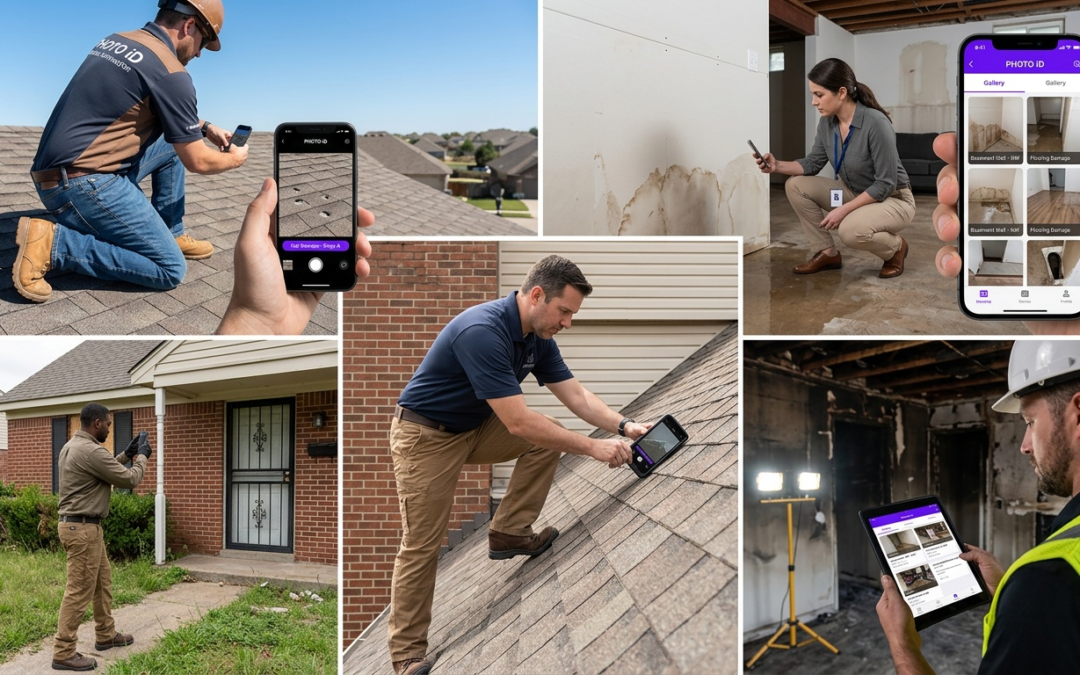
The mobile labeling app vs voice note app for inspections debate resolves when you use a tool built for accuracy and speed. PHOTO iD by U Scope combines real-time photo labeling, GPS tagging, and built-in field tools in one field-ready platform.
Voice Labeling Directly on Photos Cuts Errors
PHOTO iD by U Scope attaches voice labels directly to each image at capture. There is no separate audio file to reconcile. The label travels with the photo through every export and report.
Built-In Field Tools Speed Up On-Site Decisions
A built-in pitch gauge and compass eliminate the need for separate instruments on roofing and exterior inspections. Capture measurements and photos at the same time, cutting site time on every job.
Seamless Exports for Xactimate and Partner Workflows
Pre-cataloged, labeled images from PHOTO iD by U Scope import directly into Xactimate for faster, more accurate estimating. Reports also export to PDF or push directly to Guidewire (ClaimCenter), Salesforce, Jobber, and JobNimbus.
Pick the Right Tool and Streamline Your Inspections Today
Match Your Workflow to the Best Option
If your work involves insurance claims, roofing, or property preservation, a mobile labeling app vs voice note app for inspections comparison has a clear answer: structured labeling wins on accuracy, speed, and adjuster readiness.
Get Started with PHOTO iD by U Scope for Faster Reports
Download PHOTO iD by U Scope and eliminate post-inspection bottlenecks starting on your next job.
Visit PHOTO iD by U Scope to learn more about features, workflows, and integrations.
The Clear Verdict for Field Professionals
The mobile labeling app vs voice note app for inspections comparison ends with a practical verdict: voice notes are a liability on any job where documentation drives payment. Structured labeling is not a preference; it is a professional standard.
Three realities reinforce this conclusion:
- Insurance adjusters require photo-linked context, not separate audio files
- Noisy, low-signal job sites make voice transcription unreliable
- Post-processing time from voice notes consistently exceeds capture time saved
For roofing, property preservation, and insurance claims, the documentation method you choose directly affects approval speed and dispute frequency. Structured labeling wins on every measurable dimension.
Forward-Looking Workflow Considerations
Field documentation standards are tightening. Carriers and clients increasingly expect structured, auditable photo records, not informal notes. Inspectors who build labeled, GPS-tagged workflows now will be positioned ahead of that shift, not scrambling to catch up.
Hybrid tools that combine labeling, field measurement, and direct platform exports represent where professional inspection documentation is heading. Standalone voice apps do not scale into that future.
PHOTO iD by U Scope is built for exactly that trajectory. Real-time labeling, offline capability, pitch gauge, GPS tagging, and direct exports to Guidewire (ClaimCenter), Salesforce, Jobber, and JobNimbus help field professionals stay ahead of rising documentation demands.
Stop reconciling audio files after every job. Download PHOTO iD by U Scope and deliver submission-ready reports from the field.
Frequently Asked Questions
What’s the biggest problem voice note apps create for field inspections?
Voice note apps often lead to significant post-processing time. While initial capture might seem fast, transcribing audio and manually matching it to photos adds hours back at the office, especially with transcription errors from noisy environments. This erases any perceived time savings, making your workflow less efficient.
How do mobile labeling apps improve inspection report accuracy?
Mobile labeling apps embed key details like location, timestamp, and descriptive tags directly onto each image at the point of capture. This structured output eliminates ambiguity, ensuring every photo has clear context for adjusters and stakeholders. It cuts down on guesswork and follow-up calls, speeding up approvals.
Are voice note apps reliable in loud inspection environments?
No, voice note apps struggle with reliability in noisy field conditions. Ambient noise above 70 dB, common on job sites, sharply reduces transcription accuracy. This means inspectors spend more time re-listening and correcting errors, making the documentation unreliable for liability-sensitive work.
Can I use a mobile labeling app when there’s no cell signal?
Yes, quality mobile labeling apps are designed with offline capability. This means you can capture and label photos with full functionality even in rural areas, basements, or metal-clad structures where cell signal fails. Your workflow remains uninterrupted, unlike voice apps that rely on cloud transcription.
How does PHOTO iD by U Scope streamline the inspection process?
PHOTO iD by U Scope combines real-time photo labeling, GPS tagging, and built-in field tools into one platform. It attaches voice labels directly to images, eliminating separate audio files and reconciliation. This integration means faster capture, immediate report readiness, and seamless exports to platforms like Xactimate.
What’s the verdict for choosing an app for insurance or roofing inspections?
For insurance claims, roofing, and property preservation, structured labeling apps are the clear choice. They provide the accuracy, auditability, and immediate report readiness that adjusters and carriers demand. Voice notes introduce too many variables and post-processing delays for these critical workflows.