
What if you could finish your inspection, close the front door, and have the complete report already sitting in your client’s inbox? You’ve spent years perfecting your craft, yet you likely still find yourself chained to a desk late at night labeling photos and fixing formatting errors. It’s an exhausting reality in an industry where fragmented tools and manual documentation create a massive bottleneck. You want to scale your business, look professional, and reclaim your evenings.
Building a high-performance tech stack for a modern home inspector is the only way to stay competitive in 2026. This isn’t just about buying new gadgets; it’s about creating a seamless data highway from the crawlspace to the cloud. Mastering the right digital toolkit will allow you to slash your reporting time and dominate your local market with ease. This guide breaks down the essential hardware and software you need to eliminate safety risks, automate your workflow, and finally finish your reports before you even leave the driveway.
Key Takeaways
- Build a high-velocity foundation by integrating hardware, field software, and back-office operations into one seamless workflow.
- Deploy non-invasive hardware to eliminate safety risks and provide deep property insights that slash your liability.
- Identify the ultimate tech stack for a modern home inspector to automate photo labeling and finish reports before you even leave the driveway!
- Scale your business effortlessly by centralizing the customer journey from instant booking to secure payment on one dashboard.
- Execute a proven 4-step roadmap to upgrade your business, starting with a documentation core that delivers immediate ROI.
The Evolution of the Digital Inspector: What is a Modern Tech Stack?
The era of the flashlight and clipboard is over. In 2026, the housing market moves at high velocity, and clients expect more than a static PDF. They want precision, speed, and immersive data. To survive this shift, you must move beyond the “Analog Inspector” mindset. Relying on manual notes and a basic camera creates a massive bottleneck that drains your energy and your bank account. It leads to report writing fatigue, where you spend three hours at your kitchen table for every one hour spent on-site. This fragmented approach is a revenue killer.
A professional tech stack for a modern home inspector is a synchronized ecosystem designed to eliminate friction. It’s not just a collection of random apps; it’s a unified data highway. Before diving into the high-tech hardware, it helps to understand the standard scope of What is a Home Inspection? to see exactly where digital tools can sharpen your edge. By 2026, tech adoption has become the primary competitive advantage for the 2.1 million inspections performed annually in the United States. If you aren’t digital, you’re invisible.
The Three Layers of Professional Inspection Tech
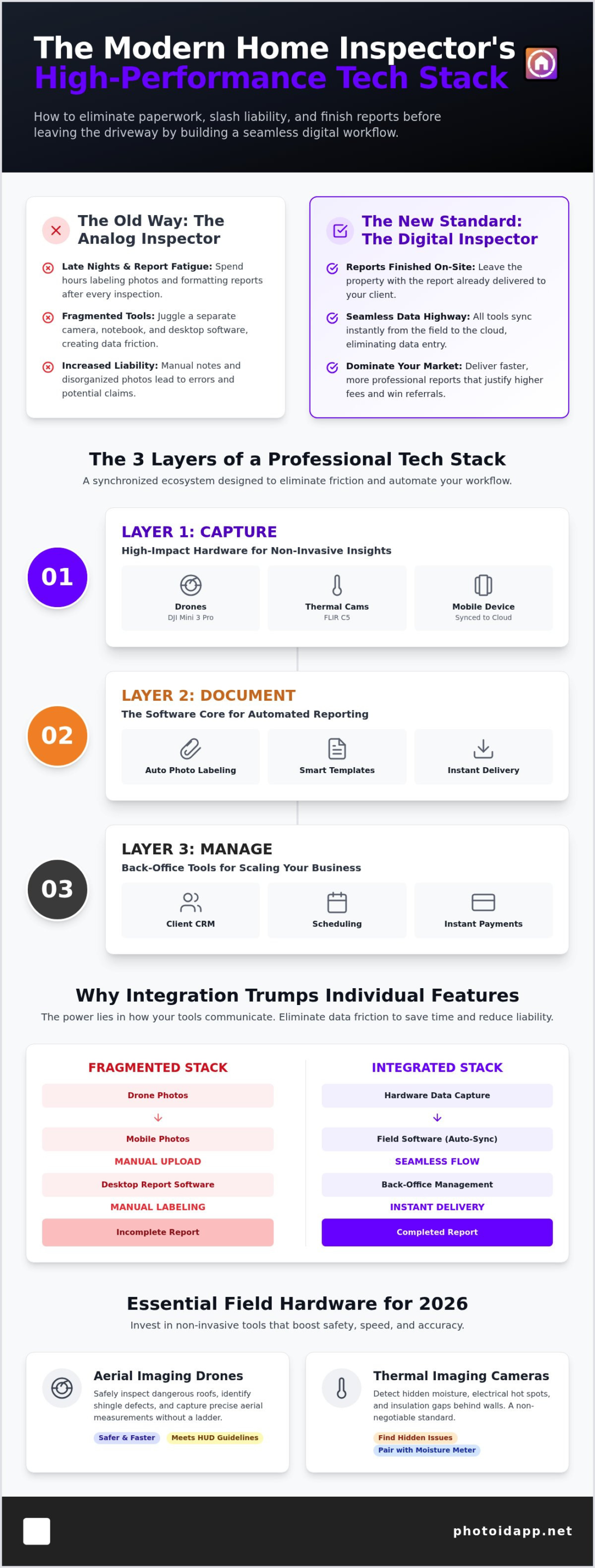
Think of your business as a three-layered foundation. Layer 1 is the Capture phase. This involves high-impact hardware like drones for roof assessments, thermal imaging for moisture detection, and 360 cameras for total room coverage. Layer 2 is the Document phase. This is your software core where you organize, label, and use templates to turn raw data into a narrative. Layer 3 is the Manage phase. These are your back-office tools for CRM, scheduling, and instant payments. When these layers work together, you create a professional image that justifies higher fees and wins more referrals!
Why Integration Trumps Individual Tool Features
Stop chasing every new shiny feature. The real power lies in how your tools talk to each other. Data friction happens when your photos don’t sync with your report builder, or your scheduler doesn’t update your field app. This friction wastes time and increases liability. A unified stack reduces the claim cycle time, especially for insurance-heavy inspections where documentation precision is everything.
The psychological benefit is even greater. When your stack is integrated, you can end your workday when the inspection ends. You don’t have to carry the mental load of “unfinished paperwork” home with you. Use technology to restore order to the chaos of onsite documentation. Capture the data, document the findings, and deliver the result. Fast, precise, and professional; that is the 2026 standard.
The Hardware Stack: Essential Field Tools for 2026
Your hardware choices define your professional boundaries. In 2026, the tech stack for a modern home inspector must prioritize non-invasive insights that protect both the property and the professional. High-tech tools aren’t just toys; they are your primary defense against liability claims. By using smart hardware that syncs directly with your mobile device, you ensure that every data point is captured instantly without manual entry. Thermal imaging is a non-negotiable standard for modern moisture detection.
Investing in professional-grade hardware like the FLIR C5 thermal camera or the DJI Mini 3 Pro drone provides an immediate ROI through safety and speed. These tools allow you to identify the 18% of safety-related issues that research shows are often identified during a standard assessment. When your physical tools talk to your digital platform, you eliminate the “data dump” that slows down your evening. Capture the data once, sync it instantly, and move to the next room!
Aerial Imaging and Roof Inspection Drones
Stop climbing dangerous pitches. High-resolution drones now identify shingle defects and gutter blockages from the safety of the ground. By 2026, standardized roof certifications often require aerial documentation to meet updated HUD’s Inspection Guidelines. These tools don’t just take pictures; they capture precise aerial measurements that feed directly into your estimating workflow. It’s safer, faster, and far more accurate than a ladder and a tape measure. Drones like the DJI Mini 3 series offer a cost-effective way to provide these high-value views without the risk of a fall.
Thermal Imaging and Infrared Thermography
See what others miss. Infrared cameras detect hidden pipe leaks, electrical hot spots, and missing insulation behind finished walls. Always pair your thermal camera with a moisture meter, such as the Extech MO55, to confirm your findings with physical data. When explaining these “invisible” issues to clients, focus on the solution rather than the scare. Be the expert who provides clarity, not alarm! Using a mobile photo app to organize these specialized images ensures your thermal data remains tied to the specific room and defect.
360-Degree Cameras and Virtual Site Tours
Create a permanent digital twin of the property. 360-degree cameras provide total coverage for remote buyers and insurance adjusters who can’t be on-site. These immersive records serve as a “state of the property” snapshot, protecting you from claims about damage that existed before you arrived. It’s the ultimate liability shield. This level of documentation is becoming the standard for the 2.1 million inspections performed annually, setting the pros apart from the amateurs.
The Field Software Core: Automating Documentation and Reporting
Hardware captures the data, but software determines your profit. The single biggest bottleneck in this industry isn’t the inspection itself; it’s the mountain of unlabeled photos waiting for you at the end of the day. Most inspectors lose two to three hours every evening sorting through a “photo dump” to remember which leak belonged to which bathroom. This manual burden is a relic of the past. A high-performance tech stack for a modern home inspector replaces post-inspection sorting with real-time documentation.
By shifting to a “Real-Time Labeling” workflow, you eliminate the mental fatigue of drafting reports from memory. Using custom inspection templates ensures you never miss a critical check, maintaining strict IICRC compliance while you move through the property. Cloud-based syncing provides immediate team oversight, allowing office managers to review field data before you even pack up your sensors. This is how you restore order to the chaos of onsite documentation!
Automated Photo Labeling and Voice-to-Text
Stop typing and start talking. PHOTO iD utilizes advanced voice-to-text labeling to identify defects as you capture them. This creates a “No-Type” workflow where a 200-photo roof or crawlspace inspection is fully documented in minutes, not hours. You simply point, shoot, and speak the description. The app organizes everything into the correct category instantly. This eliminates the confusion of the dreaded photo dump and ensures your back office or final client receives a perfectly structured record every time.
Instant Photo Report Generation
Move from “Drafting” to “Delivering” while you’re still parked in the driveway. Instant photo report generation allows you to hand over a professional, polished document before the real estate agent even leaves the site. In a market where 2026 buyers leverage technology for rapid decisions, being the fastest inspector in the room is a massive competitive advantage. Standardized layouts ensure consistency across your entire team, building a brand that looks as professional as the tools you carry. Finish the job, sync the data, and win the referral!
Virtual Inspection Tools for Remote Collaboration
The rise of “Hybrid Inspections” is changing how experts work together. Use virtual inspection software to walk contractors, specialized engineers, or insurance adjusters through a site remotely. You provide the onsite data collection while a remote expert provides a secondary review in real time. This collaborative approach allows you to handle complex assessments without waiting for a second person to drive to the location. It’s about maximizing your reach and scaling your business without adding more admin hours or travel time.
The Back-Office Stack: Scaling Your Inspection Business
Modern inspectors must also integrate with platforms like Xactimate or Verisk to handle high-volume insurance work efficiently. Use your data analytics to identify your most profitable inspection types. Look at the numbers, pivot your strategy, and dominate your market. Don’t just work in your business; use your tech stack to work on your business. Collect the data, analyze the profit, and scale the brand!
CRM and Automated Scheduling
Stop playing phone tag with real estate agents. Online booking allows clients to schedule inspections 24/7 without a single phone call. Automated reminders ensure everyone is ready when you arrive, reducing the risk of a “no-show” or a locked property. Manage client expectations early with automated pre-inspection agreements that are signed digitally. This professional approach establishes trust before you even step on-site. For larger teams, integrate your scheduling with field GPS to optimize routes, save fuel, and maximize daily capacity.
Team Management and Real-Time Dashboards
Take control of your operations with a centralized dashboard. You shouldn’t have to call your inspectors to check their progress. A real-time view allows you to monitor field data, review photo labels, and oversee project status as it happens. Assign custom templates to specific team members to ensure consistency across every job. This is the ultimate quality control tool. You can verify that every safety issue is documented and every photo is clear before the report is ever finalized. For those ready to scale, the team management dashboard provides the oversight needed to grow without the chaos.
Payment Processing and Financial Integration
Protect your cash flow with an automated paywall. Implement a “No Report Without Payment” workflow to ensure you get paid for every hour worked. This system automatically locks the final report until the invoice is settled, eliminating the need to chase down late checks. It’s clean, it’s professional, and it’s effective. Integrate your field invoices with accounting software to stop the double-entry nightmare. When your payments sync with your books, you reclaim hours of administrative time every single week.
Implementation: Building Your Integrated Stack with PHOTO iD
Building a high-velocity business requires a clear plan. You’ve seen the hardware and the software. Now, it’s time to integrate. The most efficient tech stack for a modern home inspector begins with the documentation core. This is where you see the fastest ROI. PHOTO iD acts as your central command center, connecting your mobile device, your specialized cameras, and your back-office operations into one powerful engine. Capture the data, document the findings, and deliver the results!
By following a structured roadmap, you can transition from a manual struggle to a digital powerhouse. This isn’t about adding complexity; it’s about removing friction. When your tools work in harmony, you reclaim your evenings and present a more professional image to every client. Let’s break down the four steps to total inspection efficiency.
Step 1: Audit Your Current Time Sinks
Be honest about your schedule. Identify exactly where you spend the most unpaid hours. For most professionals, it’s the nightly grind of labeling and sorting hundreds of photos from a “photo dump.” This is a massive drain on your profitability. Determine which hardware tools, such as a $649 thermal camera or a $759 drone, will add the most value to your specific market. Don’t buy gadgets; buy solutions that solve your biggest bottlenecks!
Step 2: Deploy the PHOTO iD Mobile App
Get the right tools in your hands immediately. Start by setting up custom templates for your most frequent inspection types, from standard residential to specialized insurance assessments. Train your team to use voice-to-text labeling to standardize field data. This ensures every report looks identical and professional, regardless of who performed the assessment. Experience the speed of automated labeling with PHOTO iD and stop the manual typing nightmare today. It’s time to work smarter, not harder.
Step 3: Connect Your Hardware and Office
Bridge the gap between the field and the office. Sync your drone and thermal imagery directly into your centralized photo organization software. This prevents data fragmentation and ensures all visual evidence is stored in one secure location. Bridge the gap to Xactimate or your preferred CRM for seamless billing and project management. When your hardware and office talk to each other, you eliminate double entry and reduce errors. This level of integration is what allows you to scale without adding more admin hours.
Step 4: Reclaim Your Time and Scale
The goal is simple: finish the report before you leave the driveway. By 2026, the demand for tech-savvy inspectors is only growing, with 1.32 million new construction projects projected for the year. Position yourself as the leader in your market by delivering comprehensive, technology-driven reports in record time. Stop writing reports at night and start using technology that works as hard as you do. Your business, your clients, and your family will thank you!
Dominate the Market with a High-Velocity Workflow
The future of home inspection isn’t about working more hours. It’s about maximizing every minute spent on-site. By integrating advanced drones, thermal sensors, and real-time documentation software, you transform your business into a precision-driven operation. A complete tech stack for a modern home inspector eliminates the photo dump nightmare and restores order to your administrative chaos. You’ve seen the roadmap; now it’s time to execute.
Founded by Ken “The Claims Coach” Perry, PHOTO iD is the game-changing partner that top field professionals nationwide trust to handle their documentation. Use automated photo labeling to generate instant reports and reclaim your evenings! Stop letting manual paperwork drain your energy and your profit. You have the tools to look more professional than the competition and scale your business without the admin fatigue.
Start your journey toward 100% automated inspection documentation with PHOTO iD. Build your foundation, automate your workflow, and dominate the market!
Frequently Asked Questions
What is the most important tool in a home inspector tech stack?
The documentation software is the most critical component of any professional setup. While high-end hardware like drones and thermal cameras capture essential data, your software is the engine that turns that data into a finished product. It functions as the brain of the tech stack for a modern home inspector. Without a solid documentation core to organize your findings, you’re just a person with expensive gadgets and a mountain of unfinished paperwork.
How does automated photo labeling save time?
Automated labeling eliminates the manual sorting process that usually happens after the inspection. By using voice-to-text to identify defects as you take the photo, you skip the “photo dump” confusion entirely. This workflow allows you to finish your reports on-site. You don’t have to spend your evenings at a desk trying to remember which leak belonged to which room. Capture the data, speak the label, and move to the next task!
Do I need a separate camera if I use a home inspection app?
You don’t need a standalone point-and-shoot camera for standard photos. Modern smartphones have high-resolution lenses that are more than capable of capturing professional-grade inspection images. You only need specialized hardware for non-visual assessments. This includes thermal imaging cameras for moisture detection and drones for roof inspections. For everything else, your mobile device is the only camera you need to carry on your tool belt.
Can I integrate my field photos with Xactimate?
Direct integration with insurance platforms like Xactimate or Verisk is a core feature of a professional digital setup. This allows you to sync your field data directly into your estimation and billing workflow without double entry. It reduces errors, speeds up the claim cycle, and ensures that your documentation meets the strict requirements of insurance carriers. Seamless integration is the key to handling high-volume insurance work without increasing your admin hours.
Is voice-to-text labeling accurate for technical inspection terms?
Modern recognition engines are highly tuned for industry jargon and technical nouns. They accurately capture specific terminology related to HVAC systems, electrical components, and structural defects. You don’t have to worry about the software tripping over professional language. It’s designed for the jobsite environment, allowing you to document complex findings while keeping your hands free for tools and safety equipment. Speak naturally, be specific, and let the tech handle the typing.
What are the benefits of a cloud-based inspection dashboard?
The primary benefits are real-time syncing and total oversight of your business operations. A cloud-based dashboard serves as a secure vault for all your property records, accessible from any device at any time. It’s a vital part of the tech stack for a modern home inspector because it allows for instant collaboration with clients and agents. You can review reports, manage schedules, and track project status without being tethered to a physical office space.
How do I manage a team of inspectors using technology?
Centralize your operations through a professional team management dashboard. This allows you to assign specific templates, monitor field progress in real time, and perform quality control on photos before reports are finalized. You can oversee multiple jobsites simultaneously without making a single phone call. Technology provides the transparency needed to maintain high standards across your entire team. Assign the work, track the data, and scale your brand with confidence!
Does virtual inspection software replace the need for onsite visits?
Virtual tools are designed for collaboration, not replacement. They enable “hybrid inspections” where an on-site professional can walk a remote expert or insurance adjuster through a property in real time. This is especially useful for specialized assessments that require a secondary opinion. It allows you to leverage remote expertise without the delay of additional travel. You still need a boots-on-the-ground presence to capture the physical data and ensure a thorough assessment.